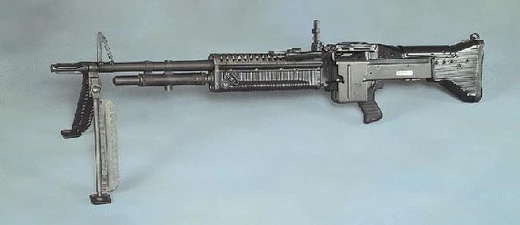
M73 machine gun
A tank machine gun that suffered chronic jamming and was later improved.

The M73 is a 7.62 mm NATO caliber machine gun designed primarily for coaxial use in armored vehicles. It was developed by Rock Island Arsenal and produced by General Electric as a replacement for the M1919 series of machine guns in the post-World War II period. The weapon was officially adopted in 1959 and saw service on the M48 Patton and M60 Patton main battle tanks, the M551 Sheridan, and other armored vehicles.
Quick Facts
- Is Ranged
- yes
Facts from the source article.
Lore & Background
The M73 was designed as a simplified alternative to the M1919A4E1, M1919A5, and M37 machine guns that remained in service after World War II. It was air-cooled and recoil-operated, but also used cartridge gases to boost recoil. The weapon featured a quick-change barrel and a pull-chain charging assembly. Although intended to simplify maintenance and operation, the M73 was prone to numerous malfunctions and jamming. An attempt to adapt it as a flexible infantry gun resulted in the M73C, fitted with sights and a pistol grip, but very few were produced and it never entered service. Sources claim limited use of the M73C in Vietnam. The M73 was used on the M48 Patton and M60 Patton MBT series (including the M728 Combat Engineer Vehicle), the MBT-70 prototype vehicles, and the M551 Sheridan. It was also mounted in a twin mount in the turret of the V-100 Commando (M706) light armored car during the Vietnam War.
Reader's Guide
The M73's significance lies in its role as a dedicated coaxial machine gun for American armored vehicles during the Cold War, replacing the older M1919 variants. However, its reputation was marred by persistent reliability problems, particularly chronic jamming. An improved version, the M73E1, was developed in 1970 with a simplified ejection system and type classified as the M73A1. In 1972, this variant was deemed sufficiently different and redesignated the M219. Despite these improvements, the M73 series was eventually replaced by the M60E2 and M240 machine guns, and vehicles still in service were refitted with these newer weapons. The M73's troubled service life illustrates the challenges of designing a compact, vehicle-mounted machine gun that could withstand the rigors of armored combat, and its replacement by more reliable designs marked the end of its use by NATO countries.
Did You Know?
- It was officially adopted in 1959 and used on the M48 Patton and M60 Patton tanks.
- An infantry variant, the M73C, was developed but never entered service.
- The improved M73A1 was redesignated as the M219 in 1972.
A Century of Versatile Service
The M1919 Browning machine gun carved out an extraordinary niche across the entire twentieth century. Originally conceived as an air-cooled evolution of John M. Browning's water-cooled M1917 from World War I, the .30 caliber weapon went on to see action in World War II, the Korean War, and the Vietnam War. Its utility was not confined to a single role. U.S. forces and allied nations employed it as a light infantry weapon, mounted it on vehicles as a coaxial gun, fitted it to aircraft, and even pointed it skyward in an anti-aircraft capacity. This remarkable adaptability made it one of the most widely deployed medium machine guns of its era, serving not only the United States but a broad coalition of other countries throughout the century.
From Frontline Staple to Secondary Role
The arrival of general-purpose machine guns in the 1950s gradually displaced the M1919 from its primary combat positions, a process accelerated when the M60 entered U.S. Army service. Yet the weapon refused to vanish entirely. The United States Navy took a pragmatic approach, converting a large number of examples to 7.62 mm NATO caliber and designating them Mk 21 Mod 0. These reworked guns found a second life aboard riverine craft during the 1960s and 1970s in Vietnam. Across the Atlantic, many NATO nations undertook similar caliber conversions, and their upgraded M1919s remained operational well into the 1990s. In a handful of countries, these converted weapons are still in service today, a testament to the design's enduring mechanical reliability even after decades of continuous development in the machine gun field.
Belt Feeding and the Firing Cycle
The M1919 originally accepted .30 caliber M1906 ball cartridges in woven cloth belts, later transitioning to the M2 ball cartridge and eventually to a metal M1 link that formed what was called a disintegrating belt. Loading required the gunner to feed the belt from the left side until the feeding pawl caught the first round, then pull the cocking handle back and release it twice. The first pull positioned the round before the bolt; the second advanced the extractor to strip the cartridge from the belt and chamber it. Once firing began, the cycle repeated at roughly ten rounds per second. The bolt reciprocated, ejecting the spent case while simultaneously drawing the next round, chambering it, and advancing the belt. The accelerator assembly, a half-moon spring-loaded piece, drove the bolt rearward rapidly, while a camming track guided the extractor-ejector to push the spent case out the ejection port.
Managing Heat and the Cook-off Hazard
Because the M1919 fired from a closed bolt without a quick-change barrel, prolonged automatic fire posed a genuine danger. A cartridge resting in an overheated barrel could heat its propellant enough to ignite spontaneously, a cook-off, triggering a cascade of uncontrolled discharges as the barrel grew progressively hotter. Gunners were drilled to pull the cocking handle with the palm facing upward, protecting the thumb from a sudden jolt of the charging handle, and to seize the ammunition belt and yank it free if the weapon began cooking off. In normal operation, they were instructed to fire in controlled bursts of three to five rounds to limit barrel temperature. Unlike many later air-cooled designs that featured quick-change barrels and open-bolt firing, the M1919 lacked both of these heat-mitigating features, making disciplined burst fire essential to safe operation.
Frequently Asked Questions
Who is M73 machine gun?
The M73 is a 7.62 mm NATO coaxial machine gun that Rock Island Arsenal designed and General Electric built as the post-WWII successor to the M1919 family. It entered official service in 1959 and was purpose-built for mounting inside armored vehicles rather than for infantry use.
What are M73 machine gun's powers/role?
Its core job is to serve as the coaxial companion gun on tanks and APCs, cycling 7.62 mm NATO rounds through a recoil-operated, gas-assisted action while staying air-cooled. It weighs almost the same as the M1919 it replaced and can be set up for either left- or right-hand feed, with left-hand being the more common configuration.
Why is M73 machine gun important?
The M73 standardized 7.62 mm NATO coaxial armament across the major Cold War-era armored vehicles in the U.S. fleet, giving the M48, M60, and Sheridan a common, vehicle-integrated gun. Its near-identical weight to the M1919 made the transition a practical drop-in swap for existing vehicle mounts.
What's the biggest controversy around M73 machine gun?
The weapon's persistent jamming problems are its most discussed flaw, with operators reporting chronic reliability headaches that demanded repeated field improvements. Despite those setbacks, fans of the platform still credit the M73 for keeping Cold War armored vehicles armed with a workable, standardized coaxial option.
More in Machine Guns, Part 5 1-24
Spotted an error? Know more?
Reader corrections go straight into our review queue. Suggest an edit · How this site is sourced