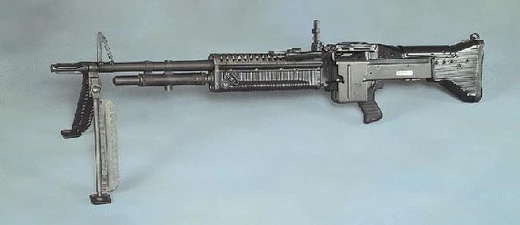
Sumitomo Type 62
Standard Japanese general-purpose machine gun adopted in 1962.

The Sumitomo Type 62, also known as the NTK-62, is the standard issue general-purpose machine gun of the Japan Self-Defense Forces. Chambered in 7.62×51mm NATO, it was designed to replace the Browning M1919A4 and serves in both light and medium machine gun roles, though the M249 has largely taken over the squad-level light machine gun role. It continues to be used as a platoon and company-level support weapon and as a coaxial armament in armored vehicles.
Quick Facts
- Origin
- Japan
- Is Ranged
- yes
- Service
- February 15, 1962–present
- Wars
- Cold War / Iraq War
- Designer
- Masaya Kawamura
- Design Date
- 1954
- Manufacturer
- Sumitomo Heavy Industries
- Production Date
- 1962–present
- Unit Cost
- ¥2,000,000 (c. 1985)
- Weight
- 10.15 kg
- Length
- 1200 mm
- Part Length
- 546 mm
Facts from the source article.
Lore & Background
Development of the Type 62 began in 1954 after the Land Staff Equipment Committee decided to replace the M1919A4/A6 and M1918A2 automatic rifles. The designer, Dr Masaya Kawamura, drew on pre-war prototypes such as the Type Hei Rifle and Trial Ultra Light Machine Gun, as well as wartime experience from the Battle of Okinawa and the Battle of Kamata. The first prototype, completed in October 1956, resembled the Type 99 light machine gun and was initially chambered for .30-06 before being adapted to 7.62×51mm NATO. Subsequent prototypes included the NITTOKU Type 14 (1958) and Type 15 (1960), leading to provisional adoption in 1962.
The Type 62 is gas-operated with a long-stroke piston and uses a unique front-end pivoting tilting bolt closure mechanism. The receiver is press-formed steel sheet assembled with rivets. The barrel, which has cooling fins and a chrome-plated lumen, is integrated with a carrying handle and can be changed in 2.5 seconds. The feed tray has a pivoting lever above the bolt rather than in the feed tray cover. The design accounted for the physique of Japanese soldiers, and parts are fully interchangeable. The safety is located on the right side of the trigger, and the bottom cover can be opened by pushing a latch toward the muzzle.
The weapon has a bipod for light machine gun use and can be mounted on a tripod for sustained fire. Direct aiming scopes can be attached. Firing postures include prone, hip shot, crouch shot, shoulder fire, and crouched fire, though the latter two are taxing due to weight and recoil.
Reader's Guide
The Type 62 has been the backbone of Japanese infantry support for decades, but it has faced significant criticism from troops. Problems include a high number of parts making disassembly and assembly time-consuming, spontaneous firing due to poor fire control group design, components falling off due to loose tolerances, barrels pulling out of receivers when lifted by the carrying handle at an angle, poor accuracy in sustained fire, malfunctions, negligent discharges, and runaways. These issues earned it derogatory nicknames such as 'the gun that does not listen', 'Type 62 single-shot machine gun', 'King of Stupid Guns', 'The Better Without machine gun', and 'Squad suicide firearm'.
Mitsuo Tsunose, a developer of the Type 64 rifle, noted that the Type 62's barrel outer diameter is smaller than that of the Type 64 (28 mm vs 34 mm), with a weaker structure. The barrel weight is about 2 kg for a 20.5-inch barrel, compared to the FN MAG (3 kg for 24.8 inches) and the M60 (4.17 kg for 22 inches). The M60E3 later lightened its barrel to 2.18 kg but was found dangerous for firing more than 200 rounds continuously. Shinkichi Ito, another Type 64 developer, documented that the Type 62's barrel chamber wall thickness is 8.6 mm, 3.5 mm thinner than the Type 64 and equal to the French M1890 Lebel rifle. Despite these issues, the Type 62 remains in service as a medium machine gun and vehicle coaxial weapon, and it was never exported, like all modern Japanese-made firearms.
Did You Know?
- The Type 62 was designed by Dr Masaya Kawamura, who also worked on pre-war prototypes like the Type Hei Rifle and the Type 5 30 mm fixed machine gun.
- In 2013, Sumitomo Heavy Industries was involved in a scandal where test data for 5,350 Type 62 machine guns produced from 1974 was falsified.
- The barrel of the Type 62 has a wall thickness of 8.6 mm, the same as the French M1890 Lebel rifle, and thinner than the Type 64 rifle's barrel.
More in Machine Guns, Part 5 1-24
Spotted an error? Know more?
Reader corrections go straight into our review queue. Suggest an edit · How this site is sourced