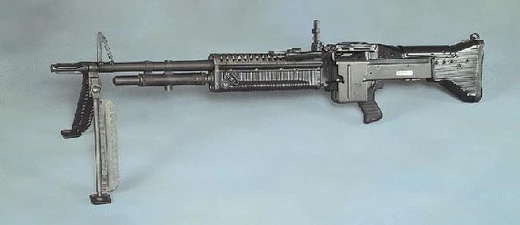
Stoner 63
Modular weapon system configurable as rifle, carbine, or machine gun.

The Stoner 63 is a 5.56×45mm NATO modular weapon system designed by Eugene Stoner in the early 1960s. Using a variety of modular components, it could be configured as an assault rifle, carbine, top-fed light machine gun, belt-fed squad automatic weapon, or vehicle mounted weapon. Also known as the M63, XM22, XM23, XM207, or Mk 23 MOD 0 machine gun, it saw very limited combat use by US military units during the Vietnam War.
Quick Facts
- Origin
- United States
- Is Ranged
- Yes
- Service
- 1963–1983 (U.S.)
- Used By
- United States Navy SEALs / United States Marine Corps
- Wars
- Vietnam War / Invasion of Grenada
- Designer
- Eugene Stoner / L. James Sullivan / Robert Fremont
- Design Date
- 1963
- Manufacturer
- Cadillac Gage / Knight's Armament Company / NWM De Kruithoorn N.V. (prototypes only)
- Production Date
- 1963–1971
- Number
- Approx. 4,000 (both versions)
- Weight
- LMG, MMG: 11.68 lb / FMG: 10.31 lb / Commando: 10.50 lb / AR: 10.19 lb / Rifle: 7.90 lb / Carbine: 7.75 lb
- Length
- LMG, MMG, AR, Rifle: 40.25 in / Carbine: 36.68 in stock extended/26.60 in stock collapsed / Commando: 35.95 in / FMG: 30.38 in
Facts from the source article.
Lore & Background
Eugene Stoner, after leaving ArmaLite, conceived a modular weapon built around a common receiver with interchangeable components. He enlisted Howard Carson of Cadillac Gage's West Coast plant to convince company president Russell Baker of the system's potential. Cadillac Gage established a small arms development branch in Costa Mesa, and Stoner recruited former ArmaLite colleagues Robert Fremont and James L. Sullivan. The first working prototype, chambered in 7.62×51mm NATO, was completed in 1962 and designated the Stoner M69W. A follow-up design, the Stoner 62, was intended for mass production, but the team shifted focus to the 5.56×45mm cartridge, resulting in the Stoner 63. The first models were produced in February 1963. Production moved from Costa Mesa to Cadillac Gage's Warren, Michigan plant in September 1964, where polycarbonate plastic replaced wood for stocks and grips.
The Stoner 63 was evaluated by the Marine Corps Landing Force Development Center at Quantico in 1963, making a positive impression for its light weight and high ammunition capacity. Army Materiel Command trials revealed issues with ammunition pressure variations, tracer round reliability, and other bugs. The system was deemed unacceptable for service use, leading to improvements that produced the Stoner 63A in 1966. From 1969 to 1971, Cadillac Gage upgraded the light machine gun version as the XM207, addressing misfires, high cyclic rates, jams, and link separations. Solutions included a Belleville spring washer stack, a rate regulator in the buttstock, an expandable steel sealing ring in the gas chamber, and urethane foam filling for the buttstock. The XM207 passed all tests, but the project was cancelled after President Nixon announced US withdrawal from Vietnam.
Reader's Guide
The Stoner 63's significance lies in its pioneering modular design, allowing a single receiver to serve multiple roles from rifle to machine gun. Despite its limited combat use by US Navy SEALs and Marine units in Vietnam, the system demonstrated the potential of a family of weapons built around common components. The weapon's development highlighted the challenges of balancing reliability across configurations, particularly with ammunition pressure variations and high cyclic rates. The XM207 upgrade program resolved many mechanical issues, but the changing political landscape—specifically the US withdrawal from Vietnam—eliminated the urgency for adoption. The Stoner 63 influenced later modular weapon concepts and remains notable as Eugene Stoner's attempt to create a universal infantry weapon system. Its legacy is that of an innovative but ultimately niche design that saw limited field use, primarily by special operations forces, and never achieved widespread military adoption.
Did You Know?
- The first working prototype was chambered in 7.62×51mm NATO and designated the Stoner M69W because it reads the same when turned upside down.
- The Stoner 63 was also known as the XM22, XM23, XM207, and Mk 23 MOD 0.
- A rate regulator similar to that used in the M60 machine gun was installed in the buttstock to limit cyclic rate to about 800 rpm.
More in Machine Guns, Part 5 1-24
Spotted an error? Know more?
Reader corrections go straight into our review queue. Suggest an edit · How this site is sourced