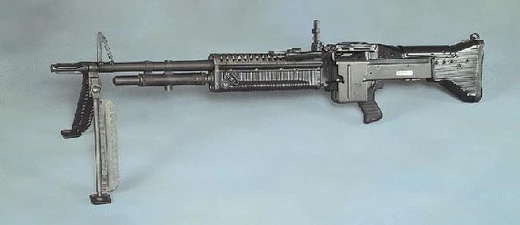
ShKAS machine gun
Fastest-firing rifle-calibre aircraft machine gun of World War II.

The ShKAS (Shpitalny-Komaritski Aviatsionny Skorostrelny) is a 7.62 mm calibre machine gun designed by Boris Shpitalniy and Irinarkh Komaritsky. Entering production in 1934, it was widely used by Soviet aircraft in the 1930s and during World War II, and served as the basis for the ShVAK cannon. The ShKAS had the highest rate of fire of any aircraft machine gun in general service during WWII, around 1800 rounds per minute.
Quick Facts
- Origin
- Soviet Union
- Is Ranged
- yes
- Wars
- World War II / Spanish Civil War / Second Sino-Japanese War
- Designer
- Boris Shpitalniy / Irinarkh Komaritsky
- Design Date
- 1932
- Production Date
- 1933–1945
- Number
- ~150,000
- Weight
- 9.8 kg (wing-mounted) / 10.6 kg (flexible) / 11.1 kg (synchronized) / 10.2 kg (1941 model, wing-mounted)
- Length
- 935 mm (wing-mounted) / 955 mm (flexible role) / 1,077-1097 mm (synchronized) / 1,005 mm (1941 model)
- Part Length
- 605 mm (wing and flexible) / 750 mm (synchronized) / 675 mm (1941 model)
- Caliber
- 7.62 mm
- Cartridge
- 7.62×54mmR
Facts from the source article.
Lore & Background
The ShKAS is a gas-operated aircraft machine gun with a single chamber where the pin strikes the primer. Its high rate of fire is enabled by a revolving drum (feed cage) holding ten rounds, providing smooth, progressive removal of cartridges from a disintegrating link belt. The bolt locking action is Browning-style, using a slightly tilted wedge bolt. The bolt action mechanism consists of a gas piston in a tube, a rod, and a bolt frame, split into several parts with a personal recoil spring for each, unlike the Kalashnikov assault rifle where the assembly is a single large part. This design gave the recoiling portion a weight of only 921 grams (2.07 lb).
Initial production included cable-charged wing-mounted and turret-mounted versions, with a synchronized variant entering service in 1936. By 1952, Western intelligence had identified five models, all marked with the number '426': a prototype from 1932; KM-33 (flexible, 1933); KM-35 (flexible 1934, wing-mounted 1935); KM-36 (flexible 1935, propeller-synchronized 1937, the latter with an extra-long barrel); and a 1941 wing-mounted model. The flexible version was typically mounted in a Soviet copy of the Scarff ring. The 1937 model had a slightly higher maximum rate of fire of 2,000 rounds per minute. Ammunition capacity was usually 750 rounds for fixed models and 1,000 to 1,500 for flexible ones.
Production volumes by year: 1933 — 365; 1934 — 2,476; 1935 — 3,566; 1937 — 13,005; 1938 — 19,687; 1940 — 34,233; 1943 — 29,450; 1944 — 36,255; 1945 — 12,455. In 1939, a small number of Ultra-ShKAS were produced with a firing rate of 3,000 rounds per minute, but saw limited use due to reliability problems. The ShKAS used specially built cartridges with smaller tolerances, marked with the Cyrillic letter 'Sh' (Ш), designed by N. M. Elizarov, featuring double crimping and a thicker bimetallic case wall. These cartridges should not be fired from regular 7.62×54mmR rifles.
Reader's Guide
The ShKAS was the fastest-firing rifle-calibre aircraft armament in general service in World War II. A one-second burst from four ShKAS guns on a Polikarpov I-153 or I-16 placed 120 bullets within 15 angular mils at 400 meters, giving a firing density of 5 bullets per square meter. The four guns with 650 rounds each weighed only 160 kg (350 lb). However, the ShKAS was not problem-free; Soviet machine-gun technician Viktor M. Sinaisky recalled issues. The gun had provision for slower cyclic rates by changing the gas regulator orifice size (2.1 mm, 2.5 mm, or 3.2 mm), with smaller orifices producing more moderate rates of fire. Some military historians believe the feed system of the Mauser 213C revolver cannon was inspired by the ShKAS, though their methods of operation differ (gas-operation versus revolving cam). The ShKAS was used by the Second Spanish Republic and served as the basis for the ShVAK cannon.
Did You Know?
- The recoiling portion of the gun weighs only 921 grams (2.07 lb) due to its split piston-rod-bolt frame design.
- A small number of Ultra-ShKAS were produced in 1939 with a firing rate of 3,000 rounds per minute, but had reliability problems.
- The ShKAS used specially built 7.62×54mmR cartridges with a thicker bimetallic case and the Cyrillic letter 'Sh' stamped on the base.
More in Machine Guns, Part 5 1-24
Spotted an error? Know more?
Reader corrections go straight into our review queue. Suggest an edit · How this site is sourced