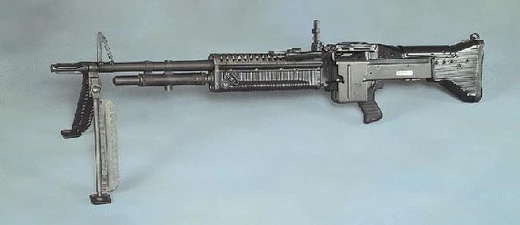
PKP Pecheneg
Russian general-purpose machine gun, modified from the PKM.

The PKP Pecheneg (GRAU index: 6P41) is a Russian general-purpose machine gun chambered in 7.62×54mmR. It is a further development of the PKM machine gun. Its name comes from the Pecheneg people, a warlike Turkic tribe that once inhabited the steppes of what is now southern Russia and Ukraine.
The weapon is widely used by the Russian Army and Spetsnaz units. Although designed primarily for infantry, it has also been mounted on several light armored vehicles.
The Pecheneg is considered more accurate than the PK and PKM. It uses a heavier, removable barrel with radial cooling ribs and a handle. This design eliminates the haze effect from hot gases and keeps the barrel cooler, improving reliability. The barrel is enclosed in a steel jacket from the front of the trunnion to the muzzle. The middle section of the barrel, from the front of the trunnion to the gas block, has transverse grooves that increase surface area for cooling. Oval holes in the jacket over this ribbed section allow air to enter. From the gas block to the muzzle, four longitudinal grooves are cut into the barrel and covered by the jacket. These grooves connect four holes in the gas block to four holes at the front of the muzzle device. When firing, low pressure at the front of the jacket draws cool air through the grooves, cooling the front part of the barrel in a manner similar to the Lewis machine gun. This constant forced cooling reduces dispersion during firing and increases barrel durability. The barrel’s service life is estimated at 25,000 to 30,000 rounds.
The Pecheneg can mount telescopic or optical sights via a side-mounted dovetail rail, which increases accuracy and effective range. It retains up to 80% parts commonality with the PKM. According to the manufacturer, it can fire 600 rounds in rapid fire without damaging the barrel. During prolonged combat, it can safely fire up to 1,000 rounds per hour without degrading combat effectiveness or reducing barrel life.
Variants include the PKP Pecheneg-N (GRAU index: 6P41N), which features a side-mounted dovetail rail for night vision and other optical sights. The Pecheneg-SP (GRAU index: 6P69) is an improved variant using titanium in its construction. The "SP" stands for special forces machine gun. It has a redesigned barrel available in standard and shortened configurations, and can mount a suppressor to reduce noise and flash.
Quick Facts
- Service
- 2001–present
- Wars
- Second Chechen War / Russo-Georgian War / Syrian Civil War / War in Iraq (2013–2017) / Russo-Ukrainian War
- Designer
- Mikhail Kalashnikov
- Design Date
- 1995
- Manufacturer
- TsNIITochMash, Degtyaryov Plant
- Weight
- 8.2 kg without a bipod / 8.7 kg with a bipod / 12.7 kg with an infantry tripod mount
- Length
- 1,200 mm
- Part Length
- 658 mm
- Action
- Gas-operated
- Origin
- Russia
- Is Ranged
- Yes
- Cartridge
- 7.62×54mmR
Facts from the source article.
Lore & Background
The PKP Pecheneg was developed as a further modification of the PKM machine gun. Its designation refers to the Pecheneg people, a warlike tribe of Turkic origin who lived in what later became the steppes of southern Russia and Ukraine. The weapon is said to be more accurate than the PK and PKM due to a heavier, removable, partially forced-air-cooled barrel with radial cooling ribs and a handle that eliminates the haze effect from hot gases and keeps the barrel cooler, making the machine gun more reliable.
The barrel is enclosed by a steel jacket from the front of the trunnion to the muzzle. The middle part of the barrel, from the front of the trunnion to the gas block, has transverse grooves to increase surface area for better cooling. Oval holes on the jacket in the ribbed section allow air access. From the gas block to the muzzle, four longitudinal grooves cut in the barrel are covered by the jacket; these grooves connect four holes in the gas block and four holes on the front end of the muzzle device. Low pressure created at the front of the jacket during firing draws cool air through the grooves, cooling the front part of the barrel similarly to the Lewis machine gun. Constant forced cooling reduces dispersion when firing and increases barrel durability.
The PKP Pecheneg is capable of mounting telescopic or optical sights via a side-mounted dovetail rail mount, which increases its accuracy and effective range. According to the manufacturer, it can fire 600 rounds in rapid fire without damaging the barrel, and during prolonged combat engagement can safely fire up to 1,000 rounds per hour without degrading combat effectiveness or reducing barrel life.
Reader's Guide
The PKP Pecheneg represents a significant evolution of the PKM platform, retaining up to 80% parts commonality while introducing a forced-air cooling system that enhances sustained fire capability and accuracy. Its design addresses the haze effect from hot gases, a common issue with earlier general-purpose machine guns, and the barrel's cooling system allows for prolonged engagement without barrel change. The weapon's adoption by the Russian Army and Spetsnaz units in significant numbers, as well as its mounting on light armoured vehicles, underscores its role as a standard infantry support weapon. Variants such as the PKP Pecheneg-N with a side-mounted dovetail rail for night vision sights, and the Pecheneg-SP (6P69) featuring titanium construction, a redesigned barrel in two lengths, suppressor capability, Picatinny rail, telescopic folding stock, and optional vertical foregrip, demonstrate ongoing modernization. Bullpup conversions have been prototyped, and a Vietnamese unlicensed copy, the STrL-P, exists. The weapon's legacy is tied to its improved reliability and accuracy over its predecessors, making it a notable entry in Russian small arms development.
Did You Know?
- The Pecheneg-SP variant uses titanium material and can mount a suppressor.
- A Vietnamese unlicensed copy called the STrL-P is made by Z111 Factory.
More in Machine Guns, Part 5 1-24
Spotted an error? Know more?
Reader corrections go straight into our review queue. Suggest an edit · How this site is sourced