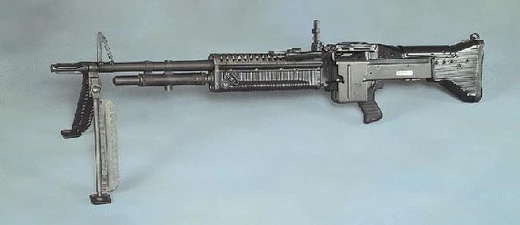
PK machine gun
Soviet general-purpose machine gun adopted in 1961, widely exported.

The PK is a belt-fed general-purpose machine gun that fires the 7.62×54mmR rimmed cartridge. It was designed in the Soviet Union and remains in production in Russia. The original PK entered service in 1961, and an upgraded version, the PKM, followed in 1969. The PKM was intended to replace the earlier SGM and RP-46 machine guns in Soviet use. Today, the PK series still serves as a front-line infantry and vehicle-mounted weapon for Russia’s armed forces, and it has been widely exported and produced under license in several other countries.
The Soviet Main Artillery Directorate (GRAU) set out requirements for a new 7.62mm general-purpose machine gun for company and battalion use in 1955. In 1958, a prototype called the Nikitin-Sokolov PN1 passed field tests, and a batch was ordered for service trials in 1960, with production planned at the Kovrov Mechanical Plant. However, the PN1 had a major flaw: it was vulnerable to water and snow entering the gas piston. After firing with water inside, the gun would only fire single shots, requiring the shooter to manually cycle the action two or three times between rounds. The army asked Nikitin to fix this, but he took too long. To push him along, the Main Artillery and Missile Directorate reopened the competition in 1958. A team from the Izhevsk Mechanical Plant, led by Mikhail Kalashnikov and including V.V. Krupin, V.N. Pushchin, A.D. Kryakushin, and others, joined the race. They took on the task even though they were also working on the AKM and RPK, and despite the PN1 already being favored by the army and supported by some ministries and senior officers. Their prototype used the proven gas-operated rotary-bolt system from Kalashnikov’s earlier designs.
Both prototypes underwent service tests in late 1960 across the Central Asian, Odessa, and Baltic Military Districts, as well as at the Vystrel officer training courses. The Main Missiles and Artillery Directorate and the Ministry of the Defence Industry preferred Kalashnikov’s design. The PK handled water well, was easier to maintain and produce, and reused the same ammunition belts as the Maxim and SG-43, whereas the PN1 required new belts not yet in production. Kalashnikov also claimed that competitors tried to skew the tests by asking operators to lower the PN1’s rate of fire due to belt overlap during long bursts.
Quick Facts
- Origin
- Soviet Union
- Is Ranged
- Yes
- Service
- 1961–present
- Designer
- Mikhail Kalashnikov
- Design Date
- 1961
- Manufacturer
- Degtyaryov Plant
- Weight
- 9 kg (with integral bipod)
- Length
- 1203 mm
- Part Length
- 605 mm
- Cartridge
- 7.62×54mmR
- Action
- Gas-operated, long-stroke piston, open, rotating bolt
Facts from the source article.
Lore & Background
The Main Artillery Directorate of the Soviet Union adopted specification requirements for a new 7.62 mm general-purpose company and battalion-level machine gun in 1955. In 1958, a prototype by G.I. Nikitin and Yuri M. Sokolov, the Nikitin-Sokolov PN1, passed field tests, and a batch was ordered for service tests. However, the PK had flaws, the main flaw being that the machine gun did not resist water and snow very well. Water and snow had a tendency to enter the gas piston, causing the gun to fire only shot by shot after two or three rounds. The army asked Nikitin to solve this problem, but the engineer took too long. To force faster work, the Main Artillery and Missile Directorate restarted the competition in 1958. A team from the Izhevsk Mechanical Plant headed by M.T. Kalashnikov joined, despite the PN1 already being chosen by the army. Their prototype was based on the gas-operated rotary-bolt design of Kalashnikov-pattern arms. Both prototypes underwent service tests in late 1960. The Main Missiles and Artillery Directorate and the Ministry of the Defence Industry preferred the Kalashnikov design. The PK could resist water perfectly and was easier to maintain and manufacture, reusing the same ammunition bands as the Maxim or SG-43, while the PN1 used a new type not yet in production. Kalashnikov claimed competitors attempted to bias the test by asking operators to lower the rate of fire due to overlapping bands during long bursts, and that the PN1's recoil was so poorly distributed that a soldier broke his cheekbone. In 1961, the Kalashnikov design was adopted and put into production at the Kovrov Mechanical Plant, using the tripod mount and ammunition belt boxes originally designed for the Nikitin-Sokolov prototype. Nikitin's and Sokolov's design was later used in the 12.7 mm NSV heavy machine gun put into production in 1971. In June 2024, it was reported that the PKZ will eventually replace the PKM in Russian military service.
Reader's Guide
The PK and its modernised PKM variant have served as the standard general-purpose machine gun of the Soviet Union and later Russia for decades, replacing the SGM and RP-46 machine guns. The design's significance lies in its adaptation of Kalashnikov's proven gas-operated rotary-bolt system to a full-power rifle cartridge, enabling reliable automatic fire in a relatively lightweight package. The PK's open bolt design improves heat management during sustained fire, reducing the risk of cook-off, and its quick-change barrels allow prolonged use. The PKM's service life is guaranteed for at least 25,000 rounds with a spare parts kit and two barrel assemblies. The weapon has been exported extensively and produced under license in several countries, such as Zastava Arms in Yugoslavia producing the M84 and M86. The most recent modification, the PKP Pecheneg, features a forced air cooling barrel with a longer barrel life of up to 10,000 rounds. A remotely controlled PKT version reportedly entered service in November 2023. The PK's feed mechanism, derived from Louis Stange's MG 39 Rh and copied in Czechoslovak machine guns, pulls rimmed cartridges from the belt and drops them into the feed way, differing from the MG 42-style forward-feed mechanism used in many NATO machine guns. The PK's continued frontline use and planned replacement by the PKZ as of June 2024 underscore its enduring role.
Did You Know?
- The PK's bolt and carrier are oriented upside down compared to the AKM, with the piston and gas system underneath the barrel.
- The PK uses a two-stage feed mechanism with preliminary extraction from a belt link due to its rimmed cartridge.
- The PK's feed mechanism is radically different from that of 7.62×51mm NATO machine guns based on the MG 42 feed mechanism.
- The PKP Pecheneg modification features a forced air cooling barrel with a barrel life of up to 10,000 rounds.
Frequently Asked Questions
What is the PK machine gun?
The PK is a Soviet-designed belt-fed general-purpose machine gun that entered service in 1961 as a standard infantry and vehicle-mounted weapon. It operates on a gas-operated, rotating-bolt system and fires from an open-bolt position.
What is the difference between the PK and the PKM?
The PKM is a refined, lighter variant of the original PK, introduced in 1969 to supersede older Soviet designs like the SGM and RP-46. It became the more widely exported and produced version of the family, though the two share the same basic operating principle and cartridge.
What caliber does the PK machine gun fire?
The PK uses the 7.62×54mmR rimmed cartridge, a long-serving Soviet and Russian military round. It is fed through a non-disintegrating looped-link belt.
Is the PK machine gun still in use today?
Yes, the PK series continues to serve as a front-line weapon in Russia's armed forces, deployed both by infantry squads and mounted on vehicles. It has also been manufactured under license and exported to many other nations, keeping the design in active service around the world.
How durable is the PKM machine gun?
The PKM is rated to endure at least 25,000 rounds of fire when backed by a spare parts kit and two interchangeable barrel assemblies. This longevity was a key factor in its long-term adoption across multiple militaries.
More in Machine Guns, Part 5 1-24
Spotted an error? Know more?
Reader corrections go straight into our review queue. Suggest an edit · How this site is sourced