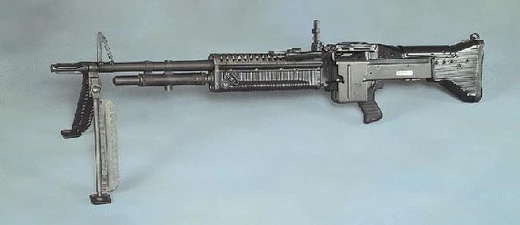
MG 51
Swiss general-purpose machine gun derived from the MG 42 design.

The 7.5 mm Maschinengewehr 1951 (Mg 51) is a Swiss general-purpose machine gun built by W+F. It entered service after the Swiss Army held a competition to find a replacement for the MG 11 heavy machine gun and the Furrer M25 light machine gun, which had been adopted in 1911 and 1925 respectively.
Around 1942, the Swiss Army launched a competition for a new service machine gun to replace both the heavy MG 11 and the light Lmg25. The War Technology Department (KTA) set a maximum cyclic rate of 1,000 rounds per minute. Three manufacturers entered: the government-owned Waffenfabrik Bern, and private firms SIG and Hispano-Suiza. Waffenfabrik Bern based its design on the highly successful German MG 42 from World War II and its accessories.
First prototypes appeared around 1944, closely resembling the MG 42, though the receiver and butt had slightly different shapes. These prototypes suffered from short shots, which was unacceptable because Swiss troops could be hit by their own fire during live exercises.
The final design, completed in 1950, remained largely similar to the MG 42, but many components were machined rather than stamped. This increased the weapon’s weight, stability, and production cost. To fix the short-shot problem caused by locking timing, Waffenfabrik Bern replaced the roller locking system with flapper locking, which works on a similar principle. In its light machine gun role, the Mg 51 weighed 4.4 kg more than the German MG 42 and was much more finely made and finished.
The Mg 51 served as the primary infantry and vehicle machine gun for the Swiss Army. It was typically fired from its universal tripod in the medium machine gun role at ranges of 600 to 1,500 m. In the light machine gun role at close range up to 600 m, short six-round bursts could be fired from the bipod, and it could also be fired from the hip during mobile assaults.
Since 2005, the Mg 51 has been gradually replaced by the lighter, less expensive, but less powerful 5.56 mm FN Minimi machine gun of Belgian origin.
The Mg 51 is a short-recoil-operated, locked-breech, air-cooled, automatic-only, belt-fed weapon. Its locking system uses a two-piece bolt with dual locking flaps in the front part of the bolt. These flaps engage cuts in the short barrel extension to lock the breech. On recoil, the flaps retract toward the bolt center to unlock it.
Quick Facts
- Origin
- Switzerland
- Is Ranged
- YES
- Service
- 1951–present
- Used By
- Swiss Army
- Design Date
- 1942–1950
- Manufacturer
- Waffenfabrik Bern
- Weight
- 16 kg (with bipod) / 26 kg (with tripod)
- Length
- 1270 mm
- Part Length
- 563 mm
- Cartridge
- 7.5×55mm Swiss
- Caliber
- 7.5 mm
- Action
- Short–recoil, flapper-locked
Facts from the source article.
Lore & Background
Around 1942 the Swiss army initiated a competition for a new service machine gun to replace both the heavy MG 11 and the light Lmg25, adopted in 1911 and 1925 respectively. The Kriegstechnische Abteilung specified that the maximum cyclic rate of fire of 1,000 rounds per minute should not be exceeded. Three participants joined: government-owned Waffenfabrik Bern, and privately owned SIG and Hispano-Suiza. Waffenfabrik Bern based its development on the German MG 42 and its accessories.
First prototypes emerged around 1944, resembling the MG 42 but with a different receiver and butt shape. These prototypes exhibited short shots, which could not be tolerated as Swiss troops overshoot their own during live fire exercises. The final design appeared in 1950, still similar to the MG 42 but with many components machined instead of stamped, increasing weight, stability, and production costs. To prevent short shots, the locking system was changed from roller locking to flapper locking.
The MG 51 served as a primary infantry and vehicle machine gun for the Swiss army. It was usually fired in the medium machine gun role from its universal tripod at ranges of 600 to 1,500 m. In the light machine gun role at close range up to 600 m, short bursts of six shots could be fired from its bipod, and it could also be fired from the hip during mobile assaults. Since 2005 it was gradually replaced by the lighter and less expensive 5.56 mm FN Minimi.
Reader's Guide
The MG 51 represents a Swiss adaptation of the German MG 42 concept, modified to meet Swiss requirements for reliability and safety during live-fire exercises. The change from roller locking to flapper locking addressed the short-shot problem that plagued early prototypes, while the extensive use of machined components increased weight but improved stability and finish. The weapon served as the standard Swiss general-purpose machine gun for decades, deployed in infantry, vehicle, and anti-aircraft roles. Its variants included the Mg 51/71 for vehicles, Mg 51/80 for fortifications, and the Pz Mg 87 for the Leopard 2 tank with an electromagnetic trigger and reduced fire rate option. The MG 51's gradual replacement by the FN Minimi after 2005 marked the end of its frontline service, though its design legacy is evident in the continued use of flapper locking in later firearms. The weapon's robust construction and Swiss manufacturing quality made it a distinctive entry in the general-purpose machine gun category.
Did You Know?
- The MG 51 uses a flapper locking system instead of the roller locking found on the MG 42.
- Early prototypes of the MG 51 suffered from short shots that caused Swiss troops to overshoot their own forces during exercises.
- The MG 51 could be fitted with a Flab (Flugabwehr) mount for anti-aircraft use up to about 800 m.
- The Pz Mg 87 variant for the Leopard 2 tank includes an electromagnetic trigger and a switch for a 50% reduced fire rate.
More in Machine Guns, Part 5 1-24
Spotted an error? Know more?
Reader corrections go straight into our review queue. Suggest an edit · How this site is sourced