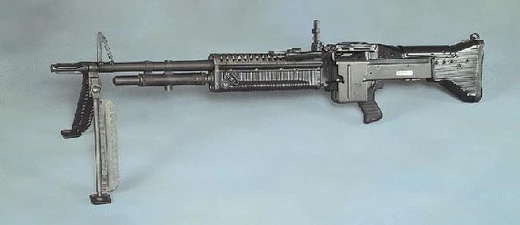
MG 45
A simplified MG 42 prototype with roller-delayed blowback.

The MG 45, also known as the MG 42V, was a machine gun developed by the German Army in World War II as a simplified, material-saving version of the MG 42. It is considered a different type of firearm due to its roller-delayed blowback operating mechanism, which differed from the recoil-operated, roller-locked MG 42. Although not fielded in significant numbers, the MG 45 influenced post-war roller-delayed blowback systems used in several later firearms.
Quick Facts
- Origin
- Nazi Germany
- Is Ranged
- YES
- Wars
- World War II
- Designer
- Metall und Lackierwarenfabrik Johannes Großfuß AG
- Design Date
- 1944
- Number
- 10 prototypes
- Weight
- 9 kg
- Part Length
- 600 mm
- Cartridge
- 7.92×57mm Mauser
- Barrels
- 1
- Action
- Roller-delayed blowback
- Rate
- 1,800 rounds per minute or 1,350 rpm
Facts from the source article.
Lore & Background
In 1944, material shortages in the Third Reich prompted the development of a simplified version of the MG 42, designated the MG 45 or MG 42V. The design reused many parts from the MG 42, including the ammunition feed, trigger group, and parts of the butt stock. The receiver housing was a metal stamped construction with a muzzle flash hider, and the barrel was a simple turned part without a locking piece. The MG 45 omitted the muzzle booster used on the MG 42, as the recoil amplification was not required for its roller-delayed blowback operation.
The MG 45 used steel of lesser quality than the MG 42 and had no bottom piece, requiring the action to be removed upwards with difficulty. The operating mechanism differed fundamentally: the MG 45 employed a roller-delayed blowback system with a two-piece bolt assembly consisting of a bolt head with rollers, a supporting locking piece, and a bolt carrier. During firing, the rollers interacted with angled ramps in the barrel extension and a wedge-shaped locking piece to delay bolt movement, allowing safe pressure drop before extraction. It is disputed whether the chamber had longitudinal gas relief flutes; designer Werner Gruner stated they were present, while colleague Hans-Joachim Kaltmann denied this.
First tests were undertaken in June 1944, but development dragged on and only ten machine guns were built. During tests, a MG 45 fired 120,000 rounds in succession at a cyclic rate of 1,350–1,800 rounds per minute. The weapon remained a prototype, deliberately kept similar to the MG 42 to maintain familiarity.
Reader's Guide
The MG 45's primary significance lies in its influence on the post-war development of the roller-delayed blowback system. This operating mechanism, which did not completely lock the breech before firing, simplified construction and increased the cyclic rate of fire compared to the MG 42. The roller-delayed blowback principle was later employed in the Rheinmetall MG 60 general-purpose machine gun prototype, the SIG 510 assault rifle, the SIG MG 710-3, the Heckler & Koch HK 21 general-purpose machine gun, and other post-World War II CETME and Heckler & Koch small arms. The MG 45 demonstrated the viability of this system, though its own development was never completed. The weapon's reduced manufacturing time—assumed by the Waffenamt to be 60% of that of the MG 42—reflected the wartime emphasis on material and labor savings. Despite only ten prototypes being built, the MG 45's mechanical concept proved influential in the design of later firearms, particularly those from German and Spanish manufacturers. The roller-delayed blowback system offered the advantage of simplicity compared to gas or recoil operation, a characteristic that contributed to its adoption in several post-war designs.
Did You Know?
- The MG 45 is also known as the MG 42V.
- Only ten MG 45 machine guns were built.
- The MG 45's roller-delayed blowback system influenced post-war firearms like the SIG 510 and Heckler & Koch HK 21.
More in Machine Guns, Part 5 1-24
Spotted an error? Know more?
Reader corrections go straight into our review queue. Suggest an edit · How this site is sourced