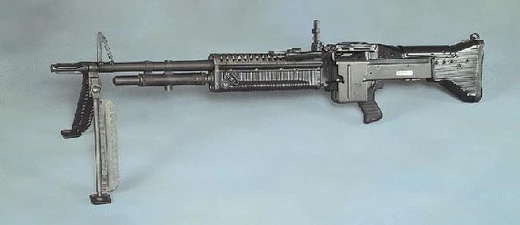
MG 3 machine gun
German general-purpose machine gun derived from the MG 42.

The MG 3 is a German general-purpose machine gun that fires the 7.62×51mm NATO round. Rheinmetall produces it for the Bundeswehr, and its design traces back to the World War II-era MG 42, which used the 7.92×57mm Mauser cartridge. Standardized in the late 1950s, it entered service with the newly formed West German military and remains in use today as both a squad support weapon and a vehicle-mounted machine gun. Armed forces in over 40 countries have also adopted the MG 3 or its variants.
After World War II, Soviet forces captured the original technical drawings and data for the MG 42, which later ended up in Czechoslovakia and Yugoslavia. Rheinmetall had to reverse-engineer the first postwar machine guns from an actual MG 42. Production of the first postwar variant—chambered for 7.62×51mm NATO and designated the MG 1—began in 1958 at Rheinmetall’s factory, following a request from the Bundeswehr. Soon after, the gun received a chrome-lined barrel and sights recalibrated for the new round, becoming the MG 1A1 (also called the MG 42/58). The MG 1A2 (or MG 42/59) followed, featuring a heavier bolt (950 grams, slowing the cyclic rate to 700–900 rounds per minute, compared to 550 grams), a new friction ring buffer for the heavier bolt, bolt-bounce preventing catches to fix ignition timing issues, and compatibility with both the German non-disintegrating DM1 belt and the American M13 disintegrating belt. The MG 1A3 added further refinements to the muzzle device, bipod, and bolt. Meanwhile, wartime MG 42s still in service that had been converted to 7.62×51mm were designated the MG 2.
In 1968, the MG 3 itself entered production. Compared to the MG 1A3, it added an improved feeding mechanism with a belt retaining pawl that holds the belt in place when the top cover is lifted, an anti-aircraft sight, and a new ammunition box. Rheinmetall produced MG 3s for Germany and export until 1979. Older non-MG 3 variants in Bundeswehr inventory were gradually upgraded to MG 3 standard. Heckler & Koch also carried out some additional production in Germany. All MG 3 variants share a high degree of parts interchangeability with the original MG 42. Turkey and Pakistan continue to produce MG 3s today.
Quick Facts
- Service
- 1959–present
- Number
- 1 million+
- Length
- 1225 mm / 1097 mm (without stock)
- Action
- Recoil-operated, roller locked
- Origin
- West Germany
- Is Ranged
- Yes
- Design Date
- 1959
- Weight
- 11.5 kg / 27.5 kg (mounted on tripod)
- Part Length
- 565 mm
- Cartridge
- 7.62×51mm NATO
- Rate
- 800–950 rounds/min (heavy-weight bolt) / 1,000–1,200 rounds/min (standard-weight bolt)
Facts from the source article.
Lore & Background
At the end of World War II, the original technical drawings and data for the 7.92×57mm Mauser–chambered MG 42 were captured by the Soviets and later taken to Czechoslovakia and Yugoslavia. Rheinmetall had to reverse engineer the first postwar machine guns from an original MG 42. Production of the first postwar variant chambered for 7.62×51mm NATO ammunition, designated the MG 1, was launched in 1958 at the Rheinmetall arms factory as requested by the Bundeswehr. This was followed by the MG 1A1 (MG 42/58) with a chrome-lined barrel and recalibrated sights, and the MG 1A2 (MG 42/59) with a heavier bolt (950 g for a slower 700–900 rounds per minute cyclic rate), a new friction ring buffer, bolt-bounce preventing catches, and compatibility with both German DM1 and American M13 belts. The MG 1A3 added further improvements to the muzzle device, bipod and bolt. Wartime MG 42s converted to 7.62×51mm were designated MG 2.
In 1968, the MG 3 was introduced and entered production. Compared to the MG 1A3, it features an improved feeding mechanism with a belt retaining pawl, an added anti-aircraft sight, and a new ammunition box. MG 3s were produced for Germany and export by Rheinmetall until 1979. Preceding variants in Bundeswehr inventory were gradually converted to MG 3 standard. Some additional German production was carried out by Heckler & Koch. The MG 3 and its variants all share a high level of parts interchangeability with the original MG 42. Production continues in Turkey and Pakistan. In 2019 there were plans in Germany to produce several thousand new MG 3 receivers for vehicle-mounted roles.
The MG 3 is an automatic, air-cooled, belt-fed short recoil–operated firearm with a roller locked bolt mechanism. It fires from an open bolt and has an automatic-only trigger mechanism with a cross-bolt safety. The cyclic rate can be altered by installing different bolts and recoil springs: a standard weight bolt (about 650 g) gives 1,000–1,200 rounds per minute, while an extra weight bolt (about 900 g) gives 800–950 rounds per minute. The barrel is quick-change and chrome-lined, weighing 1.7 kg. During sustained firing, the barrel must be changed after 150 live rounds (or 100 blank rounds); only once hand-warm can a barrel be reused. The effective rate of fire is about 250 rounds per minute.
Reader's Guide
The MG 3 remains in service with the Bundeswehr as the standard secondary weapon on most modern German armoured fighting vehicles (e.g., Leopard 2, PzH 2000, Marder), as a primary weapon on light and non-armoured vehicles (e.g., LKW 2to, MAN gl-trucks, ATF Dingo), and as an infantry weapon on bipods and tripods. Since 2015, the German Armed Forces have supplemented the MG 3 with the Heckler & Koch MG5. The MG 3 has been acquired by the armed forces of over 40 countries, with production rights purchased by Italy, Greece, Iran (as MGA3), Pakistan (as the MG 1A3), Sudan, Spain, and Turkey.
In 1974, the US Army tested German-made MG 3s alongside eight other contemporary GPMG designs to replace the M219 Tank Machine Gun. The MG 3 had worse results in mean rounds between failure (third worst), mean rounds between stoppage (fourth worst), cookoff rate (worst), and accuracy (worst) than the M60 and FN MAG. It outperformed both in ease of training, ease of changing barrels, and safety. Overall it ranked sixth of nine candidates in an unweighted ranking, and it was considered that no reasonable combination of attribute rankings would make it the winner.
The German military instructs that sustained fire must be avoided at all costs. In the bipod role, users fire short bursts of three to five rounds; in the tripod role, both short bursts and longer bursts of 20 to 30 rounds are used. The barrel is replaced after 150 live rounds (or 100 blank rounds) of sustained heavy fire; non-observance renders the barrel prematurely unusable. The machine gun crew member responsible for a hot barrel change is issued protective asbestos gloves or a cloth.
Did You Know?
- The MG 3 is derived from the World War II era MG 42, which fired the 7.92×57mm Mauser round.
- The cyclic rate of fire can be altered by installing different bolts: a standard 650 g bolt gives 1,000–1,200 rounds per minute, while a 900 g bolt gives 800–950 rounds per minute.
- In 1974 US Army tests, the MG 3 ranked sixth of nine candidates and was worst in cookoff rate and accuracy among the entrants.
More in Machine Guns, Part 5 1-24
Spotted an error? Know more?
Reader corrections go straight into our review queue. Suggest an edit · How this site is sourced