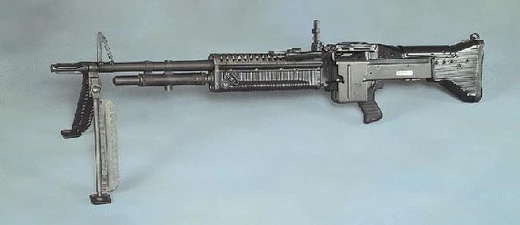
M2 Stinger
A man-portable aircraft machine gun used by Marines on Iwo Jima.

The M2 Stinger was a customized field modification of the .30-caliber AN/M2 aircraft machine gun, converted into a man-portable weapon to provide additional firepower to a platoon. A handful of these weapons were used during the Pacific Theater of World War II, and most of its fame comes from its use by Medal of Honor awardee Corporal Tony Stein during the Battle of Iwo Jima.
Quick Facts
- Origin
- United States
- Is Ranged
- yes
- Service
- 1943–1945 (United States)
- Used By
- United States Marine Corps
- Wars
- World War II
- Design Date
- 1943
- Manufacturer
- G Company, 28th Marine Regiment, 5th Marine Division
- Production Date
- 1943–1944
- Number
- 6
- Weight
- 25 lb
- Length
- 40 in
- Cartridge
- .30-06 Springfield
Facts from the source article.
Lore & Background
The beginnings of the Stinger go back to at least 1943, when various Marines attempted to convert the AN/M2 aircraft machine gun into something that could be practically fielded. The first known attempt was by Pvt. William 'Bill' H. Colby during the Bougainville Campaign, who fitted a bipod onto the muzzle of his AN/M2. Colby's creation was used just two days after the start of the campaign when he was ambushed by Japanese soldiers; fed .30-06 rounds by assistant gunner Pvt. Edward F. Crumlish, Colby repelled the attack. Two Marines, Sgt. Milan 'Mel' J. Grevich and PFC John Lyttle, later designed an improved variation, taking steps to make the weapon more man-portable and legitimately usable; with these modifications, the Stinger was born.
Grevich, after his parachute division was disbanded following the Bougainville Campaign, was reassigned to the machine gun section of G Company, 28th Marine Regiment, 5th Marine Division. Disappointed with the performance of his comrades' machine guns, he remembered his Stinger prototype and set about recreating the gun. Grevich recreated six Stingers in total before sailing toward Iwo Jima. Of the six guns, one was assigned to each of G Company's three rifle platoons, another to the company's demolitions section, and the fifth carried by Grevich. On 19 February 1945, the sixth Stinger was carried by Cpl. Tony Stein from A Company, 28th Marines.
Essentially a man-portable AN/M2, the Stinger retained most of the characteristics of the AN/M2 but in a more portable package. It had bipods and rear sights from Browning Automatic Rifles, a shoulder stock cut from an M1 Garand, and a rudimentary solenoid trigger mechanism to replace the spade grips of the aircraft AN/M2.
Reader's Guide
The Stinger's significance lies in its role as a field-expedient solution to a tactical problem: providing a platoon with a very high rate of fire in a man-portable package. While only six were produced, the weapon's use by Corporal Tony Stein during the Battle of Iwo Jima became its most famous legacy. Stein used his Stinger to provide covering fire for his platoon mates, purposefully exposing himself to reveal Japanese pillboxes and emplacements. Even though his Stinger was shot out of his hands twice by Japanese gunfire, Stein killed several Japanese infantrymen. He was killed in action on 1 March 1945 by a Japanese sniper while leading his platoon on a mission to infiltrate a number of pillboxes, and received the Medal of Honor posthumously for his actions of 19 February. After the war, most of the six Stingers were presumably destroyed, likely due to the US Army's adversity to keeping nonstandard equipment in stock. The weapon has been replicated for television and film, including a fully-functioning replica built by Paul Shull for The Weapon Hunter and another produced by Guiette Mfg., Inc. for the movie Flags of Our Fathers, though the scene where it was used was cut from the final film.
Did You Know?
- The Stinger was nicknamed for its extremely high rate of fire, which gave it 'quite a sting'.
- The first known attempt to convert an AN/M2 into a field weapon was by Pvt. William 'Bill' H. Colby during the Bougainville Campaign.
- Six Stingers were recreated by Sgt. Milan 'Mel' J. Grevich before sailing to Iwo Jima.
- A fully-functioning replica was built for the show The Weapon Hunter and remains with the Canadian Historical Arms Museum.
More in Machine Guns, Part 5 1-24
Spotted an error? Know more?
Reader corrections go straight into our review queue. Suggest an edit · How this site is sourced