DS-39
Soviet medium machine gun that failed in service and was quickly replaced.

The DS-39 was a Soviet medium machine gun developed by Vasily Degtyaryov and used during the Second World War. Work on the design began in 1930, and the Red Army adopted it in September 1939. Around 10,000 units were produced between 1939 and 1941, but the weapon performed poorly in service. Production stopped after the German invasion in June 1941, and factories switched back to making the older, more dependable PM M1910, a World War I-era Maxim design. That gun was later replaced by the SG-43 Goryunov in 1943.
The Soviets started looking for a replacement for the PM M1910 in the 1920s. The Maxim was reliable but slow to manufacture, needed specialized tools and skilled workers, and was heavy to carry, especially with the water required for barrel cooling. Keeping the gun supplied with water also caused problems in the southern deserts of the Soviet Union. In 1928, specifications were set: an air-cooled design with a firing mechanism similar to the DP and DT machine guns to simplify training, a rate of 500 rounds per minute, feeding from 150-round belts, and a total weight no more than 66 pounds with its mount. The mount itself, a tripod with or without wheels, had to weigh no more than 33 pounds. Degtyaryov started work on the DS in 1930 with help from Georgy Shpagin, who designed the belt-feeding system. After lengthy trials and fixes for early problems, the gun was formally adopted in September 1939, and serial production began in June 1940.
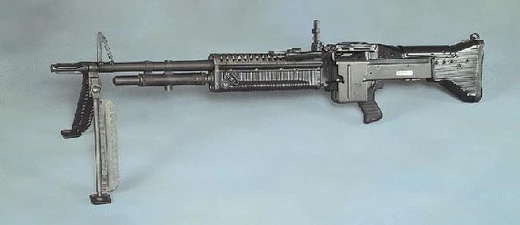
The DS-39 was a tripod-mounted gun that used the same flapper locking action and gas piston as the DP and DT machine guns. Instead of a pan magazine, it had a belt feed and a heavy finned barrel for better air cooling. When fired, the locking flaps were pushed outward by the firing pin, which was driven forward by the bolt carrier. It had an adjustable gas regulator and could take a spring-loaded buffer that doubled the rate of fire. The gun had two spade grips, each with a trigger for the index finger, but it could only fire after a thumb latch on the left grip was pressed, which required the barrel to be firmly locked. The right grip contained a brush and oil reservoir. It fed from 250-round non-disintegrating metal belts or from the canvas belts used by the Maxim.
The Degtyaryov was a relatively simple design that could be taken apart without tools, though George M.
Quick Facts
- Origin
- Soviet Union
- Is Ranged
- yes
- Service
- 1939–1945
- Wars
- World War II
- Designer
- Vasily Degtyaryov
- Design Date
- 1930
- Manufacturer
- Tula Arsenal
- Production Date
- 1940–1941
- Number
- 10,315
- Variants
- DS-42 (prototype)
- Mass
- 14.3 kg (gun body) + 28 kg (tripod and gun shield)
- Length
- 1170 mm
Facts from the source article.
Lore & Background
The DS-39 was developed to replace the PM M1910 Maxim, which was slow to manufacture, heavy, and required water cooling. Specifications issued in 1928 called for an air-cooled design with a firing mechanism similar to the DP and DT machine guns, a rate of 500 rounds per minute, 150-round belts, and a total weight no more than 66 lb with mount. Degtyaryov began work in 1930 with Georgy Shpagin, who designed the belt feed. After prolonged trials, the gun was adopted in September 1939, with serial production starting in June 1940.
The DS-39 used a flapper locking action and gas piston like the DP and DT, but replaced the pan magazine with a belt feed and had a heavy finned barrel for air cooling. It featured an adjustable gas regulator and a spring-loaded buffer that could double the rate of fire. The gun had two spade grips with triggers for each index finger, but required a thumb latch on the left grip to fire. The right grip housed a brush and oil reservoir. It could be disassembled without tools, though not as easily as some contemporaries, and had little to no interchangeable parts; its finely machined exterior hindered mass production.
In field use, the DS-39 proved unreliable. The feeding system tore cartridge cases, forcing use of steel-cased ammunition; heavy bullets split; the gun jammed in dust and froze in cold weather. As an anti-aircraft weapon, the tripod mount was unstable at maximum elevation, and increasing the rate of fire worsened problems. According to Ian V. Hogg, the defects required a complete redesign. George M. Chinn attributed the failure more to production difficulties than to the gun's performance.
Reader's Guide
The DS-39's significance lies in its failure as a replacement for the PM M1910 Maxim, despite a lengthy development process. About 10,000 were made from 1939 to 1941, but after the German invasion, production was halted and factories converted to the older, more reliable Maxim. The Soviets then sought a new medium machine gun, selecting the SG-43 Goryunov in 1943. An improved DS-42 was tested in 1942 but was passed over as the Goryunov was deemed more rugged, simpler, and cheaper to manufacture with similar performance.
The DS-39 saw limited frontline use; most were issued to second-line troops. About 200 were captured by Finland during the Continuation War and modified by Aimo Lahti, partially solving reliability issues. These Finnish conversions served until 1944, with survivors stored until 1986 and mostly scrapped afterward. A handful remain in museums and private collections. The gun's legacy is that of a promising design that could not overcome its reliability and production problems, ultimately being superseded by a more practical weapon.
Did You Know?
- The DS-39 was designed by Vasily Degtyaryov with assistance from Georgy Shpagin, who developed the belt-feeding system.
- About 200 DS-39s were captured by Finland and modified by Aimo Lahti, partially solving reliability issues.
- Production of the DS-39 was discontinued after the German invasion in June 1941, and factories converted to produce the older PM M1910 Maxim.
More in Machine Guns, Part 5 1-24
Spotted an error? Know more?
Reader corrections go straight into our review queue. Suggest an edit · How this site is sourced