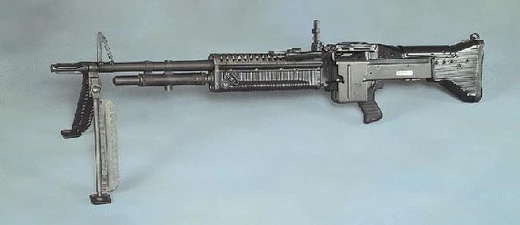
Darne machine gun
A French machine gun designed for low-cost, rapid manufacture.

The Darne machine gun is a machine gun of French origin, developed by the gun-making company Darne, which became famous for its innovative shotguns. It was designed for quick manufacture without unnecessary refinements, resulting in a crude external finish but a weapon that worked well and was much cheaper than comparable contemporary firearms.
Quick Facts
- Origin
- France
- Is Ranged
- yes
- Manufacturer
- Darne
- Weight
- 7.8 kg
- Length
- 1.12 m
- Cartridge
- 8×50mmR Lebel · .303 British · 7.5x54mm MAS −(mod. 1929)− · 7x57mm Mauser
- Action
- Gas, tilting breech block
- Rate
- 1100–1200 rounds/m
- Velocity
- 830 m/s
- Range
- Ground: 200 m
- Max Range
- Ground: 500 m
- Feed
- Belt
Facts from the source article.
Lore & Background
The Darne company began making military weapons in 1915 when contracted by the French government to manufacture Lewis machine guns. In 1916, Darne announced its own indigenous design of a belt-fed machine gun, emphasizing quick manufacture and low cost over external finish. The French Army tested these guns from 1917 to 1918, but the war ended before production contracts were signed. During the 1920s and 1930s, Darne refined an aircraft variant that was adopted by French and some other air forces as an observer's gun. The company also offered lightweight belt-fed machine guns for infantry or vehicle use, but these found no buyers in the inter-war period. The Darne machine gun was eventually replaced by the MAC 1934 for Air Force use, though the French Navy continued using them into World War II. Small numbers were exported to Brazil, Spain, Yugoslavia, Italy, and Lithuania. Captured French Darnes were used by German occupation forces for coastal defense. Initial guns were made by Darne in France, but later production appears to have been outsourced to Spain.
Reader's Guide
The Darne machine gun's significance lies in its embodiment of a design philosophy prioritizing cost reduction and rapid manufacture over refinement, a notable departure from many contemporary small arms. Its crude appearance belied functional reliability, and its low price made it competitive in the inter-war market, though only the aircraft variant saw significant adoption. The weapon's use by the French Air Force until 1935 and continued service with the French Navy into World War II demonstrates its longevity. Its export to several countries and subsequent use by German occupation forces after capture further illustrates its widespread, if limited, distribution. The Darne's unusual belt feed system, which drew cartridges rearward from the belt before pushing them forward into the barrel, and its tilting bolt lockup similar to the M1918 Browning Automatic Rifle, are distinctive mechanical features. Ultimately, the Darne machine gun represents a pragmatic approach to military weapon design during a period of rapid technological change, though its impact was overshadowed by more widely adopted contemporaries.
Did You Know?
- It used an unusual belt feed system that withdrew cartridges from the belt to the rear before pushing them forward into the barrel.
- The French Navy continued to use Darne machine guns into World War II after they were replaced in Air Force service.
More in Machine Guns, Part 5 1-24
Spotted an error? Know more?
Reader corrections go straight into our review queue. Suggest an edit · How this site is sourced