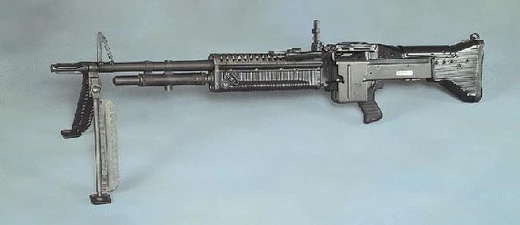
Ciężki karabin maszynowy wz. 25
Polish Hotchkiss derivative plagued by overheating and jamming.

The ckm wz. 25, short for *ciężki karabin maszynowy wzór 25* (heavy machine gun pattern 1925), was a Polish adaptation of the French Hotchkiss M1914. It was modified to fire the 7.92×57mm Mauser round. The design emerged in late 1924 and was rushed into Polish military service. At least 1,249 units were purchased from France, entering use with the Polish Army from 1926 onward.
The weapon proved unsuccessful. The more powerful ammunition generated higher velocity, which caused the barrel to overheat quickly. This led to excessive barrel wear and a noticeable drop in accuracy. The wz. 25 also suffered frequent jams and more part failures than its predecessor, the wz. 14, with the firing pin being especially fragile. Consequently, it was removed from infantry units and reassigned to the Border Defence Corps and artillery formations. During the 1930s, some guns were further modified and became the primary machine gun in Polish armored cars. The weapon fed from a standard 30-round metal feed strip.
Following the German and Soviet invasion of Poland in 1939, captured wz. 25 guns were taken into German service under the designation 7.9 mm sMG 238(p).
Quick Facts
- Is Ranged
- yes
- Origin
- France
- Service
- 1926–1939
- Used By
- Poland · Nazi Germany (captured)
- Wars
- Polish Campaign
- Cartridge
- 7.92×57mm Mauser
- Feed
- 30 round strip
- Action
- gas-actuated
- Rate
- 450–600 round/min
- Number
- 1249
Facts from the source article.
Lore & Background
The ckm wz. 25 was a Polish modification of the French Hotchkiss Mle.1914, designed in late 1924 and quickly adopted by the Polish Army. At least 1,249 were purchased in France and entered service in 1926. The weapon was rechambered for the more powerful 7.92×57mm Mauser cartridge, which proved problematic. The higher velocity ammunition caused the barrel to heat rapidly, leading to excessive barrel wear and a deterioration of accuracy. The wz. 25 also had a tendency to jam, and certain parts—particularly the firing pin—suffered more frequent damage than in the earlier wz. 14.
As a result of these reliability issues, the wz. 25 was withdrawn from infantry service and reassigned to the Border Defence Corps and artillery units. Some weapons were further modified in the 1930s and used as the main machine gun in Polish armoured cars. Feeding was provided by a standard 30-round metal feed strip. During the German and Soviet invasion of Poland in 1939, captured wz. 25 guns were pressed into German service under the designation 7,9 mm sMG 238(p).
Reader's Guide
The ckm wz. 25 is notable primarily as a failed attempt to adapt a proven French design to Polish requirements. Its rapid adoption in 1924–1926 reflected an urgent need for modern heavy machine guns, but the decision to rechamber for the 7.92×57mm Mauser cartridge—without adequate redesign of the barrel and action—led to fundamental flaws. The excessive barrel wear and accuracy loss, combined with frequent jams and firing pin breakages, made it unsuitable for front-line infantry use. Its relegation to the Border Defence Corps and artillery units, and later to armoured cars, demonstrates a pattern of downgrading rather than outright replacement. The weapon's capture and reuse by the Wehrmacht as the sMG 238(p) during the 1939 invasion underscores its continued presence in Polish arsenals at the outbreak of war. The wz. 25 thus represents a cautionary example of hasty modification without sufficient testing, and its limited service life highlights the challenges faced by interwar Polish ordnance development.
Did You Know?
- The ckm wz. 25 was a Polish derivative of the Hotchkiss M1914 machine gun.
- It was rechambered for 7.92×57mm Mauser ammunition, which caused rapid barrel heating and wear.
- At least 1,249 were bought in France and used by the Polish Army since 1926.
- Captured by the Wehrmacht in 1939, it was redesignated 7,9 mm sMG 238(p).
More in Machine Guns, Part 5 1-24
Spotted an error? Know more?
Reader corrections go straight into our review queue. Suggest an edit · How this site is sourced