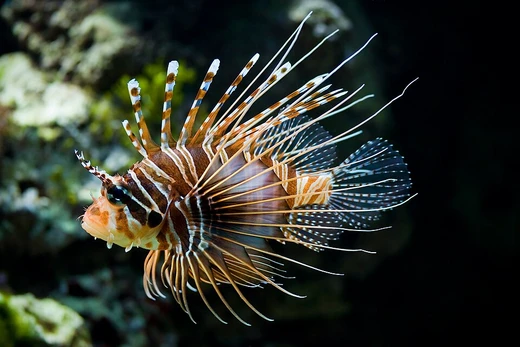
Trachyscorpia
A genus of venomous, deep-dwelling rockfishes found worldwide.

Trachyscorpia is a genus of marine ray-finned fish within the rockfish subfamily Sebastinae, which is part of the family Scorpaenidae. Members of this genus inhabit the Atlantic, Indian, and Pacific Oceans. They are recognized for their venomous spines and live as demersal fish, usually dwelling deeper than 100 meters.
The genus was established in 1953 by Lithuanian-born American ichthyologist Isaac Ginsburg. Its type species is *Scorpaena cristulata*, originally described in 1896 by George Brown Goode and Tarleton Hoffman Bean from waters off Georgia. The name *Trachyscorpia* combines the Greek *trachys* ("coarse" or "rough") and *scorpia* ("scorpion")—the first part refers to the ctenoid scales of the type species, the second to its original placement in *Scorpaena*.
Seven species are currently recognized: *T. carnomagula* (deepsea scorpionfish), *T. cristulata* (Atlantic thornyhead), *T. echinata* (spiny scorpionfish), *T. eschmeyeri* (Cape rockfish), *T. longipedicula* (stylish scorpionfish), *T. osheri*, and *T. verai* (Ecuadorian deep-sea scorpionfish).
These fish have a large head—nearly half the body length—with a short snout and robust, heavily spined bones. They lack a pit behind the eyes, which are large and have a horizontal, spiny ridge beneath them. The preoperculum bears 4–5 spines, the first being longer and having both a main and a supplementary spine. The dorsal fin has 13 spines and 8–10 soft rays; the anal fin has 3 spines and 5 soft rays. The pectoral fin is bilobed (not wedge-shaped), with the longest rays at the top, 21–24 rays in total, and the upper rays branched. In larger individuals, the lower pectoral rays are fleshy. Rough scales cover the cheek, intraorbital space, and behind the eyes. The lateral line is complete, extending to the caudal fin base, and consists of tubed scales. Maximum sizes range from 14.7 cm standard length in *T. osheri* to 56.9 cm total length in *T. echinata*.
*Trachyscorpia* species are found in the Atlantic, Pacific, and Indian Oceans. They are demersal, typically at depths exceeding 100 meters. They are thought to be oviparous, with females likely extruding internally fertilized eggs in floating gelatinous masses, as seen in other members of the tribe Sebastolobini. Their spines are venomous, and they are predatory, feeding on benthic invertebrates and other fishes.
- First described by
- Isaac Ginsburg
- Year described
- 1953
- Type species
- Scorpaena cristulata
- Type species described by
- George Brown Goode and Tarleton Hoffman Bean
- Type species year
- 1896
- Number of species
- 7
- Maximum length range
- 14.7 cm (T. osheri) to 56.9 cm (T. echinata)
Lore & Background
The genus Trachyscorpia was first described by Lithuanian-born American ichthyologist Isaac Ginsburg in 1953, with Scorpaena cristulata as its type species. The generic name combines trachys, meaning 'coarse' or 'rough', referring to the ctenoid scales of the type species, and scorpia, meaning 'scorpion', derived from Scorpaena, the original genus of T. cristulata. Currently, seven species are recognized, including the Atlantic thornyhead (T. cristulata) and the deepsea scorpionfish (T. carnomagula).
Trachyscorpia species have a large head nearly half the body length, a short snout, robust bones with strong spines, and no pit behind the eyes. They have large eyes with a horizontal ridge beneath armed with spines, 4–5 preopercular spines (the first longer with a main and supplementary spine), 13 dorsal spines and 8–10 soft rays, and 3 anal spines with 5 soft rays. The pectoral fin is bilobed with 21–24 rays, the upper branched, and lower rays fleshy in larger fish. Rough scales cover the cheek, intraorbital space, and behind the eyes; the lateral line is complete with tubed scales.
These fish are demersal, usually found deeper than 100 meters in the Atlantic, Pacific, and Indian Oceans. They are thought to be oviparous, with females likely extruding internally fertilized eggs in gelatinous masses. They have venomous spines and are predatory, feeding on benthic invertebrates and other fishes.
Reader's Guide
Trachyscorpia holds significance as a genus within the rockfish subfamily Sebastinae, contributing to the diversity of scorpionfishes in deep marine environments. Its description by Isaac Ginsburg in 1953, based on a species originally named in 1896, highlights the ongoing taxonomic work in ichthyology. The genus is notable for its venomous spines, a common defensive trait in Scorpaenidae, and its role as a predator of benthic invertebrates and fishes. The seven recognized species, ranging from the small T. osheri (14.7 cm) to the larger T. echinata (56.9 cm), occupy depths over 100 meters across three oceans, indicating a widespread but specialized deep-water habitat. The reproductive strategy—oviparous with gelatinous egg masses—is shared with other members of the tribe Sebastolobini. The genus's rough scales and spiny head are key identifying features, and its presence in Atlantic, Indian, and Pacific waters underscores its global distribution in temperate and tropical seas. The legacy of Trachyscorpia lies in its representation of deep-sea rockfish diversity and the continued discovery of new species, such as T. carnomagula and T. verai, described in the 2000s.
Did You Know?
- The genus name Trachyscorpia means 'rough scorpion', referring to its ctenoid scales and relation to Scorpaena.
- The largest species, T. echinata, reaches a total length of 56.9 cm, while the smallest, T. osheri, reaches only 14.7 cm standard length.
- Females likely extrude internally fertilized eggs in gelatinous masses, similar to other Sebastolobini.
More in Lionfish and Scorpionfish, Part 2 1-24
Spotted an error? Know more?
Reader corrections go straight into our review queue. Suggest an edit · How this site is sourced