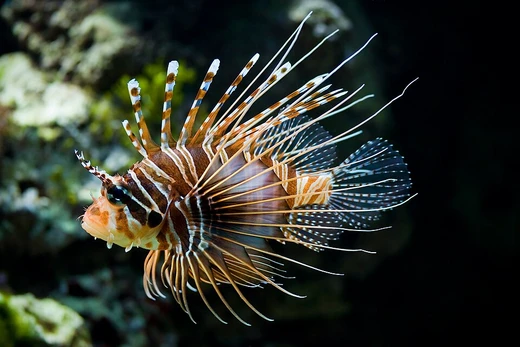
Neoscorpaena
Monotypic scorpionfish genus with a slit behind the gill arches.

Neoscorpaena is a monotypic genus of marine ray-finned fish in the family Scorpaenidae, containing only the spotfin scorpionfish (Neoscorpaena nielseni). It is notable for being distinguished from the related genus Scorpaena by the presence of a slit behind the gill arches.
Quick Facts
- Taxon
- Neoscorpaena nielseni
Facts from the source article.
Lore & Background
The spotfin scorpionfish was first formally described in 1964 by South African ichthyologist J. L. B. Smith as Sebastapistes neilseni, with the type locality given as off Durban in South Africa. In 2001, Russian biologist Sergey Mandritsa placed this species in the monotypic genus Neoscorpaena. The genus name translates as 'new Scorpaena', reflecting its similarity to fishes in the genus Scorpaena but distinguished by having a slit behind the gill arches. The specific name honors Danish zoologist Jørgen G. Nielsen for his assistance to Smith's research.
The species has a dorsal fin with 12 spines and 9–10 soft rays, an anal fin with 3 spines and 5 soft rays, and 18 pectoral fin rays. Its large head length is 45.9–48.6% of standard length, and its large eyes have an orbital diameter of 12.0–17.1% of standard length, decreasing markedly with growth. It lacks a lateral lacrimal spine; the anterior lacrimal spine is rounded, and the posterior lacrimal spine is triangular. It has 4–8 suborbital spines, 5 preopercular spines with an extra spine on the uppermost, and well-developed preocular, supraocular, postocular, and tympanic spines. The interorbital ridges connect to the bases of the tympanic spines, and parietal spines are absent. The nuchal spine is large and well developed. There are no interorbital, coronal, or pretympanic spines, and the back of the head is almost flat without an occipital pit. It has 2–13 sphenotic spines, and the parietal, lower posttemporal, and supracleithral spines are well developed. The maxilla extends to just short of or as far as the rear edge of the orbit. Vomerine and palatine teeth are present, and the pectoral fin is bilobed. The overall color is reddish with yellow blotches on the upper head and body, and typically a dark blotch near the rear of the spiny part of the dorsal fin. It grows to a maximum recorded standard length of 21.6 cm.
The spotfin scorpionfish is found in the southwestern Indian Ocean, off the eastern coast of South Africa, as well as Madagascar, Seychelles, Mauritius, and Réunion. It is a demersal fish found at depths between 40 and 507 m. Little is known about its biology.
Reader's Guide
The genus Neoscorpaena is significant as a monotypic taxon within the scorpionfish family, defined by the distinctive slit behind the gill arches that separates it from the larger genus Scorpaena. Its sole species, the spotfin scorpionfish, was originally described in 1964 by J. L. B. Smith and later reclassified by Sergey Mandritsa in 2001, reflecting ongoing taxonomic refinement in scorpionfish systematics. The species is known from the western Indian Ocean, with records from South Africa, Madagascar, Seychelles, Mauritius, and Réunion, inhabiting depths from 40 to 507 m. Its morphology includes a suite of spines and fin-ray counts typical of scorpionfishes, with a reddish coloration and a dark blotch on the dorsal fin. Despite its description over half a century ago, little is known about its biology, leaving gaps in understanding its ecology and behavior. The genus name itself—'new Scorpaena'—highlights its close relationship to Scorpaena while underscoring the anatomical difference that warranted its own genus. As the only member of Neoscorpaena, it represents a distinct evolutionary lineage within the Scorpaenidae, and its limited distribution and depth range suggest a specialized niche in the southwestern Indian Ocean.
Did You Know?
- The spotfin scorpionfish is the only known member of the genus Neoscorpaena.
- It was originally described in 1964 as Sebastapistes neilseni by J. L. B. Smith.
- The genus name Neoscorpaena means 'new Scorpaena', referring to its similarity to Scorpaena but with a slit behind the gill arches.
- This species is found at depths between 40 and 507 m in the southwestern Indian Ocean.
Taxonomic Origins and Placement
Neoscorpaena is a genus of scorpionfish formally described by Mandrytsa in 2001, making it one of the more recently recognized members of the family Scorpaenidae. It is assigned to the subfamily Scorpaeninae, a grouping that encompasses scorpionfishes and lionfishes and includes well-known names such as Scorpaena, described by Linnaeus as far back as 1758, alongside more recently erected genera like Hipposcorpaena (Fowler, 1938) and Phenacoscorpius (Fowler, 1938). The family itself was established by the French naturalist Antoine Risso in 1826. While it was long housed under the order Scorpaeniformes, more recent taxonomic authorities have reassigned it to the suborder Scorpaenoidei within Perciformes. A sweeping 2018 revision reshuffled the family's internal architecture: subfamilies such as Synanceiidae and Plectrogeniidae were elevated to full family rank, and tribes like Pteroinae were promoted to subfamily status. Neoscorpaena, however, retained its position within Scorpaeninae, one of the subfamilies that survived the reorganization intact. The family as a whole now comprises 39 genera and no fewer than 388 species.
Morphological Heritage of the Scorpaeninae
As a member of Scorpaeninae within Scorpaenidae, Neoscorpaena shares the broad morphological blueprint that defines the family. Scorpaenids are characterized by a laterally compressed body and a head typically studded with ridges and spines. The operculum bears one or two spines, usually two that diverge, while the preoperculum carries three to five, with five being the norm. Where scales are present, they are ctenoid in type. A single dorsal fin, often deeply incised, runs along the back, armed with 11 to 17 spines followed by 8 to 17 soft rays. The anal fin typically presents three spines and five soft rays, and the pelvic fin carries a single spine with two to five soft rays. The pectoral fin is notably large, containing 11 to 25 soft rays, with some species showing a few lower rays freed from the fin membrane. Gill membranes remain unattached to the isthmus, and in certain species the swim bladder is entirely absent. These shared structural features underscore how tightly the genera of Scorpaeninae, including Neoscorpaena, are woven into a common anatomical framework.
Venom and the Architecture of Defense
The Scorpaenidae are renowned as a family that includes many of the world's most venomous fish species, and Neoscorpaena, as a member of this lineage, inherits the broader defensive strategy that makes the group so dangerous. The hallmark of scorpionfishes is a sting delivered through sharp spines coated in venomous mucus. In various species across the family, dedicated venom glands are associated with the spines of the dorsal, anal, and pelvic fins, turning what appears to be a mere fin structure into a potent chemical weapon. This defensive apparatus is a key reason the family commands respect among marine biologists and coastal communities alike. It is also worth noting a taxonomic distinction that can cause confusion: the cabezones, represented by the genus Scorpaenichthys, are sometimes mistaken for true scorpionfishes but actually belong to the separate, though related, family Cottidae. For Neoscorpaena and its Scorpaeninae relatives, the venom-spine system represents a deeply conserved evolutionary trait, one that has persisted across the family's long history, with fossil otoliths of scorpaenids dating back to the mid-Eocene and body fossils appearing in the Oligocene or Miocene.
Ecological Range and Habitat Context
Scorpaenidae as a family enjoy a broad ecological footprint, and Neoscorpaena's broader taxonomic group is no exception to the patterns seen across the family. Scorpaenid species are predominantly found in the Pacific and Indian Oceans, with a strong concentration in the Indo-Pacific region, though some members also range into the Atlantic. Their preferred environments span marine and brackish waters, with a particular affinity for reef systems, yet they are equally at home in estuaries, bays, and lagoons. This habitat versatility is reflected in the family's remarkable size range: while the largest member, the shortraker rockfish Sebastes borealis, reaches a total length of 108 centimetres, many species top out at just 5 centimetres. Reproductive strategies also vary; most species rely on internal fertilisation, with some being ovoviviparous and others depositing eggs in gelatinous masses, the spotted scorpionfish Scorpaena guttata reportedly producing an egg balloon up to 20 centimetres across. A few genera, such as the lionfishes Pterois, have become invasive non-native species in the Caribbean and eastern Mediterranean, underscoring the family's capacity to establish itself far beyond its native tropical and temperate range.
Frequently Asked Questions
What is Neoscorpaena?
Neoscorpaena is a monotypic genus of marine ray-finned fish belonging to the scorpionfish family (Scorpaenidae). It houses a single species, the spotfin scorpionfish (Neoscorpaena nielseni), and nothing else.
How do you tell Neoscorpaena apart from the closely related genus Scorpaena?
The defining difference is a small slit situated behind the gill arches, a feature that Scorpaena species do not possess. That single anatomical trait is what separates the two genera in the field.
Who erected the genus Neoscorpaena and when?
Sergey Mandritsa formally established the genus in 2001, separating the species from its prior taxonomic placement. The fish itself had been originally described in 1964 by J. L. B. Smith under the name Sebastapistes neilseni.
How big does the spotfin scorpionfish get?
The maximum standard length recorded for Neoscorpaena nielseni is 21.6 cm, placing it on the smaller end of the scorpionfish family.
Where was Neoscorpaena first collected?
The type locality for the species is off the coast of Durban, South Africa, the waters where the original specimen was gathered for description.
More in Lionfish and Scorpionfish, Part 2 1-24
Spotted an error? Know more?
Reader corrections go straight into our review queue. Suggest an edit · How this site is sourced