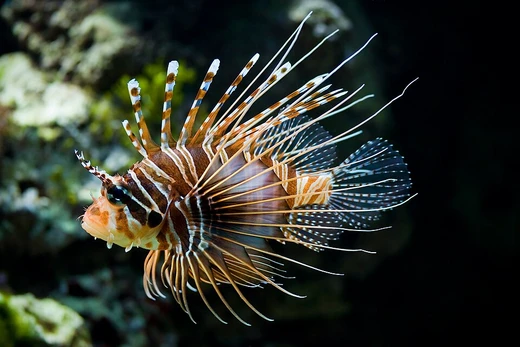
Red lionfish
Venomous Indo-Pacific reef fish invasive in the Atlantic and Caribbean.

The red lionfish (Pterois volitans) is a venomous fish from the Scorpaenidae family that lives on coral reefs. Its natural range covers the Indo-Pacific, but it has invaded the Caribbean Sea, the East Coast of the United States, the East Mediterranean, and Brazil’s Fernando de Noronha. Along with its close relative Pterois miles, it is considered an invasive species. It ranks among the largest lionfish species, with adults reaching up to 47 cm (18.5 in) long, while juveniles start under 1 inch (2.5 cm). Its body is marked by white stripes alternating with red, maroon, or brown ones. The fish has 13 venomous spines on its dorsal fin, plus two on its pelvic fins and three on its anal fin. These spines, together with its long non-venomous fins, create a mane-like look that gives it the name “lionfish.” The dorsal spines ward off most predators. Red lionfish reproduce monthly, and their larvae spread quickly, helping the invasion expand. No definitive predators are known in invaded areas, so many groups encourage harvesting and eating lionfish to control their growing numbers.
Taxonomy: Carl Linnaeus first described the red lionfish in 1758 as Gasterosteus volitans in his Systema Naturae, with the type location given as Ambon Island, Indonesia. In 1856, French naturalist Eugène Anselme Sébastien Léon Desmarest designated Scorpaena volitans (named by Bloch in 1787, matching Linnaeus’s species) as the type species for the genus Pterois, which Oken had originally described in 1817. A molecular study of this species, the common lionfish, the luna lionfish, and Russell’s lionfish found that common lionfishes in the western Indian Ocean formed one lineage, while a second lineage included both the luna and Russell’s lionfish (suggesting they are the same species). The red lionfish formed a third lineage that appeared to have genetic contributions from the other two, hinting it arose from hybrids between P. miles and P. russelii sensu lato. The species name volitans means “flying,” likely referring to its large pectoral fins that resemble wings.
Distribution: P. volitans is native to the Indo-Pacific, including the western and central Pacific and the coast of western Australia. It has been introduced to the Western Atlantic, where it is invasive, as well as to the northern Gulf of Mexico and the Caribbean.
Quick Facts
- Genus
- Pterois
- Species
- volitans
Facts from the source article.
Lore & Background
The red lionfish was first formally described in 1758 as Gasterosteus volitans by Carl Linnaeus in the 10th edition of his Systema Naturae, with the type locality given as Ambon Island in Indonesia. In 1856, French naturalist Eugène Anselme Sébastien Léon Desmarest designated Scorpaena volitans as the type species of the genus Pterois. A molecular study suggested that the red lionfish arose from hybrids between P. miles and P. russelii sensu lato. The specific name volitans means 'flying', presumed to refer to the large pectoral fins resembling wings.
Red lionfish are clad in white stripes alternated with red, maroon or brown stripes. Adults can grow as large as 47 cm, while juveniles are typically shorter than 1 inch. They have large, venomous spines on their dorsal fin (13), pelvic fins (2), and anal fins (3), along with other long non-venomous fins that create a mane-like appearance. The dorsal spines deter most potential predators. Lionfish reproduce monthly, with females releasing up to 30,000 eggs per mating session, and are able to quickly disperse during their larval stage. They are mainly solitary, courting only at night, with one male and several females.
Reader's Guide
The red lionfish is notable primarily as a highly successful invasive species. Likely first introduced off the Florida coast in the early to mid-1980s from the aquarium trade, it has spread along the East Coast from Cape Hatteras, North Carolina, to Florida, and throughout Bermuda, the Bahamas, the Caribbean, and Brazil at Fernando de Noronha. About 93% of the invasive lionfish population is the red lionfish. Its high rates of prey consumption, wide variety of prey (crustaceans, small fishes, and juveniles of its own species), and increasing abundance threaten fragile ecosystems by outcompeting overfished snapper and grouper and disrupting food chains. No definitive predators are known in its invasive range, though Nassau and tiger groupers in the Bahamas have been found with lionfish in their stomachs. In its native range, two species of moray eels and the Bobbit worm prey on lionfish. Many organizations promote harvest and consumption of lionfish to control population densities. The venomous spines are used purely for defense; their sting is usually not fatal to humans but causes extreme pain, and hot water is a common treatment.
Did You Know?
- The red lionfish was first described by Carl Linnaeus in 1758 as Gasterosteus volitans.
- Females can lay up to 30,000 eggs in one mating session.
- The larval stage lasts about one month and is the shortest stage of its life.
- The species name volitans means 'flying', referring to its large pectoral fins.
Taxonomy & the Story Behind the Name
Pterois russelii carries a long and somewhat tangled taxonomic history. The species was first formally described in 1831 by English naturalist Edward Turner Bennett, who designated the Coromandel Coast of India as the type locality. The specific epithet honors Patrick Russell, a Scottish surgeon and herpetologist who had illustrated and described the fish back in 1803 without ever assigning it a formal name. In a curious quirk of scientific nomenclature, Bennett dropped the final "l" from Russell's surname, and this misspelling was perpetuated consistently by Cuvier and Valenciennes in their own works. The fish also goes by a remarkable array of common names—including largetail turkeyfish, plaintail firefish, Russell's lionfish, and spotless butterfly-cod—reflecting the many ways different regions and traditions have tried to capture its appearance. More recently, molecular analyses combined with morphological comparisons have suggested that P. russelii and the luna lionfish (P. lunulata) are actually one and the same species, a finding that would consolidate two long-recognized names into a single taxon.
Range & Preferred Habitats
Russell's lionfish occupies a broad swath of the Indo-Pacific Ocean, stretching from the eastern African coastline southward to South Africa, then eastward through Oman all the way to Japan and Australia. Its presence in the Red Sea was not confirmed until 2016, suggesting that either the species arrived there relatively recently or that earlier records went unverified. Within Australian waters, the fish is encountered from the Exmouth Gulf in Western Australia, following the northern tropical coasts, and extending as far as the Great Barrier Reef in Queensland. In terms of vertical range, P. russelii inhabits depths between 15 and 60 meters. It favors areas with muddy substrates, ranging from sheltered shallow estuaries and bays in coastal waters to quieter, deeper offshore reef environments. This flexibility in habitat use—from protected inshore mudflats to more open reef settings—gives the species a notable ecological breadth within its tropical range.
Appearance & Distinguishing Features
At first glance, Pterois russelii presents a striking visual profile: a whitish body marked with vertical reddish-brown stripes, giving it a bold, banded appearance. The dorsal fin carries thirteen spines backed by ten to twelve soft rays, while the anal fin bears three spines and seven or eight soft rays. One of the most reliable ways to tell this species apart from its close relatives is the complete absence of rows of small dark spots on the soft dorsal, anal, and caudal fins—a trait that is characteristic of other lionfishes but notably missing here. The dorsal-fin spines are also comparatively short, lending the fish a slightly less imposing silhouette than some of its kin. The maximum published standard length for this species is thirty centimeters, roughly twelve inches, placing it in the medium-to-large category among scorpionfishes. All of these features, combined with its venomous spines, make it a visually distinctive and potentially dangerous member of the family Scorpaenidae.
Behavior, Diet & Human Interaction
Russell's lionfish is a solitary creature, preferring to patrol its chosen territory alone rather than in groups. Like other members of the scorpionfish family, it possesses venom-bearing spines that serve as a potent defense mechanism against predators and curious handlers alike. Its diet consists primarily of smaller fish, crabs, and shrimp, positioning it as a mid-level predator in its reef and estuary ecosystems. Despite its dramatic coloration and the general fascination people have with venomous marine species, P. russelii is only infrequently encountered in the aquarium trade. This relative scarcity in the hobbyist market may reflect challenges in sourcing, the species' solitary temperament, or simply the limited demand compared to more widely known lionfish relatives. Outside of occasional aquarium appearances, the fish's interactions with humans are largely limited to the risk of envenomation for divers or fishers who encounter it in its preferred muddy-bottom habitats across the Indo-Pacific.
Frequently Asked Questions
What is the red lionfish?
The red lionfish (Pterois volitans) is a venomous reef dweller in the Scorpaenidae family, instantly recognizable by its alternating bands of white against red, maroon, or brown. It is native to the Indo-Pacific but has since spread into the Caribbean, the U.S. East Coast, the eastern Mediterranean, and Brazil's Fernando de Noronha.
How big can a red lionfish grow?
Adults can reach roughly 47 cm (about 18.5 inches), placing it among the larger members of the lionfish group. Young fish start out under 2.5 cm (1 inch) and grow substantially over a lifespan of around ten years.
How many venomous spines does a red lionfish have?
It carries eighteen stinging spines in total: thirteen along the dorsal fin, two on the pelvic fins, and three on the anal fin. The venom injected through these spines causes intense pain in humans but is generally not life-threatening.
Why is the red lionfish considered an invasive species?
It has established self-sustaining populations far outside its native Indo-Pacific range, outcompeting native reef predators and depressing local fish diversity. Together with its close relative Pterois miles, it is classified as an invasive threat across the Atlantic, Caribbean, and eastern Mediterranean.
How does a red lionfish reproduce?
A single spawning event can release up to 30,000 eggs, and the free-floating larval stage lasts about a month before the young settle onto reefs. This high fecundity, combined with a near absence of natural predators in invaded waters, helps explain how quickly new populations take hold.
More in Lionfish and Scorpionfish, Part 2 1-24
Spotted an error? Know more?
Reader corrections go straight into our review queue. Suggest an edit · How this site is sourced