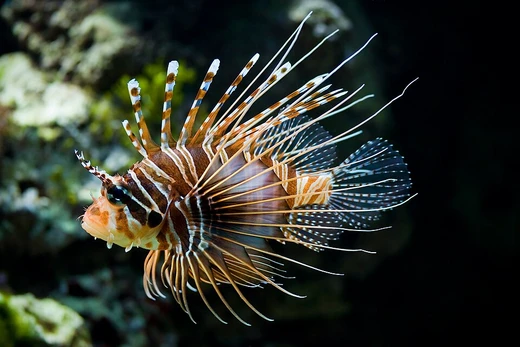
Hipposcorpaena filamentosus
A small, filament-finned scorpionfish, sole member of its genus.

The filamentous scorpionfish (Hipposcorpaena filamentosus) is a small marine fish in the scorpionfish family, Scorpaenidae. It is the sole member of the genus *Hipposcorpaena*. This species lives in the Indo-West Pacific region, with records from Bali, Sulawesi, the Timor Sea, the Philippines, Papua New Guinea, and Japan; in Australia, it has only been found at Ashmore Reef in the Timor Sea. It is a demersal fish, inhabiting silty inshore reefs at depths between 10 and 95 meters.
The fish was first scientifically described in 1938 by American zoologist Henry Weed Fowler, based on a specimen collected off Linao Point in the Philippines' Davao Gulf. The genus name combines *hippo* (meaning "horse") with *Scorpaena*, likely referring to the horse-like sloping profile of its head. The species name *filamentosus* means "filamented," probably describing the thin skin flaps on its head and body.
The body is strongly compressed, with a large head and a concave upper edge to the snout. Its body depth fits into its standard length 2.5 to 2.8 times. The dorsal fin has 11 to 12 spines and 9 to 10 soft rays, while the anal fin has 2 spines and 6 soft rays. The pectoral fin has 14 rays, with deep incisions in the membranes between the lower seven rays—these cuts are one-third to one-half the length of each ray, creating filament-like structures. Skin flaps appear on the snout, chin, lower cheek, preoperculum margin, and above the eye. Overall, the fish is reddish, with a whitish snout, two wide pale bands on the body, and a white band on the rear of the spiny part of the dorsal fin. It is a small scorpionfish, reaching a maximum standard length of 3.5 cm (1.4 inches).
Quick Facts
- Taxon
- Hipposcorpaena filamentosus
Facts from the source article.
Lore & Background
The filamentous scorpionfish was first formally described in 1938 by American zoologist Henry Weed Fowler, with the type locality given as off Linao Point in Davao Gulf, Philippines. It is the only species in the monospecific genus Hipposcorpaena. The genus name combines the word hippo, meaning 'horse', used as a prefix of Scorpaena, thought to allude to the sloping profile of the head resembling that of a horse. The specific name filamentosus means 'filamented' and likely alludes to the thin flaps on the head and body.
This species has a strongly compressed body with a large head and a concave upper edge to its snout. Its body depth fits into its standard length 2.5 to 2.8 times. The dorsal fin has 11–12 spines and 9–10 soft rays, while the anal fin has 2 spines and 6 soft rays. The pectoral fin has 14 rays, with deep incisions in the membranes between the lower 7 rays equal to one-third to one-half the length of each ray, creating filament-like structures. There are flaps of skin on the snout, chin, lower cheek, margin of the preoperculum, and above the eye. The overall colour is reddish with a whitish snout, two wide pale bands on the body, and a white band on the posterior of the spiny part of the dorsal fin. It is a small species, reaching a maximum standard length of 3.5 cm (1.4 in).
The filamentous scorpionfish is found in the Indo-West Pacific region, recorded from Bali, Sulawesi, the Timor Sea, Philippines, Papua New Guinea, and Japan. In Australian waters it has only been recorded from Ashmore Reef in the Timor Sea. It is a demersal fish found at depths between 10 and 95 m (33 and 312 ft) on silty inshore reefs.
Reader's Guide
The filamentous scorpionfish is significant as the sole species in the monotypic genus Hipposcorpaena, a taxonomic distinction that underscores its unique morphological features. Its description by Henry Weed Fowler in 1938, with a type locality in the Philippines, established it as a distinct lineage within the scorpionfish family. The genus name, combining 'hippo' (horse) with Scorpaena, reflects the characteristic sloping head profile that sets it apart from related genera. The species name filamentosus highlights the thin, filament-like flaps on its head and body, as well as the deeply incised membranes between the lower pectoral fin rays, which create a filamentous appearance. These features, along with its small maximum size of 3.5 cm, make it a notable example of morphological specialization in shallow, silty reef habitats. Its distribution across the Indo-West Pacific, from Japan to Australia, indicates a broad but patchy range, with Australian records limited to Ashmore Reef. As a demersal fish inhabiting depths of 10 to 95 m, it occupies a specific ecological niche on inshore silty reefs. The species' legacy lies in its representation of a monotypic genus, emphasizing the diversity and specialization within Scorpaenidae, and its distinctive anatomy provides insight into adaptive traits in small reef fishes.
Did You Know?
- The filamentous scorpionfish is the only species in the monotypic genus Hipposcorpaena.
- Its genus name combines 'hippo' (horse) with Scorpaena, alluding to its horse-like head profile.
- The lower 7 rays of its pectoral fin have deep incisions creating filament-like structures.
- It has been recorded from Japan to Australia, but in Australian waters only at Ashmore Reef.
Frequently Asked Questions
Who is Hipposcorpaena filamentosus?
It is a tiny filament-finned scorpionfish and the only species ever placed in the genus Hipposcorpaena, sitting within the Scorpaenidae family. At a maximum standard length of roughly 3.5 cm (1.4 in), it is one of the smallest members of the scorpionfish group.
What is Hipposcorpaena filamentosus's role in its habitat?
As a demersal fish, it rests on silty inshore reef substrates at depths ranging from about 10 to 95 meters. It fills a small, specialized niche among the benthic community of the Indo-West Pacific rather than acting as a top predator or large herbivore.
Where can fans actually spot Hipposcorpaena filamentosus in the wild?
Documented sightings span the Indo-West Pacific, including Bali, Sulawesi, the Timor Sea, the Philippines, Papua New Guinea, and Japan. Within Australian waters it has only ever been recorded at Ashmore Reef in the Timor Sea, making that site particularly notable for enthusiasts.
What makes Hipposcorpaena filamentosus stand out from other scorpionfish?
It is the sole representative of its genus, so no other species shares the Hipposcorpaena name. Paired with its diminutive body and distinctive filament-like fin extensions, it occupies a taxonomically isolated slot within the otherwise large Scorpaenidae family.
How did Hipposcorpaena filamentosus enter the scientific record?
American zoologist Henry Weed Fowler formally described the species in 1938, basing his work on a specimen collected off Linao Point in Davao Gulf, Philippines. That Philippine locality remains the type locality and the origin point for the species' official scientific identification.
More in Lionfish and Scorpionfish, Part 2 1-24
Spotted an error? Know more?
Reader corrections go straight into our review queue. Suggest an edit · How this site is sourced