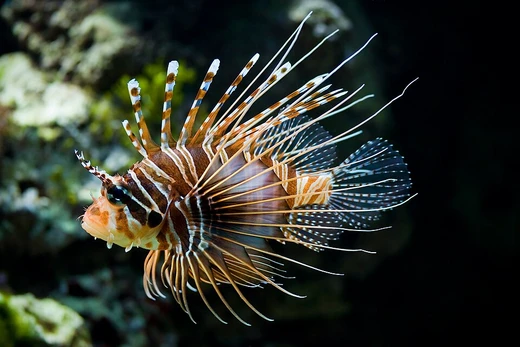
Idiastion
A small genus of hump-backed scorpionfishes from Atlantic and Pacific oceans.

Idiastion is a small genus of marine ray-finned fish in the scorpionfish family Scorpaenidae, found in the Atlantic and Pacific Oceans.
The genus was first described in 1965 by American ichthyologist William N. Eschmeyer, who also described its type species, *Idiastion kyphos*, from the southeastern Caribbean Sea between Venezuela and Grenada. Two more species were later added from the Pacific. Idiastion belongs to the tribe Scorpaenini within the subfamily Scorpaeninae. Its name comes from the Greek word for "hermit" or "recluse," a reference to how rarely these scorpionfishes were collected at the depths where they live.
Three species are currently recognized: *Idiastion hageyi* (Galapagos humpback scorpionfish), *I. kyphos* (sharpcheek scorpionfish), and *I. pacificum* (flame humpback scorpionfish).
These fish have a deep body that is deepest behind the head, giving them a hump-backed shape. They possess robust spines, some with multiple points, and lack an occipital pit behind their large eyes. A suborbital ridge bears 5 to 8 spines, and the preoperculum has four spines, with the uppermost being the longest and set apart from the other three. Their jaws and the roof of the mouth have small, simple teeth. The dorsal fin has 12 spines and 9 soft rays; the anal fin has 3 spines and 5 soft rays. The pectoral fin has 17 to 19 rays, with the central rays longest; the uppermost and lower 7 to 9 rays are unbranched, and the lower ones are fleshy with tips extending beyond the fin membrane. They have a complete lateral line with tubes on the scales and a small swim bladder. These are small fish: standard lengths range from 5.3 cm (2.1 in) in *I. kyphos* to 12.3 cm (4.8 in) in *I. pacificum*.
*Idiastion kyphos* occurs in the western Atlantic Ocean, *I. hageyi* around the Galápagos Islands, and *I. pacificum* near Japan and over the Emperor Seamounts in the northwestern Pacific. They live close to the bottom over reefs and soft substrates.
Quick Facts
- Taxon
- Idiastion
- Type Species
- Idiastion kyphos
- Type Species Authority
- Eschmeyer, 1965
Facts from the source article.
Lore & Background
The genus Idiastion was first described by American ichthyologist William N. Eschmeyer in 1965, based on the type species Idiastion kyphos from the southeastern Caribbean Sea, between Venezuela and Grenada. Two additional species were later added from the Pacific Ocean. The genus name comes from the Greek word for 'hermit' or 'recluse', alluding to the rarity of these scorpionfishes at the depths where they were collected.
Idiastion scorpionfishes have a deep body that is deepest behind the head, giving them a hump-backed shape. They possess well-developed, robust spines that can have more than one point, and lack an occipital pit behind their large eyes. The suborbital ridge is armed with 5 to 8 spines, and the preoperculum has 4 spines, with the uppermost being the longest and set apart from the other three. Their teeth are small and simple on the jaws and roof of the mouth. The dorsal fin has 12 spines and 9 soft rays, the anal fin has 3 spines and 5 soft rays, and the pectoral fin has 17–19 rays, with the central rays longest and the lower rays fleshy with protruding tips. They have a complete lateral line with tubes on the scales and a small swim bladder. These are small fishes, with standard lengths ranging from 5.3 cm in I. kyphos to 12.3 cm in I. pacificum.
The three recognized species are Idiastion hageyi (Galapagos humpback scorpionfish), Idiastion kyphos (Sharpcheek scorpionfish), and Idiastion pacificum (Flame humpback scorpionfish). They are found in the western Atlantic Ocean (I. kyphos), the Galápagos Islands (I. hageyi), and around Japan and over the Emperor Seamounts in the northwestern Pacific (I. pacificum). They live close to the bottom over reefs and soft substrates.
Reader's Guide
Idiastion represents a small but distinctive genus within the scorpionfish family Scorpaenidae, first recognized by William N. Eschmeyer in 1965. Its significance lies in its unique morphology—particularly the deep, hump-backed body and robust, multi-pointed spines—which distinguishes it from other scorpionfishes. The genus name, meaning 'hermit' or 'recluse', reflects the rarity of these fishes at the depths from which they were collected. The three species are distributed across the Atlantic and Pacific oceans, with each occupying a distinct geographic range: I. kyphos in the western Atlantic, I. hageyi in the Galápagos Islands, and I. pacificum near Japan and the Emperor Seamounts. Their habitat preferences include reefs and soft substrates, where they live close to the bottom. The genus is classified within the tribe Scorpaenini, subfamily Scorpaeninae, and its species are small, with standard lengths between 5.3 and 12.3 cm. The pectoral fin structure—with unbranched, fleshy lower rays protruding beyond the membrane—is a notable anatomical feature. Overall, Idiastion contributes to the diversity of scorpionfishes and illustrates the adaptive radiation of this family in both Atlantic and Pacific waters.
Did You Know?
- The genus name Idiastion is Greek for 'hermit' or 'recluse', alluding to the rarity of these fishes at the depths they were collected.
- Idiastion scorpionfishes have a hump-backed shape, with the body deepest behind the head.
- The type species, Idiastion kyphos, was described from the southeastern Caribbean Sea between Venezuela and Grenada.
- The pectoral fin has 17–19 rays, with the lower 7–9 rays unbranched, fleshy, and protruding beyond the membrane.
Taxonomic Identity and Discovery
The genus Idiastion was formally described by Eschmeyer in 1965, placing it within the subfamily Scorpaeninae—a group that encompasses both scorpionfishes and lionfishes. This subfamily sits inside the broader family Scorpaenidae, a lineage first recognized as a distinct family by the French naturalist Antoine Risso back in 1826. Over nearly two centuries, the taxonomic home of these fishes has shifted: while earlier editions of Fishes of the World placed Scorpaenidae within the order Scorpaeniformes, more recent authorities now assign it to the suborder Scorpaenoidei under the order Perciformes. Idiastion occupies one of twenty genera within Scorpaeninae, a subfamily that also includes well-known names like Scorpaena, described by Linnaeus in 1758, and Taenianotus, named by Lacépède in 1802. The entire family Scorpaenidae now encompasses thirty-nine genera and no fewer than three hundred eighty-eight species, making Idiastion a relatively small but recognized component of a vast and diverse assemblage.
Morphological Framework
As a member of Scorpaeninae and by extension the family Scorpaenidae, Idiastion shares the structural hallmarks that define this group. The body plan is one of lateral compression, with the head region typically armored by ridges and spines. The operculum carries one or two spines—usually two that diverge—while the preoperculum normally displays five. A single dorsal fin, frequently incised, contains between eleven and seventeen spines alongside eight to seventeen soft rays. The anal fin typically presents three spines with five soft rays, and the pelvic fin holds a single spine with two to five soft rays. The large pectoral fin spans eleven to twenty-five soft rays, with some lower rays occasionally free of the membrane. In certain species, venom-producing glands are linked to the spines found in the dorsal, anal, and pelvic fins, producing the well-known defensive apparatus of venomous spines sheathed in toxic mucus. Most species in the family employ internal fertilization, with reproductive strategies ranging from ovoviviparity to the production of gelatinous egg masses.
Biogeographic Setting
The family Scorpaenidae, within which Idiastion is classified, is predominantly a marine group with a strong presence in the Pacific and Indian Oceans, though certain species extend into the Atlantic. Their range spans both tropical and temperate waters, with particular concentration in the Indo-Pacific region. Habitats are varied: while reefs represent the typical environment, scorpaenids also occupy estuaries, bays, and lagoons, and some tolerate brackish conditions. The family's ecological footprint has, in some cases, crossed natural boundaries—genus Pterois, a member of the sister subfamily Pteroinae, has become an invasive non-native in the Caribbean and the eastern Mediterranean. Idiastion, as a Scorpaeninae genus, would be expected to fall within the broader marine and semi-marine range characteristic of the family, though its specific distributional limits are not detailed in the available taxonomic record. The family's presence in both open marine and sheltered coastal environments underscores the adaptive breadth of scorpaenid fishes across diverse aquatic settings.
Evolutionary Depth and Taxonomic Revision
The deep evolutionary history of Scorpaenidae provides context for where Idiastion fits in the broader picture of marine fish diversification. Fossil otoliths attributed to scorpaenids date back to the mid-Eocene, yet definitive body fossils do not appear until the Oligocene or Miocene epochs, suggesting a long period of gradual morphological elaboration. The taxonomic architecture surrounding Idiastion has also been subject to significant revision. A major 2018 reorganization elevated several former subfamilies—such as Synanceiidae and Plectrogeniidae—to full family status, while simultaneously promoting certain tribes, including Pteroinae, to subfamily rank. These changes reflect an ongoing effort to resolve relationships within what was once a more loosely defined assemblage. Idiastion itself, described by Eschmeyer in 1965, has remained within Scorpaeninae through these revisions, anchoring it alongside genera like Hipposcorpaena, Parascorpaena, and Rhinopias in a subfamily that has retained its identity even as the boundaries of the wider family were redrawn.
Frequently Asked Questions
What is Idiastion?
Idiastion is a small genus of hump-backed scorpionfishes belonging to the family Scorpaenidae. It sits within the subfamily Scorpaeninae and the tribe Scorpaenini, and its members are marine ray-finned fish found across both the Atlantic and Pacific Oceans.
Who described Idiastion and when?
American ichthyologist William N. Eschmeyer erected the genus in 1965. He also named its type species, Idiastion kyphos, based on specimens collected in the southeastern Caribbean between Venezuela and Grenada.
What are Idiastion's key physical traits?
Species in this genus range from about 5.3 cm to 12.3 cm in standard length, with I. kyphos at the small end and I. pacificum at the large end. Their dorsal fin carries 12 spines followed by 9 soft rays, while the anal fin has 3 spines and 5 soft rays.
Why is the genus called Idiastion?
The name derives from a Greek word meaning 'hermit' or 'recluse.' Eschmeyer chose it to reflect just how seldom these scorpionfishes turned up in collections, making them elusive finds for any angler or researcher.
How many Idiastion species exist and where are they found?
Three species make up the genus today. The original I. kyphos comes from the Caribbean, while the two additional species were later identified from Pacific waters, giving the genus a trans-oceanic distribution.
More in Lionfish and Scorpionfish, Part 2 1-24
Spotted an error? Know more?
Reader corrections go straight into our review queue. Suggest an edit · How this site is sourced