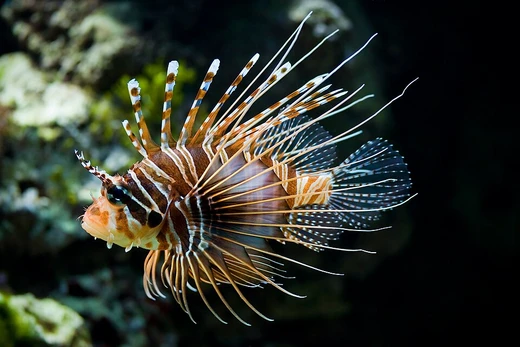
Neomerinthe
A genus of deep-water scorpionfishes found in Atlantic, Indian and Pacific Oceans.

Neomerinthe is a genus of marine ray-finned fish in the scorpionfish family, Scorpaenidae. These fish inhabit the Atlantic, Indian, and Pacific Oceans.
The genus was established in 1935 by American ichthyologist Henry Weed Fowler, who designated *Neomerinthe hemingwayi* as the type species. The name combines "neo," meaning new, with *Merinthe*, a synonym for the genus *Pontinus*, which Fowler thought the new species resembled.
The genus contains 12 species. They have an elongate, robust body and lack an occipital pit behind the eyes. A bony suborbital ridge under the eye is armed with three spines, and the uppermost spine on the preoperculum is longer than the others. Teeth are present on the sides of the roof of the mouth. The dorsal fin has 12 spines and 9–10 soft rays, with the rearmost ray split to its base. The wedge-shaped pectoral fin has 16–18 rays; the longest rays are in the center, and in adults, some upper rays are branched at the tips. The body scales are rough, and the lateral line extends to the base of the caudal fin. Sizes range from a standard length of 7.1 cm (2.8 in) in the curved-spine scorpionfish (*N. procurva*) to a total length of 59 cm (23 in) in Folger's scorpionfish (*N. folgeri*).
Neomerinthe scorpionfishes are found worldwide except in the eastern Pacific Ocean, and they live in deep water.
Quick Facts
- Taxon
- Neomerinthe
- Type Species
- Neomerinthe hemingwayi
- Type Species Authority
- Fowler, 1935
Facts from the source article.
Lore & Background
Neomerinthe was first described as a genus in 1935 by the American ichthyologist Henry Weed Fowler. Fowler was describing the species N. hemingwayi, with a type locality given as off Cape May, New Jersey, which he designated as the type species of the new genus. The genus name is a compound of 'neo', meaning new, and 'Merinthe', a synonym of the genus Pontinus, which Fowler thought N. hemingwayi resembled.
Neomerinthe scorpionfishes have an elongate and robust body. They do not have an occipital pit located on the rear of the eyes, but there is a bony suborbital ridge under the eye which is armed with three spines. The uppermost spine on the preoperculum is longer than the others. There are teeth on the sides of the roof of the mouth. The dorsal fin has 12 spines and 9-10 soft rays, the rearmost ray being split to its base. The pectoral fin is wedge-shaped with 16-18 rays, the longest rays being in the centre, and some of the upper rays are branched at their tips in adults. The scales on the body are rough, and the lateral line reaches the base of the caudal fin.
These scorpionfishes vary in size from a standard length of 7.1 cm in the curved-spine scorpionfish (N. procurva) to a total length of 59 cm in Folger's scorpionfish (N. folgeri). They are found throughout the world's oceans except for the Eastern Pacific Ocean, and they live in deep water.
Reader's Guide
The genus Neomerinthe holds significance as a distinct group within the scorpionfish family Scorpaenidae, first recognized by Henry Weed Fowler in 1935. Its naming reflects a taxonomic relationship to the genus Pontinus, with the prefix 'neo' indicating a new or revised grouping. The genus includes 12 species, such as the spiny-cheek scorpionfish (N. hemingwayi) and Folger's scorpionfish (N. folgeri), which represents the largest known member at 59 cm total length. The morphological characteristics described—such as the absence of an occipital pit, the presence of a three-spined suborbital ridge, and the specific fin ray counts—serve as key diagnostic features for identifying members of this genus. The distribution of Neomerinthe across the Atlantic, Indian, and Pacific Oceans, but notably absent from the Eastern Pacific, highlights a biogeographic pattern. Their deep-water habitat distinguishes them from many other scorpionfishes. The legacy of this genus lies in its contribution to the understanding of scorpionfish diversity and the taxonomic work of Fowler, who established the genus based on a specimen collected off Cape May, New Jersey.
Did You Know?
- The type species of Neomerinthe is N. hemingwayi, described by Henry Weed Fowler in 1935 from off Cape May, New Jersey.
- Neomerinthe scorpionfishes have a bony suborbital ridge under the eye armed with three spines.
- The largest species in the genus is Folger's scorpionfish (N. folgeri), reaching a total length of 59 cm.
Taxonomic Identity and Classification
Neomerinthe is a genus of marine fish situated within the family Scorpaenidae, commonly known as the scorpionfishes. Fowler formally described the genus in 1935, placing it under the subfamily Scorpaeninae, a group that encompasses both scorpionfishes and lionfishes. The parent family Scorpaenidae was first erected as a taxonomic unit by the French naturalist Antoine Risso in 1826. In contemporary classification the family is assigned to the suborder Scorpaenoidei within the order Perciformes, a shift from its earlier position under Scorpaeniformes. A sweeping 2018 revision further reorganised the family's internal architecture: several groups formerly treated as subfamilies, including Synanceiidae and Plectrogeniidae, were elevated to full family rank, while certain tribes such as Pteroinae were reclassified as subfamilies. Neomerinthe retains its position in Scorpaeninae alongside established genera like Scorpaena, Taenianotus, and Rhinopias. The family as a whole now accounts for 39 genera and no fewer than 388 species.
Morphology and Physical Design
As a member of Scorpaenidae, Neomerinthe shares the family's characteristic body plan. These fishes display a laterally compressed form, and the head is typically studded with ridges and spines. The operculum carries one or two spines, usually divergent, while the preoperculum bears three to five. The suborbital stay is normally firmly anchored to the preoperculum, though in some species the attachment is absent. Where scales occur, they are ctenoid in type. A single dorsal fin, frequently incised, holds between 11 and 17 spines alongside 8 to 17 soft rays. The anal fin typically presents three spines and five soft rays; the pelvic fin has one spine with five soft rays; and the large pectoral fin ranges from 11 to 25 soft rays, with some of the lower rays occasionally free of the fin membrane. The gill membranes are detached from the isthmus, and certain species within the family lack a swim bladder altogether.
Venom, Distribution, and Habitat
Scorpaenidae, the family to which Neomerinthe belongs, are predominantly marine fishes found across tropical and temperate seas, with the Indo-Pacific region representing their principal stronghold. While the Pacific and Indian Oceans harbour the bulk of species, some members also range into the Atlantic. Their preferred habitats include reef systems, though they are likewise encountered in estuaries, bays, and lagoons, and they tolerate both fully marine and brackish-water conditions. A defining feature of the family is its arsenal of venom: sharp spines coated with venomous mucus serve as a defensive sting, with venom glands located in the spines of the dorsal, anal, and pelvic fins in some species. This makes many scorpaenids among the world's most dangerous fish to handle. It is important to distinguish Scorpaenidae from the cabezones of the genus Scorpaenichthys, which belong to the related but separate family Cottidae.
Reproduction, Fossil Record, and Size Range
Reproductive strategies across Scorpaenidae are diverse, and Neomerinthe, as a member of this family, fits within that broader pattern. Most species rely on internal fertilisation. Some are ovoviviparous, while others deposit eggs in a gelatinous mass; the species Scorpaena guttata, for example, has been reported to produce a gelatinous egg balloon spanning up to 20 cm across. The evolutionary history of the family stretches deep into the Cenozoic: fossil otoliths of scorpaenids are known from the mid-Eocene, although body fossils do not appear until the Oligocene or Miocene. Size variation across the 39 genera and at least 388 species is remarkable. The largest member, the shortraker rockfish Sebastes borealis, reaches a total length of 108 cm, whereas many species in the family max out at merely 5 cm. Neomerinthe occupies a distinct niche within this vast and still-evolving taxonomic framework.
Frequently Asked Questions
What is Neomerinthe?
Neomerinthe is a genus of deep-water scorpionfish belonging to the family Scorpaenidae. The group is distributed across the Atlantic, Indian, and Pacific Oceans.
Who created the genus Neomerinthe and why is it named that way?
American ichthyologist Henry Weed Fowler established the genus in 1935. He combined the prefix 'neo' (meaning new) with Merinthe, a synonym for Pontinus, because he felt his new species resembled that older group.
How many species does Neomerinthe include?
The genus currently holds 12 species. All share an elongate, robust body plan and notably lack the occipital pit found behind the eyes in some related scorpionfishes.
What are the key physical features of Neomerinthe fish?
They bear 12 dorsal-fin spines paired with 9 to 10 soft dorsal rays, and a bony ridge beneath the eye that carries three small spines. The type species, N. hemingwayi, was collected off Cape May, New Jersey.
What is the type species of Neomerinthe and where was it found?
Neomerinthe hemingwayi serves as the type species, having been designated by Fowler at the genus's establishment in 1935. Its type locality is off Cape May, New Jersey.
More in Lionfish and Scorpionfish, Part 2 1-24
Spotted an error? Know more?
Reader corrections go straight into our review queue. Suggest an edit · How this site is sourced