Iracundus
The only known member of its genus, with a unique luring dorsal fin.

The decoy scorpionfish (*Iracundus signifer*) is a marine ray-finned fish in the scorpionfish family (Scorpaenidae). It lives in the western Indian and Pacific Oceans, sticking close to coral reefs at depths between 10 and 70 meters. This fish doesn’t migrate and grows to about 13 centimeters long. It’s the only species in its genus, *Iracundus*, and stands out for a hunting trick: it uses its dorsal fin to lure prey.
This fish was first described in 1903 by American ichthyologists David Starr Jordan and Barton Warren Evermann, based on a specimen from Oahu, Hawaii. The genus name *Iracundus* means “wrathful,” a nod to its red color. The species name *signifer* combines “signa” (mark) and “fera” (to bear), referring to a black spot on the spiny part of the dorsal fin.
In the Indian Ocean, you’ll find it off South Africa, Mauritius, and Réunion. In the Pacific, it shows up around Hawaii, the Ryukyu Islands, and Taiwan. Like other scorpionfish, it’s a bottom-dweller, staying near the seafloor and coral for shelter and camouflage. It prefers cavernous, rubble-filled spots under the edges of reefs.
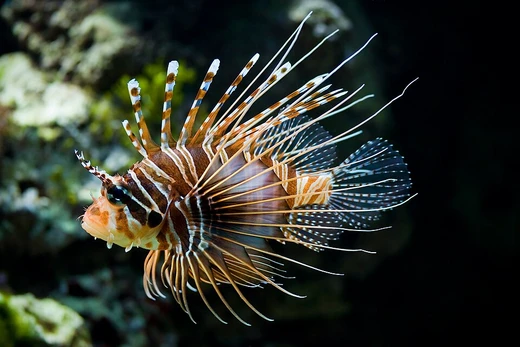
The decoy scorpionfish is small and spiny, with a reddish-orange to white body that blends into Indo-Pacific coral reefs. It has a stocky, football-shaped body reaching 13 centimeters total length. Venomous spines cover its body—around the eyes, along a fleshy head membrane, and between the back scales, especially in lateral stripes. Its dorsal fins are broad and fan-like, with deep notches between spines. Like many scorpionfish, it can change color: duller for camouflage, brighter to startle predators.
Its most unusual feature is the dorsal fin’s pattern. The fourth spine is nearly twice as long as the others, and a black mark sits between the first and third spines. Together, these make the fin look like a tiny fish. No other scorpionfish uses this trick.
During luring, the fish moves its dorsal fin to act like a small fish. The first spine traces a figure-eight, making the rest of the fin wave and sway side to side. The gap between the first and second spines opens and closes, mimicking a fish’s mouth. At the same time, the fin’s deep red color intensifies, while the body fades to duller tones for camouflage.
Quick Facts
- Taxon
- Iracundus signifer
Facts from the source article.
Lore & Background
The decoy scorpionfish was first formally described in 1903 by American ichthyologists David Starr Jordan and Barton Warren Evermann, with the type locality given as Oahu in Hawaii. The genus name Iracundus means 'wrathful,' an allusion to the red color of this species, while the specific name signifer is a compound of signa meaning 'mark' and fera meaning 'to bear,' referencing the black spot on the spiny part of the dorsal fin.
This species is native to tropical coral reefs of the Indian and Pacific oceans, observed along the coast of South Africa, Mauritius, Reunion, the Hawaiian islands, the Ryukyu islands, and Taiwan. It is a benthic, non-migratory organism that remains in close association with coral reefs at depths from 10 to 70 metres, preferring cavernous, rubble-laden inlets underneath the edges of coral reefs.
The decoy scorpionfish has a stocky, football-like body covered in small to medium-sized venomous spines, a characteristic trait of all scorpionfish. Its reddish-orange to white coloring provides camouflage, and it can actively change color in response to its environment. The most unique aspect is the dorsal fin: the fourth dorsal spine is nearly twice the length of the others, and a distinct black mark appears between the first and third dorsal spines, giving the fin the appearance of a smaller fish.
Reader's Guide
The decoy scorpionfish is significant as the sole member of the genus Iracundus, distinguished by a unique prey-luring mechanism not seen in any other members of the Scorpaenidae family. Its dorsal fin strongly resembles a small fish, with the elongated fourth spine representing the lure fish's dorsal fin and the black dot between spines 1-3 representing the eye. The fish moves this fin in a coordinated manner: the first dorsal spine moves in a figure-eight pattern, causing the rest of the fin to wave and move laterally, mimicking a small fish gyrating in the water. The subtle movement between the first and second dorsal spines mimics the opening and closing of a fish's mouth. During luring, the normally deep red dorsal fin becomes more intense in color, while the body becomes duller for camouflage. This behavior has been noted on multiple accounts and represents a key evolutionary adaptation within scorpionfishes. The species' venomous spines, typical of the family, can be lethal to humans, adding to its notability as a dangerous yet fascinating reef inhabitant.
Did You Know?
- The decoy scorpionfish is the only known member of its genus Iracundus.
- The black spot on the dorsal fin between spines 1-3 represents the eye of the lure fish.
- This species can actively change color, becoming more intense on the fin and duller on the body during luring.
Taxonomic Identity and Systematic Placement
Iracundus is a genus of marine fish formally established by Jordan and Evermann in 1903, and it occupies a position within the subfamily Scorpaeninae, a group that encompasses both scorpionfishes and lionfishes. This subfamily sits inside the broader family Scorpaenidae, which was first recognized as a distinct family by the French naturalist Antoine Risso back in 1826. Taxonomic placement of the family itself has shifted over time: earlier editions of Fishes of the World assigned it to the suborder Scorpaenoidei within the order Scorpaeniformes, while more recent authorities have reclassified it under the order Perciformes, still within Scorpaenoidei. A sweeping 2018 revision further reshuffled the family's internal structure, elevating several former subfamilies—such as Synanceiidae and Plectrogeniidae—to full family rank, while promoting certain tribes like Pteroinae to subfamily status. Iracundus remains firmly within Scorpaeninae, one of the original subfamilies outlined by Risso, and is one of thirty-nine genera that together account for at least 388 described species across the family.
Morphological Architecture
As a member of Scorpaeninae, Iracundus shares the characteristic body plan of its family: a laterally compressed form crowned by a head bearing prominent ridges and spines. The opercular region typically carries one or two spines, often divergent, while the preoperculum hosts three to five, with five being the norm. The suborbital stay is usually firmly anchored to the preoperculum, though in certain species it may be detached. Where scales are present, they are of the ctenoid type. A single dorsal fin runs along the back, frequently with an incised profile, and contains between eleven and seventeen spines alongside eight to seventeen soft rays. The anal fin generally presents one to three spines—three being typical—with three to nine soft rays, most often five. The pelvic fin bears a single spine and two to five soft rays, again typically five. The large pectoral fin spans eleven to twenty-five soft rays, and in some cases the lower rays extend free beyond the fin membrane. Gill membranes do not fuse to the isthmus, and certain species entirely lack a swim bladder.
Venom, Reproduction, and Size Range
One of the most consequential traits shared across Scorpaenidae—and by extension relevant to Iracundus—is the presence of venom glands associated with the spines of the dorsal, anal, and pelvic fins in numerous species. Venomous mucus coats these sharp spines, giving the family its reputation as home to many of the world's most dangerous marine fishes. In terms of reproductive strategy, most scorpaenid species rely on internal fertilization. Some are ovoviviparous, carrying developing young internally, while others deposit their eggs in a gelatinous mass; the species Scorpaena guttata, for instance, has been reported to produce a gelatinous egg balloon measuring as much as twenty centimeters across. Size variation within the family is enormous: while many species top out at just five centimeters in total length, the shortraker rockfish (Sebastes borealis) reaches a maximum of one hundred and eight centimeters. Fossil evidence for scorpaenids stretches back to the mid-Eocene in the form of otoliths, though complete body fossils do not appear until the Oligocene or Miocene epochs.
Geographic Range and Ecological Setting
Scorpaenidae as a family is predominantly a Pacific and Indian Ocean assemblage, with a handful of species extending into the Atlantic. Their preferred environments span marine and brackish waters, and while they are most commonly associated with coral reefs, they also occupy estuaries, bays, and lagoons. The Indo-Pacific region hosts the greatest concentration of diversity. It is important to distinguish true scorpaenids from the cabezones of the genus Scorpaenichthys, which belong to the separate but related family Cottidae. The family's ecological footprint has occasionally crossed natural boundaries: lionfishes in the genus Pterois, a close relative within Scorpaeninae, have become invasive non-native species in the Caribbean and the eastern Mediterranean Sea, disrupting local reef ecosystems. Iracundus, as part of this subfamily, inhabits the same broad tropical and temperate marine landscapes. The family's overall diversity—thirty-nine genera and no fewer than 388 species—reflects the extensive adaptive radiation that has allowed scorpaenids to fill a wide array of reef and open-water niches across the world's oceans.
Frequently Asked Questions
What is the decoy scorpionfish (Iracundus signifer)?
It's a small, reef-associated scorpionfish native to the western Indian and Pacific Oceans, belonging to the family Scorpaenidae. It holds the distinction of being the sole species in its genus, Iracundus.
How does the decoy scorpionfish hunt its prey?
Rather than relying on pure ambush like many of its scorpionfish relatives, it actively waves its dorsal fin to draw curious small fish and invertebrates within striking range. This deliberate luring trick is what gives the species its common name.
Where and at what depth can you find the decoy scorpionfish?
It hangs around coral reefs in the western Indian and Pacific Oceans, typically between roughly 10 and 70 metres below the surface. It's a sedentary fish that stays put rather than undertaking long migrations.
Who first described the decoy scorpionfish and when?
American ichthyologists David Starr Jordan and Barton Warren Evermann gave it its formal scientific name in 1903. Their description was based on a specimen collected off the coast of Oahu, Hawaii.
How big does the decoy scorpionfish get?
It's a modestly sized fish, reaching a maximum of about 13 centimetres (roughly 5 inches) in total length. Despite its small stature, it remains the only known member of the genus Iracundus.
More in Lionfish and Scorpionfish, Part 2 1-24
Spotted an error? Know more?
Reader corrections go straight into our review queue. Suggest an edit · How this site is sourced