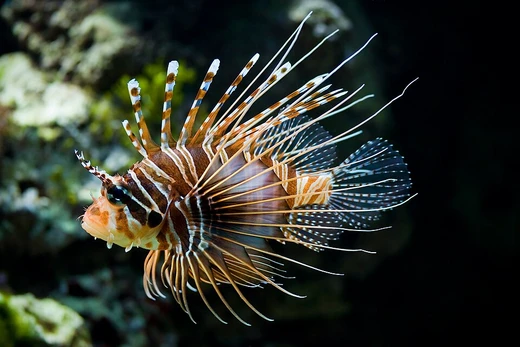
Pterois sphex
Venomous Hawaiian lionfish endemic to seaward reefs and lagoons.

Pterois sphex, also called the Hawaiian turkeyfish or Hawaiian lionfish, is a ray-finned fish with venomous spines, part of the scorpionfish and lionfish family Scorpaenidae. It lives only in the eastern Central Pacific, in marine waters around Hawaii, where it inhabits seaward reefs and lagoons at depths ranging from 3 to 122 meters.
American ichthyologists David Starr Jordan and Barton Warren Evermann first formally described this species in 1903, using a specimen from Honolulu on Oahu, Hawaii. In 2023, scientists reclassified it into the revalidated genus Pteropterus. Its specific name, sphex, comes from the Greek word for "wasp," likely referring to the sting from its venomous spines.
This fish has 13 spines and 11 or 12 soft rays in its dorsal fin, while its anal fin contains 3 spines and 6 to 8 soft rays. The pectoral fins have 6 to 8 very long, unbranched rays that extend past the fin membrane. Some dorsal fin spines are as long as the body is deep. It has coronal spines, and most head spines multiply as the fish grows; larger individuals also develop a dense covering of spines on the lachrymal and suborbital bones. Its overall color is brownish pink and white, with irregular bright white and brown vertical bars on the sides. Young fish have supraorbital tentacles banded with black, but these disappear in older fish. The maximum total length is 22 centimeters.
During the day, Pterois sphex hides under ledges and in caves, emerging at night to feed on smaller fishes and crustaceans. It uses its fins to shift sand or mud on the seabed, uncovering any daytime prey resting there. These fish are solitary except for mating, though they have been observed hunting cooperatively. Despite being solitary, they do not appear to defend a home range from other Hawaiian lionfish.
Quick Facts
- Taxon
- Pteropterus sphex
Facts from the source article.
Lore & Background
Pterois sphex was first formally described in 1903 by American ichthyologists David Starr Jordan and Barton Warren Evermann, with the type locality given as Honolulu on Oahu, Hawaii. In 2023, it was reclassified as a species of the revalidated genus Pteropterus. The specific name sphex is Greek for 'wasp,' thought to be an allusion to the sting delivered by its venomous spines.
This species has 13 spines and 11 or 12 soft rays in its dorsal fin, while the anal fin has 3 spines and between 6 and 8 soft rays. The pectoral fins have 6 to 8 very long, unbranched fin rays that extend beyond the membrane. The dorsal fin spines are very long, some as long as the body is deep. It has coronal spines, and most head spines multiply as the fish grows; in larger individuals, the lachrymal and suborbital bones have a dense covering of spines. The overall color is brownish pink and white with irregular bright white and brown vertical barring on the flanks. Young fish have supraorbital tentacles banded with black, but these disappear in older fish.
Pterois sphex spends the day hiding underneath ledges and in caves, emerging at night to feed on smaller fishes and crustaceans. It uses its fins to shift sand or mud on the seabed to reveal diurnal prey resting in the substrate. It is a solitary fish that only gathers for mating, although it has been known to hunt cooperatively. Despite being solitary, it is not thought to defend a home range from other Hawaiian lionfishes.
Reader's Guide
Pterois sphex is significant as an endemic Hawaiian species within the family Scorpaenidae, distinguished by its venomous spines and reclassification to the genus Pteropterus in 2023. Its specific name sphex, meaning 'wasp' in Greek, highlights the defensive sting that characterizes this group. The species inhabits seaward reefs and lagoons at depths from 3 to 122 meters, where it exhibits nocturnal hunting behavior, using its fins to disturb substrate and reveal prey. Its solitary nature, with only occasional cooperative hunting and mating gatherings, contrasts with the lack of territorial defense against conspecifics. The physical description—including long dorsal spines, multiple head spines in adults, and a brownish-pink and white barred coloration—provides key identification features. The loss of black-banded supraorbital tentacles in older fish marks an ontogenetic change. With a maximum total length of 22 cm, it represents a moderate-sized lionfish. The legacy of this species lies in its taxonomic history, from its original description by Jordan and Evermann in 1903 to its modern reclassification, and in its ecological role as a venomous predator in Hawaiian waters.
Did You Know?
- The specific name sphex is Greek for 'wasp,' alluding to the sting of its venomous spines.
- It was reclassified from the genus Pterois to Pteropterus in 2023.
- Young fish have supraorbital tentacles banded with black, which disappear in older fish.
Frequently Asked Questions
Who is Pterois sphex?
Pterois sphex is a small venomous ray-finned fish in the scorpionfish family Scorpaenidae, popularly called the Hawaiian turkeyfish or Hawaiian lionfish. It grows to roughly 22 cm in total length and bears 13 dorsal fin spines.
What are Pterois sphex's powers or ecological role?
Its most notable trait is a set of venomous dorsal spines that deliver a painful sting to deter predators or careless handlers. On the reef it functions as a mid-level predator, hunting small invertebrates and fish among seaward reef structures and lagoon habitats.
Why is Pterois sphex important to fans and scientists?
Because it is endemic to the eastern Central Pacific around Hawaii, no other population exists anywhere else on the planet. That makes it a focal point for reef-ecology studies and a symbol of the unique biodiversity found in Hawaiian marine environments.
Where does Pterois sphex live and how deep can it be found?
It is restricted to marine waters around the Hawaiian Islands, occupying seaward reefs and lagoons from roughly 3 meters down to 122 meters. The original type specimen that anchored its 1903 description by Jordan and Evermann was collected in Honolulu on Oahu.
More in Lionfish and Scorpionfish, Part 2 1-24
Spotted an error? Know more?
Reader corrections go straight into our review queue. Suggest an edit · How this site is sourced