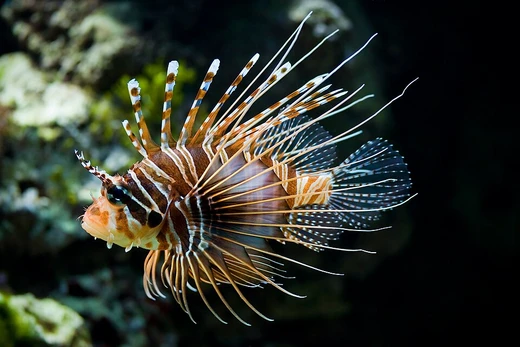
Decoy scorpionfish
A scorpionfish that lures prey with a fish-like dorsal fin.

The decoy scorpionfish (Iracundus signifer) is a species of marine ray-finned fish belonging to the family Scorpaenidae, the scorpionfishes. It is native to the Western Indian and Pacific oceans, where it is a non-migratory species observed in close association with coral reefs at depths of from 10 to 70 metres. This species grows to a length of 13 centimeters total length and is the only known member of its genus. It is notable for its unique prey-luring behavior, which involves a specialized dorsal fin that mimics a small fish.
Quick Facts
- Taxon
- Iracundus signifer
Facts from the source article.
Lore & Background
The decoy scorpionfish was first formally described in 1903 by American ichthyologists David Starr Jordan and Barton Warren Evermann, with the type locality given as Oahu in Hawaii. It is the sole member of the genus Iracundus, a name meaning 'wrathful' in allusion to its red color. The specific name signifer is a compound of signa meaning 'mark' and fera meaning 'to bear', referring to the black spot on the spiny part of the dorsal fin. This species is a benthic organism, remaining close to the seafloor and coral reef for shelter and camouflage, preferring cavernous, rubble-laden inlets underneath the edges of coral reefs.
Morphologically, the decoy scorpionfish has a stocky, football-like body covered in small to medium-sized venomous spines, a characteristic trait of all scorpionfish. Its reddish-orange to white coloring provides camouflage along Indo-Pacific coral reefs, and it can actively change color in response to its environment. The most unique aspect is the dorsal fin: the fourth dorsal spine is nearly twice the length of the others, and a distinct black mark appears between the first and third dorsal spines, giving the fin the appearance of an even smaller fish. This feature is used in a coordinated luring mechanism not seen in any other members of the Scorpaenidae family.
The luring behavior involves moving the dorsal fin so that it behaves like a small fish. By moving the first dorsal spine in a figure-eight pattern, the rest of the fin follows in a wave-like motion while also moving laterally. The subtle movement between the first and second dorsal spines mimics the opening and closing of a fish's mouth. During luring, the normally deep red dorsal fin becomes more intense in color, while the body becomes more dull as camouflage.
Reader's Guide
The decoy scorpionfish is significant as the only known member of its genus, Iracundus, and for its unique prey-luring behavior, which is not seen in any other members of the family Scorpaenidae. This behavior involves a specialized dorsal fin that mimics a small fish in both appearance and movement, including a figure-eight motion and a simulated mouth opening. The species is also notable for its venomous spines, which can be lethal to humans, a trait common to scorpionfishes. Its distribution spans the Western Indian and Pacific oceans, from South Africa to Hawaii, and it is a benthic, non-migratory species associated with coral reefs at depths of 10 to 70 metres. The decoy scorpionfish was first described in 1903 by Jordan and Evermann, and its type locality is Oahu, Hawaii. Its ability to change color for camouflage and luring further underscores its specialized predatory adaptations. The species grows to a maximum length of 13 centimeters and is distinguished by the elongated fourth dorsal spine and black spot on the dorsal fin, which together create the decoy.
Did You Know?
- Its fourth dorsal spine is nearly twice the length of the others, helping form a fish-like decoy.
- The species can change color, becoming more intense on the dorsal fin and duller on the body during luring.
- Its venomous spines can be lethal to humans.
Frequently Asked Questions
What is the decoy scorpionfish?
The decoy scorpionfish (Iracundus signifer) is a small marine ray-finned fish placed in the scorpionfish family, Scorpaenidae. It was formally named in 1903 by David Starr Jordan and Barton Warren Evermann, with Oahu, Hawaii serving as its type locality.
What makes the decoy scorpionfish's hunting method special?
This species has evolved a remarkable trick: its dorsal fin has developed a structure that looks like a tiny fish, which it uses to bait in unsuspecting prey. This mimicry behavior is what gives the species its common name and sets it apart from other scorpionfishes.
Where can you find the decoy scorpionfish in the wild?
It inhabits coral reef environments across the Western Indian and Pacific Oceans, typically at depths between 10 and 70 metres. As a non-migratory species, it stays in one general area rather than traveling long distances.
How large does the decoy scorpionfish grow?
It reaches a maximum total length of about 13 centimeters (roughly 5 inches), making it a relatively small member of the scorpionfish family.
Why is the decoy scorpionfish considered unique in its genus?
Iracundus signifer is the sole described species within the genus Iracundus, meaning no other fish shares that particular genus-level classification. Its one-of-a-kind luring adaptation further cements its status as a singular entry in the marine fish record.
More in Lionfish and Scorpionfish, Part 2 1-24
Spotted an error? Know more?
Reader corrections go straight into our review queue. Suggest an edit · How this site is sourced