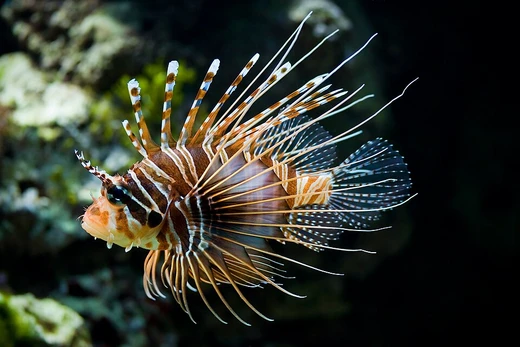
Hipposcorpaena
Monotypic genus of small scorpionfish with filamented pectoral fins.

Hipposcorpaena is a monotypic genus of marine ray-finned fish in the family Scorpaenidae, containing only the filamentous scorpionfish (Hipposcorpaena filamentosus). It is notable for being the sole species in its genus, distinguished by its small size and filament-like structures on the pectoral fin.
Quick Facts
- Taxon
- Hipposcorpaena filamentosus
Facts from the source article.
Lore & Background
The genus Hipposcorpaena was first described in 1938 by American zoologist Henry Weed Fowler, with the type locality off Linao Point in Davao Gulf, Philippines. The genus name combines 'hippo' (horse) with Scorpaena, alluding to the sloping profile of the head resembling a horse. The specific name filamentosus means 'filamented', referring to the thin flaps on the head and body.
The filamentous scorpionfish has a strongly compressed body and a large head with a concave upper edge to its snout. Its body depth fits into standard length 2.5 to 2.8 times. The dorsal fin has 11-12 spines and 9-10 soft rays, while the anal fin has 2 spines and 6 soft rays. The pectoral fin has 14 rays, with deep incisions in the membranes between the lower 7 rays, creating filament-like structures. Skin flaps occur on the snout, chin, lower cheek, margin of the preoperculum, and above the eye. The overall colour is reddish with a whitish snout, two wide pale bands on the body, and a white band on the posterior spiny part of the dorsal fin.
This species is demersal, found at depths between 10 and 95 m on silty inshore reefs in the Indo-West Pacific. It has been recorded from Bali, Sulawesi, the Timor Sea, Philippines, Papua New Guinea, and Japan; in Australian waters only from Ashmore Reef in the Timor Sea.
Reader's Guide
The genus Hipposcorpaena holds significance as a monotypic taxon within the scorpionfish family, representing a unique evolutionary lineage. Its sole species, the filamentous scorpionfish, was described by Henry Weed Fowler in 1938, adding to the known diversity of Indo-West Pacific marine fishes. The genus name's horse allusion and the species name's reference to filamentous structures highlight morphological traits that distinguish it from related genera. The species' small maximum size of 3.5 cm standard length and its distinctive pectoral fin filaments contribute to its ecological niche on silty inshore reefs. Its distribution across a broad Indo-West Pacific range, including records from the Philippines, Indonesia, Papua New Guinea, Japan, and Australia's Ashmore Reef, underscores its adaptability to varied reef environments. The detailed description of fin ray counts, body proportions, and colouration provides a foundation for taxonomic identification and future research on scorpionfish diversity. As the only member of its genus, Hipposcorpaena represents a distinct branch in the evolutionary tree of Scorpaenidae, warranting continued study of its biology and conservation status.
Did You Know?
- Hipposcorpaena is a monotypic genus containing only the filamentous scorpionfish.
- The genus name combines 'hippo' (horse) with Scorpaena, referring to the horse-like sloping head profile.
- The filamentous scorpionfish has deep incisions in the membranes between the lower 7 pectoral fin rays, creating filament-like structures.
- This species has a maximum standard length of only 3.5 cm (1.4 in).
Taxonomic Identity and Classification
Hipposcorpaena is a genus of scorpionfish formally established by Fowler in 1938, placing it within the subfamily Scorpaeninae alongside other scorpionfishes and lionfishes. Its broader family, Scorpaenidae, was first recognized as a distinct taxonomic group by the French naturalist Antoine Risso in 1826. Over the decades, the family's higher-level placement has shifted: earlier editions of Fishes of the World assigned it to the order Scorpaeniformes, while more recent authorities have reclassified it under the order Perciformes, though it remains in the suborder Scorpaenoidei in both schemes. A sweeping 2018 revision further reshaped the family's boundaries, elevating former subfamilies such as Synanceiidae and Plectrogeniidae to full family status and promoting tribes like Pteroinae to subfamily rank. Within this constantly refined framework, Hipposcorpaena sits among 39 recognized genera and at least 388 species. It is important to distinguish these true scorpionfishes from the cabezones of the genus Scorpaenichthys, which belong to the separate but related family Cottidae.
Morphology and Venomous Defense
Members of the Scorpaeninae subfamily, including Hipposcorpaena, share a suite of distinctive physical traits that set them apart from many other marine fishes. Their bodies are laterally compressed, and the head is typically armored with prominent ridges and spines. When scales are present, they are of the ctenoid type. A single dorsal fin runs along the back, frequently showing an incised or notched profile, and it carries between eleven and seventeen spines alongside eight to seventeen soft rays. The anal fin usually bears three spines and five soft rays, while the pelvic fin has a single spine with two to five soft rays. The large pectoral fin contains eleven to twenty-five soft rays, and in some species a few of the lower rays break free from the fin membrane. Perhaps most notably, venom glands are associated with the spines of the dorsal, anal, and pelvic fins in certain species, making the characteristic sting a serious hazard to humans and other animals. Gill membranes are not fused to the isthmus, and some species entirely lack a swim bladder.
Geographic Range and Habitat Preferences
The Scorpaenidae family, of which Hipposcorpaena is a member, is predominantly a marine group whose range centers on the Pacific and Indian Oceans, with a smaller number of species extending into the Atlantic. Their preferred environments span tropical and temperate waters, with the Indo-Pacific region hosting the greatest concentration of diversity. While most species are strictly marine, the family as a whole also occupies brackish-water settings. Typical habitats include coral reefs, but members of the family are equally at home in estuaries, sheltered bays, and coastal lagoons. This broad ecological tolerance allows the family to occupy a wide range of niches across coastal and open-water environments. It is worth noting that some scorpionfish relatives, particularly the lionfishes of the genus Pterois, have become invasive non-native species in regions such as the Caribbean and the eastern Mediterranean Sea, where they disrupt local ecosystems. Hipposcorpaena, as part of the core Scorpaeninae subfamily, shares the general marine and reef-associated lifestyle that characterizes the family, reflecting the broader biogeographic pattern of scorpionfishes across the Indo-Pacific.
Evolutionary History and Reproductive Strategies
The evolutionary record of scorpionfishes stretches back remarkably far. Fossil otoliths, tiny ear bones preserved in sediment, have been identified as scorpaenid as early as the mid-Eocene epoch, though complete body fossils do not appear until the Oligocene or Miocene. This suggests that the lineage, including the ancestors of Hipposcorpaena, has been present in Earth's oceans for tens of millions of years. In terms of reproduction, most scorpaenids use internal fertilization. Some species are ovoviviparous, meaning the young develop internally and are born alive, while others deposit their eggs in a gelatinous mass. The species Scorpaena guttata, a close relative within the same subfamily, has been reported to produce a gelatinous egg balloon measuring up to twenty centimeters across. Size variation within the family is striking: the largest member, the shortraker rockfish Sebastes borealis, reaches a total length of 108 centimeters, whereas many species top out at just five centimeters. Hipposcorpaena occupies the middle ground of this remarkable spectrum, representing one of 39 genera that together encompass at least 388 species.
Frequently Asked Questions
What is Hipposcorpaena?
Hipposcorpaena is a monotypic genus of marine ray-finned fish belonging to the Scorpaenidae family, and it contains exactly one species: the filamentous scorpionfish (Hipposcorpaena filamentosus). Because no other species share the genus, it stands as a one-of-a-kind taxonomic group.
Who described Hipposcorpaena and when?
The genus was formally erected by ichthyologist Henry Weed Fowler in 1938. He designated Hipposcorpaena filamentosus as the type species, which remains the sole representative to this day.
How large does the filamentous scorpionfish grow?
It is a remarkably small fish, topping out at a maximum standard length of about 3.5 centimeters (roughly 1.4 inches). That tiny stature is one of the traits that sets it apart from many of its larger scorpionfish cousins.
At what depths can you find Hipposcorpaena filamentosus?
The species ranges from about 10 meters down to 95 meters (approximately 33 to 312 feet) below the surface. That span covers relatively shallow coastal waters all the way into the upper mesopelagic zone.
What makes Hipposcorpaena unique among scorpionfish?
Its most eye-catching feature is the set of filament-like projections extending from the pectoral fins, which earn it the common name 'filamentous scorpionfish.' It also bears 11 to 12 dorsal spines paired with 9 to 10 soft dorsal rays, and it is the only species ever placed in its genus.
More in Lionfish and Scorpionfish, Part 2 1-24
Spotted an error? Know more?
Reader corrections go straight into our review queue. Suggest an edit · How this site is sourced