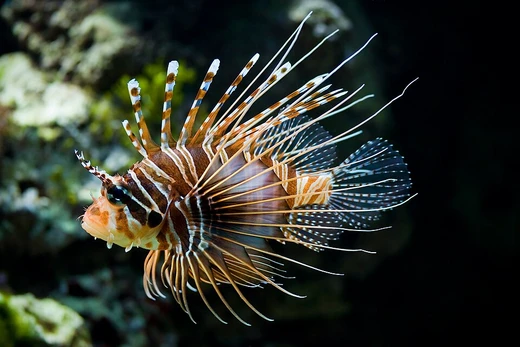
Pterois russelii
Venomous Indo-Pacific lionfish with short dorsal spines and spotless fins.

Pterois russelii, known commonly as the largetail turkeyfish, plaintail firefish, Russell's lionfish, or spotless firefish, is a species of ray-finned fish with venomous spines belonging to the family Scorpaenidae. It is native to the Indo-Pacific Ocean from the eastern part of Africa to the Persian Gulf, and is notable for its lack of dark spots on the soft dorsal, anal, and caudal fins, distinguishing it from related species.
Quick Facts
- Taxon
- Pterois russelii
Facts from the source article.
Lore & Background
Pterois russelii was first formally described in 1831 by the English naturalist Edward Turner Bennett, with the type locality given as the Coromandel Coast in India. The specific name honors the Scottish surgeon and herpetologist Patrick Russell, who had illustrated and described the species without naming it in 1803; Bennett misspelled Russell's name by leaving out the final 'l'. Molecular studies and some morphological data have indicated that this species and the luna lionfish (P. lunulata) are the same species, P. russelii.
This species has a wide Indo-Pacific distribution from the coast of eastern Africa as far south as South Africa, then east from Oman to Japan and Australia. It was recorded in the Red Sea only in 2016. In Australian waters, it is found from the Exmouth Gulf in Western Australia around the northern tropical coasts to the Great Barrier Reef in Queensland. It occurs at depths of 15 to 60 m in areas of muddy substrate in sheltered shallow estuaries, bays, and coastal waters down to deeper waters in quiet offshore reefs.
Pterois russelii has 13 spines and between 10 and 12 soft rays in its dorsal fin, and 3 spines and 7 or 8 soft rays in its anal fin. It has a whitish body striped vertically with reddish brown, and no rows of small dark spots on the soft dorsal, anal, and caudal fins, which are a feature of related species. It has comparatively short dorsal-fin spines. The maximum published standard length is 30 cm.
Reader's Guide
Pterois russelii holds significance as a venomous member of the Scorpaenidae family, distinguished by its lack of dark spots on the soft dorsal, anal, and caudal fins—a key trait separating it from similar lionfish species. Its taxonomic history includes a naming honor to Patrick Russell, though with a misspelling, and ongoing debate with molecular and morphological evidence suggesting it may be the same species as the luna lionfish (P. lunulata). Ecologically, it is a solitary predator feeding on smaller fishes, crabs, and shrimp, inhabiting muddy substrates from shallow estuaries to deeper offshore reefs across a broad Indo-Pacific range. Despite its venomous spines, it is infrequently found in the aquarium trade, limiting its direct human interaction. Its confirmed presence in the Red Sea as recently as 2016 highlights ongoing discoveries about its distribution. The species' relatively short dorsal-fin spines and maximum length of 30 cm contribute to its identification in the field.
Did You Know?
- The specific name honors Patrick Russell, but Bennett misspelled it by leaving out the final 'l'.
- It was only confirmed in the Red Sea in 2016.
Taxonomy and the Story Behind the Name
The largetail turkeyfish carries a taxonomic history that stretches back over two centuries. In 1803, the Scottish surgeon and herpetologist Patrick Russell produced an illustration and description of this fish, though he never assigned it a formal species name. It was not until 1831 that the English naturalist Edward Turner Bennett gave the creature its scientific designation, Pterois russelii, with the Coromandel Coast of India recorded as the type locality. Bennett intended the specific epithet as a tribute to Russell, yet he inadvertently dropped the final letter from the surname — a misspelling that was then perpetuated by Cuvier and Valenciennes in their own consistent usage. The species sits within the family Scorpaenidae, the broader group encompassing scorpionfishes and lionfishes. More recently, molecular analyses combined with certain morphological measurements have led researchers to conclude that P. russelii and the so-called luna lionfish, P. lunulata, are in fact one and the same species, collapsing what had been treated as two distinct taxa into a single entity.
Range and Preferred Habitats
Russell's lionfish occupies an impressively broad swath of the Indo-Pacific Ocean. Its range stretches along the eastern African coastline southward to the waters off South Africa, then sweeps eastward from the Persian Gulf region through Oman and onward to the coasts of Japan and Australia. A record from the Red Sea was not formally confirmed until 2016, underscoring how slowly some distributional knowledge accumulates. Within Australian waters, the species is documented from the Exmouth Gulf in the far north of Western Australia, following the tropical northern coastline all the way to the Great Barrier Reef off Queensland. In terms of vertical habitat, this fish inhabits depths between roughly 15 and 60 metres. It favours muddy substrates in sheltered environments — shallow estuaries, protected bays, and calm coastal zones — as well as quieter offshore reef areas at greater depths. This preference for sheltered, sediment-rich settings distinguishes its microhabitat from the more open, rocky environments favoured by some congeners.
Appearance and Distinguishing Features
Among the many lionfishes and scorpionfishes, Pterois russelii can be recognised by a combination of fin architecture and colouration. The dorsal fin bears thirteen spines followed by ten to twelve soft rays, while the anal fin carries three spines and seven or eight soft rays. The body is predominantly whitish, crossed by vertical bands of reddish brown. Two features set it apart from closely related species: it lacks the rows of small dark spots that decorate the soft dorsal, anal, and caudal fins of its congeners, and its dorsal-fin spines are comparatively short. These traits have earned it several common names that capture different aspects of its look — spotless butterfly-cod, spotless firefish, plaintail turkeyfish, and largetail turkeyfish, among others. The maximum published standard length for this species is thirty centimetres, or about twelve inches, placing it in the medium range for its family. Despite its modest size, the fish possesses venom-bearing spines that make handling it a genuine hazard for divers and fishers alike.
Solitary Life and Human Encounters
Russell's lionfish is fundamentally a solitary creature, spending its life largely alone rather than in groups. Its diet consists of smaller fishes, crabs, and shrimp, which it captures in the sheltered waters it inhabits. The venomous spines that characterize this species make it a genuine hazard to handle, a fact immediately apparent to any diver or fisher who encounters one in the wild. In terms of human interaction beyond the ocean, this species is only infrequently encountered in the aquarium trade — a notable contrast to some of its more visually striking relatives that are regularly sought by hobbyists. The limited availability may reflect its preference for muddy, sheltered habitats in estuaries and quiet offshore reefs, environments less frequently visited by collectors than open reef systems. Whatever the underlying reason, most people will never encounter a Pterois russelii outside of a research expedition or a deep dive in the calm, sediment-rich waters where it makes its home across the Indo-Pacific.
Frequently Asked Questions
What is Pterois russelii?
Pterois russelii is a venomous ray-finned fish in the Scorpaenidae family, widely known as the largetail turkeyfish, plaintail firefish, or Russell's lionfish. It belongs to the Indo-Pacific lionfish group and is instantly recognizable by its spiny, venomous dorsal fin.
How do you tell Pterois russelii apart from similar lionfish?
The standout feature is its spotless soft fins — the dorsal, anal, and caudal fins carry no dark spots, unlike its close relatives. That clean, unmarked trailing-fin look is exactly what earns it the common names 'plaintail' and 'spotless firefish.'
What are Pterois russelii's spines like, and are they dangerous?
It bears 13 sharp dorsal spines backed by 10 to 12 soft dorsal rays, plus 3 anal spines. The dorsal spines are notably shorter than those on some other lionfish, but they still deliver a painful venomous sting if the fish is grabbed carelessly.
Where does Pterois russelii live in the wild?
Its native range stretches across the Indo-Pacific, from the eastern coast of Africa through to the Persian Gulf. You'll typically encounter it in warm, shallow marine habitats throughout that broad stretch of ocean.
Who first described Pterois russelii and when?
The species was formally named in 1831 by Edward Turner Bennett, based on specimens collected along the Coromandel Coast of India. That Indian type locality still serves as the species' reference point today.
More in Lionfish and Scorpionfish, Part 2 1-24
Spotted an error? Know more?
Reader corrections go straight into our review queue. Suggest an edit · How this site is sourced