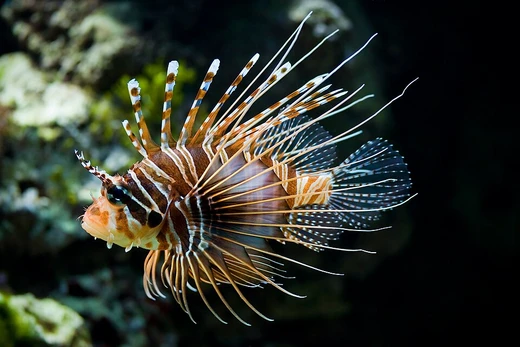
Filamentous scorpionfish
A small, filament-finned scorpionfish, sole member of genus Hipposcorpaena.

The filamentous scorpionfish (Hipposcorpaena filamentosus) is a small marine fish in the scorpionfish family, Scorpaenidae. It is the sole member of its genus, Hipposcorpaena, and lives in the Indo-West Pacific. Its body is strongly compressed, with a large head and a snout that slopes concavely. The body depth is about 2.5 to 2.8 times its standard length. The dorsal fin has 11 to 12 spines and 9 to 10 soft rays, while the anal fin has 2 spines and 6 soft rays. The pectoral fin has 14 rays, and deep notches in the membranes between the lower 7 rays create filament-like extensions, each notch reaching one-third to one-half the ray’s length. Skin flaps appear on the snout, chin, lower cheek, preoperculum edge, and above the eye. Overall, the fish is reddish, with a whitish snout, two wide pale bands on the body, and a white band on the rear of the spiny dorsal fin. It reaches a maximum standard length of 3.5 cm (1.4 in). This species was first described in 1938 by American zoologist Henry Weed Fowler, based on a specimen from off Linao Point in Davao Gulf, Philippines. The genus name combines *hippo* (meaning “horse”) with *Scorpaena*, likely referring to the horse-like sloping head profile. The species name *filamentosus* means “filamented,” probably alluding to the thin flaps on the head and body. The filamentous scorpionfish is demersal, inhabiting silty inshore reefs at depths between 10 and 95 m (33 to 312 ft). Its range includes Bali, Sulawesi, the Timor Sea, the Philippines, Papua New Guinea, and Japan. In Australian waters, it has only been recorded at Ashmore Reef in the Timor Sea.
Quick Facts
- Taxon
- Hipposcorpaena filamentosus
Facts from the source article.
Lore & Background
The filamentous scorpionfish was first formally described in 1938 by American zoologist Henry Weed Fowler, with the type locality given as off Linao Point in Davao Gulf, Philippines. It is the only species in the monospecific genus Hipposcorpaena. The genus name combines 'hippo' (meaning 'horse') with Scorpaena, alluding to the sloping profile of the head resembling that of a horse. The specific name filamentosus means 'filamented', likely referring to the thin flaps on the head and body.
This species has a strongly compressed body with a large head and a concave upper edge to its snout. Its body depth fits into its standard length 2.5 to 2.8 times. The dorsal fin has 11-12 spines and 9-10 soft rays, while the anal fin has 2 spines and 6 soft rays. The pectoral fin has 14 rays, with deep incisions in the membranes between the lower 7 rays equal to one-third to one-half the length of each ray, creating filament-like structures. Skin flaps are present on the snout, chin, lower cheek, margin of the preoperculum, and above the eye. The overall colour is reddish with a whitish snout, two wide pale bands on the body, and a white band on the posterior of the spiny part of the dorsal fin. It is a small species, reaching a maximum standard length of 3.5 cm (1.4 in).
The filamentous scorpionfish is found in the Indo-West Pacific region, recorded from Bali, Sulawesi, the Timor Sea, Philippines, Papua New Guinea, and Japan. In Australian waters, it has only been recorded from Ashmore Reef in the Timor Sea. It is a demersal fish found at depths between 10 and 95 m (33 and 312 ft) on silty inshore reefs.
Reader's Guide
The filamentous scorpionfish holds significance as the sole representative of the monotypic genus Hipposcorpaena, making it a distinct lineage within the scorpionfish family Scorpaenidae. Its description by Henry Weed Fowler in 1938 from a specimen collected off Linao Point in the Philippines established its taxonomic identity. The genus name, combining 'hippo' (horse) with Scorpaena, reflects the unique sloping head profile that distinguishes it from related fishes. The species name filamentosus highlights the filament-like structures formed by incised membranes on its lower pectoral fin rays, a key morphological feature. Its small size, with a maximum standard length of only 3.5 cm, and its cryptic coloration—reddish with pale bands—adapt it for life on silty inshore reefs. The species' distribution across the Indo-West Pacific, from Japan to Australia's Ashmore Reef, indicates a broad but patchy range. As a demersal fish inhabiting depths between 10 and 95 m, it occupies a specific ecological niche. Its legacy lies in being a rare, little-known scorpionfish that exemplifies the diversity within the family, with its filamentous fins and horse-like head profile making it a notable subject for ichthyological study.
Did You Know?
- The filamentous scorpionfish is the only species in the monotypic genus Hipposcorpaena.
- It has been recorded from locations including Bali, Sulawesi, the Timor Sea, Philippines, Papua New Guinea, and Japan.
Taxonomic Origins & Naming Controversies
Parapterois heterura entered the scientific record in 1856 when the Dutch physician and ichthyologist Pieter Bleeker formally described the species under the name Pterois heterurus, designating Ambon Island as the type locality. Two decades later, in 1876, Bleeker erected the genus Parapterois, with this very species serving as its type. The specific epithet "heterura" translates to "different tail," a direct reference to the species' distinctive long, flared caudal fin whose upper ray extends into a filamentous projection. Taxonomic debate persists regarding a population from the southwestern Indian Ocean. In 1904, John Dow Fisher Gilchrist, a Scottish-born South African ichthyologist, described specimens collected from the mouth of the Ohlanga River in KwaZulu-Natal as Pterois nigripinnis. While some researchers treat this as a valid separate species, Parapterois nigripinnis, others lump it with P. heterura. This ongoing classification question highlights how geographic isolation can blur the boundaries between closely related marine species.
Morphology & Distinguishing Characteristics
Reaching a maximum total length of 38 centimetres, Parapterois heterura is a modestly sized scorpionfish, though most adults encountered in the wild measure closer to 11 centimetres. The dorsal fin carries thirteen spines, each tipped with an elongated filament, alongside nine soft rays, while the anal fin presents two spines and between seven and eight soft rays. The outer rays of the caudal fin also bear filamentous extensions, giving the tail a distinctive, almost lacy appearance. Visually, this species is nearly indistinguishable from its close relative Parapterois macrura. The critical diagnostic feature is the presence of scales within a small pit situated between the posterior nostrils in P. heterura, a trait absent in P. macrura. In adult specimens, the upper margin of the eye sits below the base of the first dorsal fin spine in P. heterura but above it in P. macrura, though this distinction is unreliable in juveniles. Fin spine counts, gill raker numbers, and most body proportions remain essentially identical between the two.
Geographic Range & Habitat Preferences
Parapterois heterura occupies two geographically isolated regions rather than a single continuous range. One population lines the coast of Natal along southeastern Africa, while the other spans the central Indo-Pacific, encompassing waters off Japan, Indonesia, New Guinea, and Australia. Within these areas, the species favors sheltered coastal bays characterized by soft substrates such as fine sand or mud, environments where its sedentary lifestyle and burrowing behavior are well suited. It inhabits a remarkably broad depth band, from 40 metres down to 300 metres, indicating tolerance for a wide range of light and pressure conditions. As a largely stationary fish, P. heterura does not undertake long migrations; instead, it remains anchored to a particular bay or reef margin, sometimes sinking partially into the sediment to disappear from view. This combination of restricted horizontal range, preference for calm, soft-bottomed settings, and remarkable depth flexibility makes it a specialist of quiet, low-energy marine environments across two widely separated oceanic regions.
Nocturnal Ecology & Predatory Strategy
Parapterois heterura is predominantly a nocturnal hunter, spending daylight hours partially buried in the sandy or muddy substrate where it becomes exceedingly difficult to detect. When disturbed, the fish flashes its vividly colored pectoral fins in a dramatic display. While this sudden burst of color can startle and deter potential predators, evidence from related lionfish species suggests the fins serve a more active purpose: they are deployed to herd and corner prey during hunting bouts. The diet consists of small fish and various bottom-dwelling invertebrates, consistent with an ambush-and-pursuit strategy conducted close to the seafloor. This dual-use of the pectoral fins—as both a defensive warning signal and an offensive tool for trapping prey—illustrates the versatility of the species' morphology. Beyond its ecological role, P. heterura also appears in the aquarium trade, where its vivid pectoral fin displays and relatively small adult size appeal to marine hobbyists.
Frequently Asked Questions
What is the filamentous scorpionfish?
The filamentous scorpionfish (Hipposcorpaena filamentosus) is a small, strongly laterally compressed marine fish in the scorpionfish family Scorpaenidae. It is the only species in its genus and is native to the Indo-West Pacific region.
What makes the filamentous scorpionfish visually distinctive?
Its pectoral fin has deep notches between the lower seven rays that produce thread-like, filament-shaped extensions, which give the species its common name. It also sports a large head with a concavely sloping snout and a body depth roughly 2.5 to 2.8 times its standard length.
Where does the filamentous scorpionfish live and at what depths?
It is found throughout the Indo-West Pacific, with the original type specimen collected off Linao Point in Davao Gulf, Philippines. The species typically occupies depths between about 10 and 95 meters.
How big does the filamentous scorpionfish get?
It is a very small fish, topping out at a maximum standard length of roughly 3.5 centimeters (about 1.4 inches). Despite its tiny size, its tall, compressed body gives it a disproportionately deep profile.
Who first described the filamentous scorpionfish and when?
Ichthyologist Henry Weed Fowler formally described the species in 1938. Its dorsal fin carries 11 to 12 spines plus 9 to 10 soft rays, while the anal fin has 2 spines and 6 soft rays.
More in Lionfish and Scorpionfish, Part 2 1-24
Spotted an error? Know more?
Reader corrections go straight into our review queue. Suggest an edit · How this site is sourced