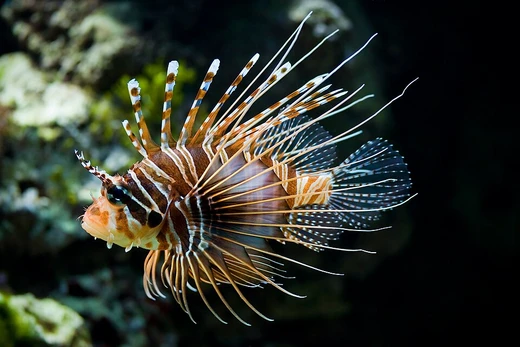
Taenianotus triacanthus
A leaf-like ambush predator with venom weaker than lionfish.

Taenianotus triacanthus, commonly known as the leaf scorpionfish, paperfish, or threespine scorpionfish, is the only species in the monotypic genus Taenianotus within the family Scorpaenidae. It is notable for its remarkable leaf-like appearance and camouflage, which it uses to ambush prey across a wide Indo-Pacific distribution.
Quick Facts
- Taxon
- Taenianotus triacanthus
Facts from the source article.
Lore & Background
Taenianotus triacanthus was first described in 1802 by the French naturalist Bernard Germain Étienne de La Ville-sur-Illon, comte de Lacépède, who created the genus Taenianotus. The type species was designated in 1829 by Cuvier in Cuvier & Valenciennes' Histoire naturelle des poissons. The genus name combines taenia (narrow flat band) and notus (back), referring to the long dorsal fin extending from head to tail. The specific name triacanthus means 'three spines,' referencing the three preopercular spines, though the article notes it actually has only two such spines.
The fish grows to about 10 cm and varies in color from green, red, pink, brown, ocher, yellowish to ghostly white. It is almost as flat as a leaf, with a large head and mouth, a dark line through the eyes, and a large dorsal fin starting just behind the eyes. The skin often has blotches for camouflage, and appendages around the mouth may host real algae and hydroids. The fish molts every 10 to 14 days and can change colors after molting.
In behavior, Taenianotus triacanthus resembles a dead leaf drifting in the water, enhancing this effect with gentle sideways movements of its pelvic area. It is an ambush predator, slowly moving with its pectoral fins toward small fish or shrimp, then sucking prey in with a sudden mouth opening. Its venom is considerably weaker than that of lionfish and stonefish.
Reader's Guide
Taenianotus triacanthus holds significance as a master of camouflage within the scorpionfish family, using its leaf-like shape, color variability, and molting ability to blend into coral reef environments. Its wide Indo-Pacific distribution—from the east African coast and Red Sea to the Galapagos Islands, Ryukyu Islands, Hawaii, and New South Wales—demonstrates its adaptability across tropical waters down to 130 meters. The species is notable for its unique hunting strategy: mimicking a dead leaf with gentle pelvic movements to approach prey before a rapid suction feeding strike. Its venom, while present, is considerably weaker than that of related lionfish and stonefish, making it less dangerous to humans. The taxonomic history, including Lacépède's original description in 1802 and Cuvier's later designation of the type species, places it within the tribe Scorpaenini of the subfamily Scorpaeninae. The species' ability to host algae and hydroids on its skin further underscores its integration into reef ecosystems. As a monotypic genus, Taenianotus represents a distinct evolutionary lineage within the scorpionfishes, valued for its biological and ecological specialization.
Did You Know?
- Taenianotus triacanthus molts every 10 to 14 days and can change color after molting.
- The fish has only two preopercular spines, despite its specific name meaning 'three spines.'
- Real algae and hydroids sometimes grow on its skin.
More in Lionfish and Scorpionfish, Part 2 1-24
Spotted an error? Know more?
Reader corrections go straight into our review queue. Suggest an edit · How this site is sourced