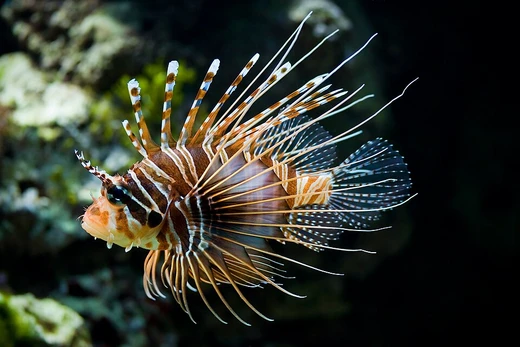
Spinycheek scorpionfish
A western Atlantic scorpionfish named for Ernest Hemingway.

The spinycheek scorpionfish (Neomerinthe hemingwayi), also called Hemingway's scorpionfish, is a ray-finned marine fish in the family Scorpaenidae. It lives in the western Atlantic Ocean.
American ichthyologist Henry Weed Fowler first described this species in 1935, basing it on a specimen collected about 70 miles southeast of Cape May, New Jersey. Fowler created a new genus, *Neomerinthe*, and made this fish its type species. He named it after author Ernest Hemingway, whom he had befriended in 1934 while staying in Cuba to study billfishes. Although Hemingway helped Fowler with research on Gulf Stream fishes, he did not collect this particular species.
The fish has a long, sturdy body. Its nasal bone has two downward-pointing spines on the lower front edge and one sideways spine at the rear. A bony ridge below the eye extends behind the eye and carries three spines. Teeth line the sides of the roof of the mouth. The preoperculum has a single central spine. The wedge-shaped pectoral fins have 16 to 18 rays (usually 17), with the longest in the middle; in adults, the third through eighth rays are branched at the tips. The dorsal fin has 12 spines and typically 10.5 soft rays (rarely 9.5), with the last ray split to its base, counted as 1.5. Body scales are rough, and the lateral line runs to the tail fin. Coloration is reddish brown with dark mottles and spots on the back and sides. Three dark spots cluster on the lateral line below the soft part of the dorsal fin. The dorsal fin is heavily mottled and spotted, the tail fin is densely spotted, and the pectoral fin has irregular spots. Maximum total length is 40 cm (16 in).
This demersal species ranges along the U.S. East Coast from New Jersey to southern Florida, and in the Gulf of Mexico from Texas to Campeche, Mexico. It lives at depths of 45 to 230 m (148 to 755 ft).
A carnivore, it eats benthic invertebrates and smaller fish. It is oviparous, laying pelagic eggs that hatch into pelagic larvae. Thick glandular tissue on the rear of each fin spine is thought to contain venom glands.
Quick Facts
- Taxon
- Neomerinthe hemingwayi
Facts from the source article.
Lore & Background
The spinycheek scorpionfish was first formally described in 1935 by American ichthyologist Henry Weed Fowler. Fowler designated it as the type species of a new genus, Neomerinthe. The specific name honors Ernest Hemingway, with whom Fowler stayed in Cuba in 1934 to study billfishes; they became friends, and Fowler named the species to mark his appreciation of Hemingway's help with his work on Gulf Stream fishes, though Hemingway was not involved in collecting this species.
This fish has an elongate, robust body. Its nasal bone bears two downward-directed spines on its lower edge in front of the eye and another sideways-directed spine on its side at the rear. The bony suborbital ridge extends behind the eye and bears three spines. There are teeth on the sides of the roof of the mouth, and a single central spine on the preoperculum. The pectoral fins are wedge-shaped with 16–18 rays (typically 17), the longest in the center, with the third to eighth rays branched at the tips in adults. The dorsal fin has 12 spines and usually 10.5 rays (rarely 9.5), with the rearmost ray divided to its base. The body scales are rough, and the lateral line extends to the caudal fin. The overall color is reddish brown with dark mottles and spots on the back and flanks, three dark spots in a group on the lateral line below the soft-rayed part of the dorsal fin, and heavily marked dorsal, caudal, and pectoral fins.
The spinycheek scorpionfish is found along the eastern coast of the United States from New Jersey to southern Florida and in the Gulf of Mexico from Texas to Campeche, Mexico. It is a demersal species at depths between 45 and 230 m.
Reader's Guide
The spinycheek scorpionfish holds significance as the type species of the genus Neomerinthe, established by Henry Weed Fowler in 1935. Its naming after Ernest Hemingway reflects a personal friendship between the ichthyologist and the author, arising from their collaboration studying billfishes in Cuba. Although Hemingway did not collect the species, Fowler named it to acknowledge the help Hemingway provided for his work on Gulf Stream fishes. This connection links a marine fish to a major literary figure, adding cultural resonance to its taxonomic history.
Ecologically, the species is a demersal carnivore feeding on benthic invertebrates and smaller fishes. It is oviparous, laying pelagic eggs that hatch into pelagic larvae. Thick glandular tissue on the rear of each fin spine is thought to be venom glands, a characteristic common among scorpionfishes. Its distribution spans the western Atlantic from New Jersey to southern Florida and across the Gulf of Mexico to Campeche, Mexico, occupying depths of 45 to 230 meters. The species reaches a maximum total length of 40 cm, making it a moderately sized member of its family. Its reddish-brown coloration with dark mottling and spots provides camouflage on the seafloor.
More in Lionfish and Scorpionfish, Part 2 1-24
Spotted an error? Know more?
Reader corrections go straight into our review queue. Suggest an edit · How this site is sourced