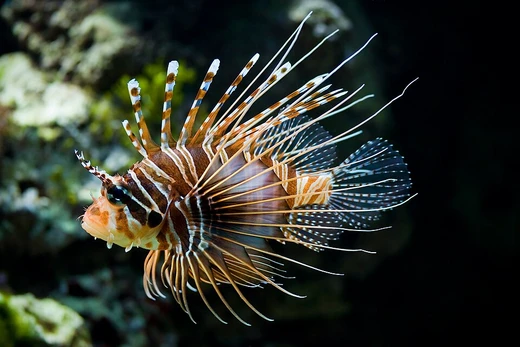
Scorpaenopsis
A genus of scorpionfishes found in the Indian and Pacific Oceans.

Scorpaenopsis is a genus of marine ray-finned fish in the scorpionfish family, Scorpaenidae. These fish live in the Indian and Pacific Oceans. The genus was first described in 1837 by Johann Jakob Heckel, an Austrian taxidermist, zoologist, and ichthyologist. Its type species was designated in 1876 by Pieter Bleeker as *Scorpaena nesogallica*, a species Georges Cuvier had described in 1829 from Mauritius. That species later turned out to be a junior synonym of *Scorpaena gibbosa*, described in 1801 by Marcus Elieser Bloch and Johann Gottlob Schneider, who mistakenly gave "America" as the type locality for this Indian Ocean fish. Scorpaenopsis belongs to the tribe Scorpaenini, within the subfamily Scorpaeninae. The genus name means "having the appearance of *Scorpaena*," the genus where the type species was originally placed.
There are 28 recognized species in this genus. These fish have 12 spines in the dorsal fin and 3 spines in the anal fin. They lack teeth on the palatine bone. A patch of black color appears between the first and third dorsal-fin spines. Their heads are strongly compressed, and they have at least three suborbital spines. The smallest species is *Scorpaenopsis rubrimarginata*, which reaches a maximum total length of 24 mm (0.94 in). The largest is the false stonefish, *Scorpaenopsis diabolus*. Scorpaenopsis scorpionfishes are found across the Indian and Pacific Oceans, from the Red Sea and East Africa eastward to Hawaii, north to Japan, and south to Australia.
Quick Facts
- Taxon
- Scorpaenopsis
- Type Species
- Scorpaena nesogallica
- Type Species Authority
- G. Cuvier, 1829
Facts from the source article.
Lore & Background
The genus Scorpaenopsis was first formally described in 1837 by the Austrian taxidermist, zoologist, and ichthyologist Johann Jakob Heckel. In 1876 Pieter Bleeker designated Scorpaena nesogallica, described in 1829 by Georges Cuvier from Mauritius, as its type species. However, S. nesogallica was later shown to be a junior synonym of Scorpaena gibbosa, which had been described by Marcus Elieser Bloch and Johann Gottlob Schneider in 1801 with 'America' erroneously given as the type locality of this Indian Ocean species. The genus name Scorpaenopsis means 'having the appearance of Scorpaena', the genus the type species was originally classified within.
Scorpaenopsis scorpionfishes are characterised by having 12 spines in the dorsal fin and 3 spines in the anal fin. They do not have any teeth on the palatine. They have some black colouration between the first and the third spines in the dorsal fin. They have a strongly compressed head and no less than 3 suborbital spines. The smallest species is S. rubrimarginata with a maximum total length of 24 mm, while the largest is the false stonefish (S. diabolus). The genus is classified within the tribe Scorpaenini, in the subfamily Scorpaeninae of the family Scorpaenidae.
Reader's Guide
Scorpaenopsis is a genus of marine ray-finned fish belonging to the family Scorpaenidae, the scorpionfishes. Its 28 recognized species are distributed across the Indian and Pacific Oceans, from the Red Sea and the coasts of Eastern Africa into the Pacific as far east as Hawaii, north to Japan, and south to Australia. The genus was first formally described in 1837 by Johann Jakob Heckel, with its type species originally designated as Scorpaena nesogallica by Pieter Bleeker in 1876, though this was later shown to be a junior synonym of Scorpaena gibbosa. The genus name reflects its resemblance to the genus Scorpaena. Key characteristics include 12 dorsal fin spines, 3 anal fin spines, no palatine teeth, black colouration between the first and third dorsal spines, a strongly compressed head, and at least 3 suborbital spines. The smallest species, S. rubrimarginata, reaches only 24 mm in total length, while the largest, the false stonefish (S. diabolus), is notably larger. The genus includes species with common names such as bearded scorpionfish, bigmouth scorpionfish, weedy stingfish, and tasseled scorpionfish, among others.
Did You Know?
- The type species was originally designated as Scorpaena nesogallica, but this was later shown to be a junior synonym of Scorpaena gibbosa.
- The smallest species in the genus is Scorpaenopsis rubrimarginata, with a maximum total length of 24 mm.
- The largest species is the false stonefish (Scorpaenopsis diabolus).
More in Lionfish and Scorpionfish, Part 2 1-24
Spotted an error? Know more?
Reader corrections go straight into our review queue. Suggest an edit · How this site is sourced