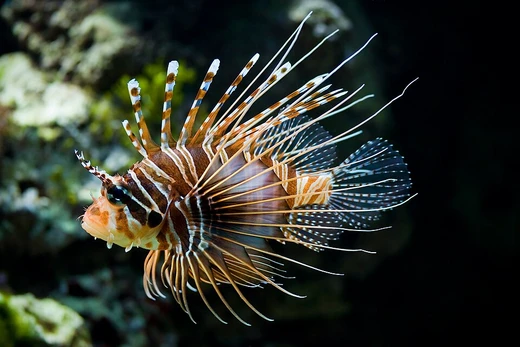
Scorpaena
A genus of venomous scorpionfishes found in tropical and warm temperate oceans.

Scorpaena is a large genus of marine ray-finned fish in the scorpionfish family, Scorpaenidae. The genus was first established by Carl Linnaeus in 1758, in the 10th edition of his *Systema Naturae*. In 1876, Pieter Bleeker designated *S. porcus* as the type species. The name comes from the Greek word *skorpaina*, meaning scorpion, which Linnaeus used because of the venomous spines he noted in his description of *S. scrofa*.
The genus contains 65 recognized living species. Several fossil species are also known, including †*Scorpaena acanthophora* from the mid-late Miocene of Turkey, †*Scorpaena boulei* and †*Scorpaena jeanneli* from the latest Miocene of Algeria, and †*Scorpaena prior* from the middle Miocene of Austria. Another fossil, †*"Scorpaena" minima* from the middle Miocene of Croatia and Serbia, is a valid scorpaenid but its otolith features make it uncertain whether it belongs in *Scorpaena*, so it is only tentatively placed here. A possible fossil, †*Scorpaena osterodenensis* from the middle Eocene of Germany, is known only from isolated otoliths.
These fish have a very bony head covered in spines. Beneath the eyes runs a horizontal bony ridge with one to four spines, and they have an occipital pit. The longest spine on the preoperculum is the uppermost one. Teeth are present in patches on the roof and sides of the mouth. The dorsal fin has 12 spines and 7 to 10 soft rays, while the anal fin has 3 spines and 5 soft rays. The pectoral fin has 16 to 21 rays, with some upper rays branched in adults. The body scales are relatively large and smooth, and the lateral line is complete with tubed scales. Sizes range from a total length of 5.6 cm (2.2 in) in *S. pascuensis* to 45.7 cm (18.0 in) in *S. mystes*.
*Scorpaena* species are found in tropical and warm temperate waters of the Atlantic, Indian, and Pacific Oceans. They are demersal fish, typically living in rocky or coral habitats. They are solitary ambush predators, using their irregular, cryptically patterned bodies to camouflage against the substrate. Their large mouths allow them to eat prey up to half their own size, and they create a vortex by suddenly opening the mouth to draw prey in. Their venomous spines can cause serious injuries to humans. In some regions, they are caught by both recreational and commercial fisheries, and their flesh is considered very palatable.
Quick Facts
- Taxon
- Scorpaena
- Type Species
- Scorpaena porcus
- Type Species Authority
- Linnaeus, 1758
Facts from the source article.
Lore & Background
The genus Scorpaena was first described in 1758 by Carl Linnaeus in the 10th Edition of his Systema Naturae. In 1876, Pieter Bleeker designated S. porcus as the type species. The genus name is based on the Greek word for a scorpion, skorpaina, an allusion to the venomous spines Linnaeus mentioned in his description of S. scrofa.
Scorpaena scorpionfishes have a very bony head armed with numerous spines, a horizontal bony ridge beneath the eyes with 1-4 spines, and an occipital pit. The uppermost spine on the preoperculum is the longest. They have patches of teeth on the roof of the mouth and at its sides. The dorsal fin has 12 spines and between 7 and 10 soft rays, while the anal fin has 3 spines and 5 soft rays. The pectoral fin has 16 to 21 fin rays, with some upper rays branched in adults. They have relatively large smooth scales, and the lateral line is complete with tubed scales.
These fish are demersal, typically found in rocky or coralline habitats in the tropical and warm temperate zones of the Atlantic, Indian, and Pacific Oceans. They are solitary ambush predators that use their cryptically patterned, irregularly shaped bodies for camouflage. They have large mouths and can eat prey up to half their own size, creating a vortex with the sudden opening of the mouth to draw prey in.
Reader's Guide
Scorpaena is a significant genus within the family Scorpaenidae due to its widespread distribution across the Atlantic, Indian, and Pacific Oceans. The genus was established by Carl Linnaeus in 1758, marking an early formal recognition of these venomous fishes. The 65 recognized extant species demonstrate considerable diversity in size, from the small S. pascuensis at 5.6 cm to the larger S. mystes at 45.7 cm. Their venomous spines are a notable feature, capable of causing serious injuries to humans, which has contributed to their reputation. Despite this, the flesh is regarded as very palatable, and they are caught by recreational and commercial fisheries in some parts of the world. The fossil record includes several species from the Miocene and Eocene, though some, like †Scorpaena minima, are only tentatively retained in the genus due to unique otolith morphology. This uncertainty highlights ongoing taxonomic questions. The genus name itself, derived from the Greek word for scorpion, directly references the venomous spines that define their ecological role as ambush predators. Their solitary, camouflaged hunting strategy and ability to consume prey up to half their own size underscore their importance as predators in rocky and coralline habitats.
More in Lionfish and Scorpionfish, Part 2 1-24
Spotted an error? Know more?
Reader corrections go straight into our review queue. Suggest an edit · How this site is sourced