Rhinopias
Venomous Indo-Pacific scorpionfishes with compressed bodies and a high aquarium value.

Rhinopias is a genus of marine ray-finned fish within the scorpionfish family Scorpaenidae. Its species inhabit the Indian and Pacific Oceans.
The genus was established in 1905 by American ichthyologist Theodore Gill, who made it monotypic with *Scorpaena frondosa* as the type species. That species had been described in 1893 by German-born British zoologist Albert Günther, with its type locality given as Mauritius. The name *Rhinopias* combines *rhino* ("snout") and *op* ("eye"), referring to the upturned snout and raised eye sockets of *R. frondosa*, plus the suffix *-ias* used in some Greek fish names, such as *Xiphias*.
As of 2022, six species are recognized. There is uncertainty whether *R. eschmeyeri* is a synonym of *R. frondosa*, as the two may represent different sexes of a single sexually dimorphic species.
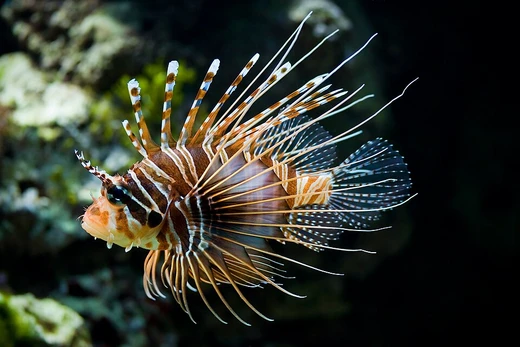
These scorpionfishes have 12 spines in the dorsal fin and 3 in the anal fin. The pectoral fins have 12 to 18 fin rays, with the lower rays thickened. The soft rays of the dorsal and anal fins, along with the upper pectoral rays, are branched. In adults, the head and body are highly compressed—the head is narrower than the body—and the body is deep, with depth measuring 38 to 54 percent of standard length. Small cycloid scales cover the body. Teeth are present on the palatine, and there are upper post-temporal spines, but no interorbital ridges or tympanic spines. Sizes range from a maximum total length of 15.3 cm (6.0 in) in *R. xenops* to 25 cm (9.8 in) in *R. aphanes*.
The genus has an Indo-Pacific distribution, from the coast of eastern Africa to Hawaii and Easter Island. These demersal fish live in habitats with soft substrate and strong currents, occurring from shallow waters down to about 300 m (980 ft).
Rhinopias are ambush predators, resting on the substrate and waiting for crustaceans and smaller fish to come within striking range. Because they are so sedentary, exoparasites and algae can quickly build up on their skin; to counter this, they frequently shed their outer skin layer, or cuticle. Their fin spines contain venom.
These fish command a high price in the aquarium trade.
Quick Facts
- Taxon
- Rhinopias
- Type Species
- Scorpaena frondosa
- Type Species Authority
- Günther, 1893
Facts from the source article.
Lore & Background
Rhinopias was described as a genus in 1905 by the American ichthyologist Theodore Gill, who designated Scorpaena frondosa as its type species. Scorpaena frondosa had originally been described in 1893 by the German-born British zoologist Albert Günther, with its type locality given as Mauritius. The genus name combines rhino meaning 'snout' and op meaning 'eye', alluding to the upturned snout and raised orbits of R. frondosa, with the suffix ias used in some Greek names for fishes.
As of 2022, there are six recognized species in the genus, though there is some doubt as to whether R. eschmeyeri is a synonym of R. frondosa, with the two possibly being different sexes of a sexually dimorphic single species. Rhinopias scorpionfishes are distinguished by having 12 spines in their dorsal fins and 3 spines in their anal fins. Their pectoral fins contain 12-18 fin rays with the lower rays thickened, and the soft fin rays of the dorsal and anal fins, as well as the upper fin rays of the pectoral fins, are branched. Adults have a highly compressed head and body, with the body depth being 38-54% of its standard length. They have small cycloid scales, teeth on the palatine, and upper post-temporal spines, but lack interorbital ridges or tympanic spines.
These scorpionfishes have an Indo-Pacific distribution from the coast of eastern Africa to Hawaii and Easter Island. They are demersal fish found in habitats with soft substrate and strong currents, occurring from shallow waters down to around 300 m. They are ambush predators that rest on the substrate waiting for crustaceans and smaller fishes. They frequently shed an outer layer of skin (the cuticle) to remove exoparasites and algae that accumulate due to their sedentary lifestyle. Their fin spines contain venom.
Reader's Guide
Rhinopias scorpionfishes hold significance as a genus within the family Scorpaenidae, noted for their distinctive morphology and ecological adaptations. The genus was established in 1905 by Theodore Gill, based on a species originally described by Albert Günther in 1893 from Mauritius. The six recognized species as of 2022 exhibit a range of sizes, from 15.3 cm in R. xenops to 25 cm in R. aphanes, and share key anatomical features such as 12 dorsal spines, 3 anal spines, and a highly compressed body. Their distribution spans the Indian and Pacific oceans, from eastern Africa to Hawaii and Easter Island, inhabiting demersal zones with soft substrate and strong currents down to about 300 m. Biologically, they are ambush predators that rely on venomous fin spines for defense and prey capture, and they shed their cuticle to manage parasites and algae. Their high price in the aquarium trade underscores their desirability, though the article notes ongoing taxonomic uncertainty regarding R. eschmeyeri and R. frondosa, which may represent a single sexually dimorphic species. This ambiguity highlights the need for further research into their systematics and life history.
Did You Know?
- There is doubt as to whether R. eschmeyeri is a synonym of R. frondosa, possibly representing different sexes of a single species.
- Rhinopias scorpionfishes shed their outer layer of skin (cuticle) to remove exoparasites and algae.
More in Lionfish and Scorpionfish, Part 2 1-24
Spotted an error? Know more?
Reader corrections go straight into our review queue. Suggest an edit · How this site is sourced