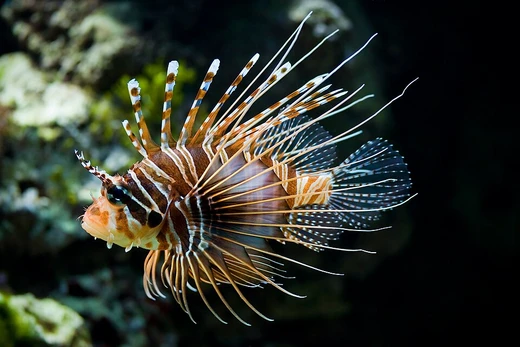
Phenacoscorpius
Deepwater scorpionfishes with an incomplete lateral line.

Phenacoscorpius, commonly known as the no-lined scorpionfishes, is a genus of marine ray-finned fish within the scorpionfish family Scorpaenidae. These fish are found in the western Atlantic, Pacific, and Indian Oceans.
The genus was established in 1938 by American ichthyologist Henry Weed Fowler, who designated *Phenacoscorpius megalops* from the Philippines as the type species. The name combines "phenaco," meaning "cheat," referring to the incomplete lateral line of *P. megalops*, with "scorpius," meaning "scorpion," indicating its classification as a scorpionfish.
As of January 2022, the genus includes seven recognized species: *P. adenensis*, *P. eschmeyeri*, *P. longilineatus*, *P. longirostris* (Longsnout No-line Scorpionfish), *P. mccoskeri* (McCosker's no-line scorpionfish), *P. megalops* (Noline scorpionfish), and *P. nebris* (Short-tube scorpionfish).
These scorpionfishes have heavily bony heads armed with strong spines, lacking an occipital pit behind the eyes. The suborbital ridge bears five to six spines. Teeth are present on the sides of the roof of the mouth but absent from the front. The uppermost preopercular spine is the largest. Their dorsal fin has 12 spines and 9 soft rays, while the anal fin has 3 spines and 5 soft rays. Pectoral fins have 15 to 17 rays, with the upper rays branched, the central rays longest, and the lower rays having exposed tips. The lateral line is incomplete, consisting of only four to five pored scales near the front. Sizes range from a standard length of 6.3 cm (2.5 in) in *P. longirostris* to a total length of 13.5 cm (5.3 in) in *P. megalops*.
Phenacoscorpius species have an almost circumtropical distribution, primarily in the Indian and Pacific Oceans, with one species in the western Atlantic; they are absent from the eastern Atlantic. These are deepwater fish, typically found at depths greater than 500 m (1,600 ft).
Quick Facts
- Taxon
- Phenacoscorpius
- Type Species
- Phenacoscorpius megalops
- Type Species Authority
- Fowler, 1938
Facts from the source article.
Lore & Background
The genus Phenacoscorpius was first described in 1938 by American ichthyologist Henry Weed Fowler, who designated Phenacoscorpius megalops from the Philippines as the type species. The genus name combines 'phenaco' (meaning 'cheat') and 'scorpius' (meaning 'scorpion'), alluding to the incomplete lateral line of P. megalops, which has only 4-5 pored scales at the front.
These scorpionfishes have very bony heads armed with strong spines and lack an occipital pit behind the eyes. The suborbital ridge bears 5-6 spines, and the uppermost preopercular spine is the largest. Their dorsal fin has 12 spines and 9 soft rays, the anal fin has 3 spines and 5 soft rays, and the pectoral fins have 15-17 rays with the upper rays branched and the lower rays with exposed tips.
As of January 2022, the genus contains seven recognized species, including Phenacoscorpius adenensis, P. eschmeyeri, P. longilineatus, P. longirostris (Longsnout No-line Scorpionfish), P. mccoskeri (McCosker's no-line scorpionfish), P. megalops (Noline scorpionfish), and P. nebris (Short-tube scorpionfish). They have an almost circumtropical distribution, mainly in the Indian and Pacific Oceans, with one species in the western Atlantic, but are absent from the eastern Atlantic.
Reader's Guide
Phenacoscorpius represents a distinctive lineage within the scorpionfish family Scorpaenidae, characterized by its incomplete lateral line—a feature that sets it apart from many other scorpionfishes. The genus was established in 1938 by Henry Weed Fowler, and its type species, P. megalops, was collected from the Philippines. The seven recognized species, as of January 2022, are all deepwater fishes typically found deeper than 500 meters, inhabiting the western Atlantic, Pacific, and Indian oceans. Their bony heads armed with strong spines and the absence of an occipital pit are key morphological traits. The species vary in size, with P. longirostris reaching a standard length of 6.3 cm and P. megalops attaining a total length of 13.5 cm. The genus's circumtropical distribution, excluding the eastern Atlantic, highlights its adaptation to deep-sea environments. The scientific name itself—'cheat scorpion'—reflects the deceptive appearance of a lateral line that is only partially developed, a notable evolutionary trait among scorpionfishes.
Did You Know?
- The genus name Phenacoscorpius means 'cheat scorpion,' referring to the incomplete lateral line of the type species.
- Phenacoscorpius scorpionfishes have only 4-5 pored scales in their lateral line.
- The largest species, P. megalops, reaches a total length of 13.5 cm.
- These fishes are typically found deeper than 500 meters.
Frequently Asked Questions
What is Phenacoscorpius?
Phenacoscorpius is a genus of deepwater scorpionfishes, commonly called the no-lined scorpionfishes, belonging to the family Scorpaenidae. The group is found across the western Atlantic, Pacific, and Indian Oceans.
Who established the genus Phenacoscorpius and when?
American ichthyologist Henry Weed Fowler created the genus in 1938, designating P. megalops, collected from the Philippines, as the type species.
What does the name Phenacoscorpius actually mean?
The name pairs the Greek 'phenaco' (cheat), a nod to the incomplete lateral line of P. megalops, with 'scorpius' (scorpion) to flag its place among scorpionfishes.
How many species does Phenacoscorpius contain and how large do they grow?
As of January 2022 the genus holds seven species, with sizes spanning from a 6.3 cm standard length in P. longirostris up to a 13.5 cm total length in P. megalops.
At what depths do Phenacoscorpius typically live?
These are deepwater fish that generally occur below 500 meters, making them one of the more elusive scorpionfish genera to observe in the wild.
More in Lionfish and Scorpionfish, Part 2 1-24
Spotted an error? Know more?
Reader corrections go straight into our review queue. Suggest an edit · How this site is sourced