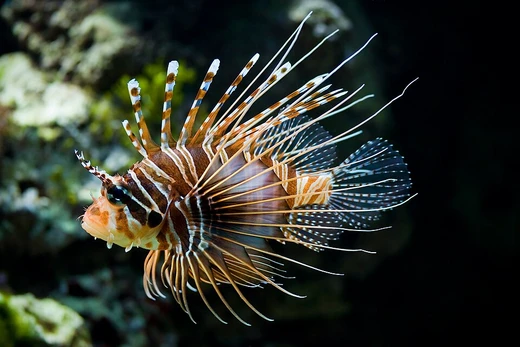
Pteroidichthys
A genus of scorpionfishes found in the Indian and Pacific Oceans.

Pteroidichthys is a genus of marine ray-finned fish in the scorpionfish family Scorpaenidae. These fish are found in the Indian and Pacific Oceans.
The genus was first described in 1856 by Dutch scientist Pieter Bleeker, who placed the single species *Pteroidichthys amboinensis* in it. The name combines *pteroides*, meaning "similar to *Pterois*" (lionfish), with *ichthys*, meaning "fish." Bleeker considered the group close to lionfishes but noted they lack head spines.
Four species are currently recognized: *Pteroidichthys acutus* (longsnout weedy scorpionfish), *P. amboinensis* (Ambon scorpionfish), *P. caussei* (Causse's scorpionfish), and *P. noronhai* (Noronha's scorpionfish).
These scorpionfishes have a strongly compressed, elongated body. Body width is 10–24% of standard length, and depth is 28–40% of standard length. They have 12 spines in the dorsal fin and no black blotches on the lower part of the caudal fin. Sizes range from a maximum standard length of 4.1 cm in *P. acutus* to a total length of 12 cm in *P. amboinensis*.
They occur in the Indian Ocean and western Pacific Ocean, including the Red Sea, and range from Japan south to Australia. These demersal fish live over soft substrates at depths of 7 to 400 meters. They are solitary ambush predators.
Quick Facts
- Taxon
- Pteroidichthys
- Type Species
- Pteroidichthys amboinensis
- Type Species Authority
- Bleeker, 1856
Facts from the source article.
Lore & Background
Pteroidichthys was first described as a genus in 1856 by the Dutch herpetologist, ichthyologist and physician Pieter Bleeker when he described Pteroidichthys amboinensis and placed it in a monotypic genus. The genus name is a compound of pteroides which means 'similar to Pterois', and ichthys meaning 'fish'. Bleeker thought that this taxon was close to the lionfishes but was distinguished by, among other features, the lack of head spines.
Pteroidichthys scorpionfishes have a body which is strongly compressed and elongated, the width of the body is equivalent to 10–24% of their standard length while its depth is equivalent to 28–40% of its standard length. They have 12 spines in their dorsal fin and there are no black blotches on the lower part of the caudal fin. These scorpionfishes vary in size from a maximum standard length of 4.1 cm (1.6 in) in P. acutus to a total length of 12 cm (4.7 in) in P. amboinensis.
Pteroidichthys scorpionfishes are found in the Indian Ocean and the western Pacific Ocean, occurring in the Red Sea as well. It is found as far north as Japan and south to Australia. They are demersal fishes which occur over soft substrates. These fishes are found in depths that range from 7 to 400 m (23 to 1,312 ft). Pteroidichthys scorpionfishes are ambush predators and tend to be solitary fishes.
Reader's Guide
The genus Pteroidichthys holds significance as a distinct lineage within the scorpionfish family Scorpaenidae, first recognized by Pieter Bleeker in 1856. Bleeker's original description established the genus as monotypic with Pteroidichthys amboinensis, and he noted its similarity to lionfishes (Pterois) while distinguishing it by the absence of head spines. This taxonomic placement reflects ongoing efforts to classify the diverse scorpionfishes of the Indo-Pacific.
Currently, the genus comprises four recognized species: Pteroidichthys acutus, P. amboinensis, P. caussei, and P. noronhai. These species exhibit a range of sizes, from the small P. acutus at 4.1 cm standard length to the larger P. amboinensis reaching 12 cm total length. Their compressed, elongated bodies and 12 dorsal-fin spines are characteristic features, and the lack of black blotches on the lower caudal fin helps distinguish them from related groups.
Ecologically, Pteroidichthys scorpionfishes are demersal ambush predators that inhabit soft substrates across a broad depth range from 7 to 400 meters. Their distribution spans the Indian Ocean and western Pacific, including the Red Sea, Japan, and Australia. As solitary fishes, they contribute to the benthic predator community in these regions.
Did You Know?
- The genus name Pteroidichthys combines pteroides ('similar to Pterois') and ichthys ('fish').
- Bleeker distinguished Pteroidichthys from lionfishes by the lack of head spines.
- They are found at depths ranging from 7 to 400 m (23 to 1,312 ft).
More in Lionfish and Scorpionfish, Part 2 1-24
Spotted an error? Know more?
Reader corrections go straight into our review queue. Suggest an edit · How this site is sourced