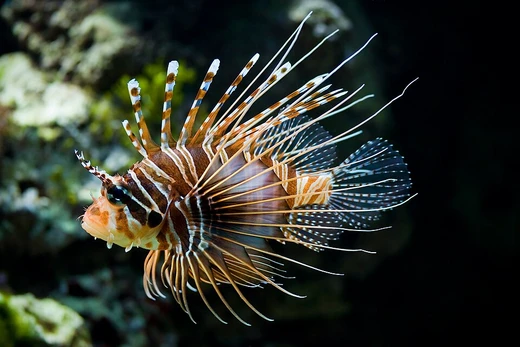
Pontinus
A genus of scorpionfishes found in tropical and warm temperate oceans.

Pontinus is a genus of marine ray-finned fish in the scorpionfish family, Scorpaenidae. Its members live in tropical and warm temperate waters across the Atlantic, Indian, and Pacific Oceans.
The genus was established in 1860 by Cuban zoologist Felipe Poey y Aloy. He based it on a single species, the longsnout scorpionfish (*Pontinus castor*), which he had collected in Havana. Because Poey placed only that species in the new genus, it is the type species by monotypy. The name *Pontinus* comes from the Latin *pontis*, meaning "bridge," a reference to the suborbital stay (a bony ridge) found in all species of the subfamily Scorpaeninae.
Currently, 19 species are recognized in the genus. They include the Ghanean rockfish (*Pontinus accraensis*), longsnout scorpionfish (*P. castor*), mottled scorpionfish (*P. clemensi*), *P. corallinus*, *P. furcirhinus*, *P. helena*, offshore rockfish (*P. kuhlii*), speckled deepwater scorpionfish (*P. leda*), longspine scorpionfish (*P. longispinis*), large-headed scorpionfish (*P. macrocephalus*), spinythroat scorpionfish (*P. nematophthalmus*), blacklash scorpionfish (*P. nigerimum*), St. Helena deepwater scorpionfish (*P. nigropunctatus*), highfin scorpionfish (*P. rathbuni*), *P. rhodochrous*, speckled scorpionfish (*P. sierra*), stalkeye scorpionfish (*P. strigatus*), *P. tentacularis*, and spotback scorpionfish (*P. vaughani*).
These fish have heavily bony heads. The head features two preorbital spines above the maxillary, and three to four spines on the suborbital ridge (though the first preorbital spine is often missing). A supplemental preopercular spine is present. The uppermost preopercular spine is the longest; the second is often absent, the third and fourth are present, and the fifth may be present or absent. They have teeth on both the vomer and palatine bones. The dorsal fin has 12 spines and 9–10 soft rays, while the anal fin has three spines and five soft rays (the rearmost ray is deeply split). The pectoral fin has 15–20 unbranched rays. They possess a swimbladder. The body scales are ctenoid, and the cheek, postorbital area, and top of the head are scaled. They lack an occipital pit. Sizes range from a total length of 14 cm (5.5 in) in the spinythroat scorpionfish to 54.9 cm (21.6 in) in the mottled spinefish.
Quick Facts
- Taxon
- Pontinus
- Type Species
- Pontinus castor
- Type Species Authority
- Poey, 1860
Facts from the source article.
Lore & Background
The genus Pontinus was established in 1860 by Cuban zoologist Felipe Poey y Aloy when he described the longsnout scorpionfish (P. castor) from specimens collected at Havana. The name Pontinus is derived from the Latin word 'pontis', meaning 'bridge', an allusion to the suborbital stay (ridge) found in all species of the subfamily Scorpaeninae. The type species is P. castor by monotypy, as it was the only species Poey definitely placed in the new genus.
Pontinus scorpionfishes have very bony heads with two preorbital spines over the maxillary and 3-4 spines on the suborbital ridge, though the first preorbital spine is frequently absent. They possess a supplemental preopercular spine, with the uppermost preopercular spine being the longest; the second is often absent, while the third and fourth are present, and the fifth may be present or absent. They have both vomerine and palatine teeth. The dorsal fin contains 12 spines and 9-10 soft rays, the anal fin has three spines and five soft rays (the rearmost ray deeply split), and the pectoral fin has 15-20 unbranched rays. They have a swimbladder, ctenoid scales on the body, and scales on the cheek, postorbital area, and top of the head, but no occipital pit.
Currently, 19 recognized species are placed in this genus, ranging in size from the spinythroat scorpionfish (P. nematophthalmus) at 14 cm total length to the mottled spinefish (P. clemensi) at 54.9 cm. These are demersal fishes found in tropical and temperate waters of the Atlantic, Indian, and Pacific oceans.
Reader's Guide
The genus Pontinus represents a notable group within the family Scorpaenidae due to its wide distribution across tropical and warm temperate waters of the Atlantic, Indian, and Pacific oceans. As demersal fishes, they occupy benthic habitats and exhibit a range of sizes from 14 cm to nearly 55 cm. The genus was first described in 1860 by Felipe Poey y Aloy, a Cuban zoologist, based on specimens collected at Havana, establishing a taxonomic foundation that now includes 19 recognized species. The etymology of the name 'Pontinus'—from the Latin for 'bridge'—highlights a key anatomical feature, the suborbital stay, which is characteristic of the subfamily Scorpaeninae. The species within Pontinus display consistent morphological traits, including a very bony head with specific spine patterns, a swimbladder, and ctenoid scales, while lacking an occipital pit. These features, along with fin ray counts (12 dorsal spines, 9-10 soft rays; 3 anal spines, 5 soft rays; 15-20 unbranched pectoral rays), help define the genus. The diversity in size and the presence of species such as the longsnout scorpionfish (P. castor) and the mottled spinefish (P. clemensi) underscore the ecological variation within this group.
Did You Know?
- Pontinus scorpionfishes have a swimbladder and ctenoid scales, but no occipital pit.
- The largest species in the genus is the mottled spinefish (P. clemensi) at 54.9 cm total length.
More in Lionfish and Scorpionfish, Part 2 1-24
Spotted an error? Know more?
Reader corrections go straight into our review queue. Suggest an edit · How this site is sourced