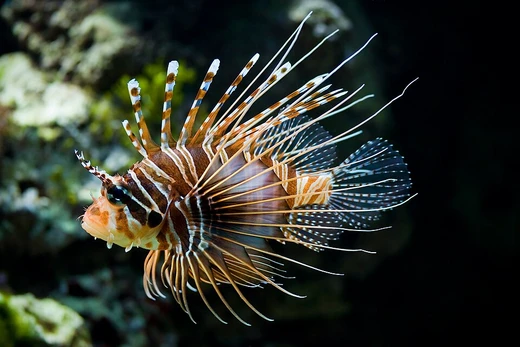
Hozukius
A rare genus of rockfishes from the northwestern Pacific.

Hozukius is a genus of marine ray-finned fish in the subfamily Sebastinae, part of the family Scorpaenidae. These fish are found only in the northwestern Pacific Ocean.
The genus was first described in 1934 by Japanese ichthyologist Kiyomatsu Matsubara as a monotypic group. Its sole species at that time was *Helicolenus emblemarius*, originally described in 1904 by David Starr Jordan and Edith Chapin Starks, with the type locality near Misaki, Japan (specifically Okinose). A second species, *H. guyotensis*, was added in 1975. The genus name likely comes from *hozuki*, the Japanese name for the flowering plant *Physalis alkekengi*, whose bright red or orange fruit resembles the coloration of *H. emblemarius*.
Two species are currently recognized: *Hozukius emblemarius* and *Hozukius guyotensis*.
These rockfishes reach maximum standard lengths of 45 to 59 centimeters. They have 12 spines in the dorsal fin, 26 vertebrae, a swim bladder, and an intraorbital bone firmly attached to the upper edge of the preoperculum. Their body is deep, with three spines on the lower margin of the eye and a truncate caudal fin.
*H. emblemarius* is found around Japan, while *H. guyotensis* occurs on the Emperor Seamounts. Both are bathydemersal or demersal fish, living at depths up to 1,000 meters. There is a single record of *H. emblemarius* from Korean waters in the Sea of Japan. Both species are described as rare.
- Species count
- 2
- Maximum standard length
- 45 to 59 cm
- Dorsal fin spines
- 12
- Vertebrae
- 26
- Depth range
- up to 1,000 m
- Type species
- Helicolenus emblemarius
- Type locality
- Okinose, near Misaki, Japan
Lore & Background
Hozukius was described as a monotypic genus in 1934 by Japanese ichthyologist Kiyomatsu Matsubara, with Helicolenus emblemarius (described by David Starr Jordan and Edith Chapin Starks in 1904) as its only species. A second species, H. guyotensis, was described in 1975. The genus name is probably derived from hozuki, the Japanese name for the flowering plant Physalis alkekengi, which has bright red or orange fruit, a color similar to that of H. emblemarius.
Hozukius rockfishes have maximum standard lengths of 45 to 59 cm. They have 12 spines in the dorsal fin and 26 vertebrae, possess a swim bladder, and the intraorbital bone is firmly connected to the upper margin of the preoperculum. They also have a deep body, three spines on the lower margin of the eye, and a truncate caudal fin.
Hozukius fishes are found only in the northwestern Pacific Ocean: H. emblemarius around Japan and H. guyotensis on the Emperor Seamounts. They are bathydemersal and demersal fish found as deep as 1,000 m. There is one record of H. emblemarius from Korean waters of the Sea of Japan. Both species are described as being rare.
Reader's Guide
Hozukius holds significance as a genus within the subfamily Sebastinae, family Scorpaenidae, representing a lineage of rare, deep-dwelling rockfishes restricted to the northwestern Pacific Ocean. Its taxonomy was established by Kiyomatsu Matsubara in 1934, based on a species originally described by Jordan and Starks in 1904. The addition of a second species in 1975 expanded the genus, though both remain rarely encountered. The genus name's probable derivation from the Japanese name for Physalis alkekengi highlights a cultural and biological connection to the bright red coloration of H. emblemarius. Ecologically, these fishes occupy bathydemersal and demersal habitats down to 1,000 meters, with H. emblemarius found around Japan and one record from Korean waters, while H. guyotensis is associated with the Emperor Seamounts. Their rarity and limited distribution make them of interest for biodiversity studies and conservation, though the article provides no further details on population status or threats. The morphological traits—such as 12 dorsal spines, 26 vertebrae, a swim bladder, and a truncate caudal fin—distinguish them within their family.
Did You Know?
- Hozukius fishes are found as deep as 1,000 meters in the northwestern Pacific Ocean.
- Both species in the genus are described as being rare.
More in Lionfish and Scorpionfish, Part 2 1-24
Spotted an error? Know more?
Reader corrections go straight into our review queue. Suggest an edit · How this site is sourced