Helicolenus
A genus of rockfishes with spiny heads and commercial importance.

Helicolenus is a genus of marine ray-finned fish in the family Scorpaenidae, grouped with the rockfishes in the subfamily Sebastinae. Its species live in the Indian, Atlantic, and Pacific Oceans. These fish are benthic, demersal, and bathydemersal, and some are commercially important, for example in fisheries off southern Australia.
The genus was established in 1896 by American ichthyologists George Brown Goode and Tarleton Hoffman Bean, who used *Scorpaena dactyloptera* as the type species. That species had originally been described in 1809 by François Étienne Delaroche, a Genevan physician, naturalist, chemist, botanist, and ichthyologist. The name *Helicolenus* combines *helikos* (meaning "twisted" or "curved," but interpreted by Goode and Bean as "strong," possibly confusing it with *hadros*) and *oleni* (meaning "elbow" or "arm"), referring to the strong pectoral fins of *H. dactylopterus*.
There are nine recognized species: *Helicolenus avius*, *H. barathri* (bigeye sea perch, offshore ocean perch, bigeye ocean perch), *H. dactylopterus* (blackbelly rosefish), *H. fedorovi*, *H. hilgendorfii* (Hilgendorf's saucord), *H. lahillei*, *H. lengerichi*, *H. mouchezi*, and *H. percoides* (red gurnard perch, inshore ocean perch, reef ocean perch, jock stewart).
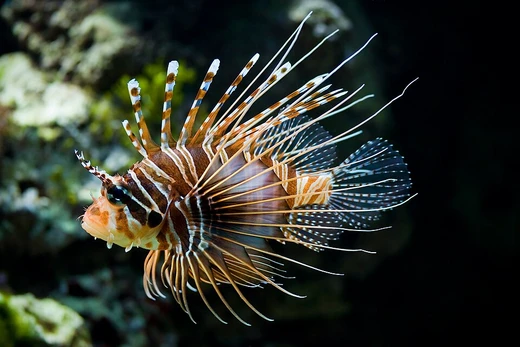
These fish have a large head with spiny ridges and a large mouth. The preoperculum has five spines along its posterior and lower margin, and there are two obvious spines near the back of the operculum. The dorsal fin has 11 to 13 robust spines and 10 to 14 soft rays. Sizes range from a standard length of 27 cm (11 in) in *H. fedorovi* and *H. hilgendorfii* to a total length of 50 cm (20 in) in *H. dactylopterus*.
*Helicolenus* rockfishes are ovoviviparous, with internal fertilization. They prey on cephalopods, echinoderms, crustaceans, and fishes. Some individuals have lived up to 42 years.
Quick Facts
- Taxon
- Helicolenus
- Type Species
- Scorpaena dactyloptera
- Type Species Authority
- Delaroche, 1809
Facts from the source article.
Lore & Background
Helicolenus was described as a genus in 1896 by American ichthyologists George Brown Goode and Tarleton Hoffman Bean, using Scorpaena dactyloptera as its type species. That species had originally been described in 1809 by the Genevan physician and naturalist François Étienne Delaroche. The genus name is a compound of helikos, meaning 'twisted' or 'curved' but interpreted by Goode and Bean as 'strong' (possibly in error for hadros), and oleni meaning 'elbow' or 'arm', an allusion to the 'strong pectoral fins' of H. dactylopterus.
Helicolenus fishes have a large head bearing spiny ridges and a large mouth. There are five spines on the posterior and lower margin of the preoperculum and two obvious spines close to the posterior of the operculum. Their dorsal fins have 11 to 13 robust spines and 10 to 14 soft rays. Species vary in length from a standard length of 27 cm in H. fedorovi and H. hilgendorfii up to a total length of 50 cm in H. dactylopterus.
These rockfishes are ovoviviparous with internal fertilization. They are predators of cephalopods, echinoderms, crustaceans and fishes, and have been known to live for up to 42 years.
Reader's Guide
Helicolenus rockfishes are notable as a genus within the subfamily Sebastinae, the rockfishes, and are found across the Indian, Atlantic and Pacific oceans. Their taxonomy was established by Goode and Bean in 1896, with the type species originally described by Delaroche. The genus name reflects an interpretation of strong pectoral fins, though the etymology may contain an error. Nine species are currently recognized, ranging in size from 27 cm to 50 cm. These fishes are benthic, demersal and bathydemersal, and their biology includes ovoviviparous reproduction and a diet of cephalopods, echinoderms, crustaceans and fishes. They can live up to 42 years. In some regions, such as southern Australia, Helicolenus species are commercially important in fisheries. The genus thus represents a group of long-lived, predatory rockfishes that contribute to both ecological and economic contexts in their respective oceans.
Did You Know?
- The genus name Helicolenus may be an error for hadros, meaning 'strong', according to Goode and Bean.
- The largest species, H. dactylopterus, reaches a total length of 50 cm.
More in Lionfish and Scorpionfish, Part 2 1-24
Spotted an error? Know more?
Reader corrections go straight into our review queue. Suggest an edit · How this site is sourced