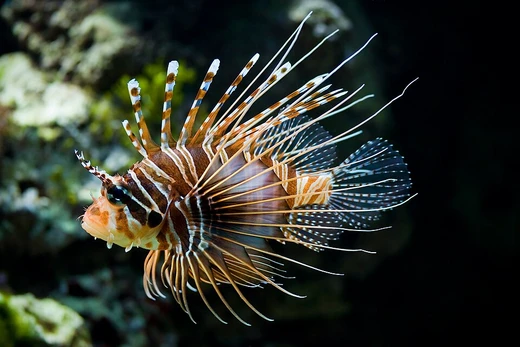
Adelosebastes latens
A deepwater scorpionfish from the Emperor Seamounts and Aleutian Islands.

Adelosebastes latens, commonly known as the Aleutian scorpionfish, is the only species in the monotypic genus Adelosebastes. This marine ray-finned fish belongs to the subfamily Sebastinae (rockfishes) within the family Scorpaenidae. It is notable for being described from specimens collected at the Emperor Seamounts and the Aleutian Islands, and for its occurrence in poorly explored deep waters of the northern Pacific Ocean.
Quick Facts
- Taxon
- Adelosebastes latens
Facts from the source article.
Lore & Background
The genus Adelosebastes was formally described in 1979 by ichthyologists William N. Eschmeyer, Tokiharu Abe, and Soji Nakano, who also described its sole species, Adelosebastes latens. The type specimens were collected from the Emperor Seamounts and the Aleutian Islands. The generic name Adelosebastes combines the Greek word adelos, meaning 'unseen,' likely referring to the species' occurrence in the poorly explored Emperor Seamount Chain at depths of 900 to 1,000 m (3,000 to 3,300 ft), with Sebastes, the type genus of the subfamily Sebastinae. The specific name latens is Latin for 'secret,' probably in line with the same allusion.
In terms of morphology, Adelosebastes latens has 12 spines and 13 soft rays in its dorsal fin, while the anal fin has 3 spines and 5 soft rays (the last ray being double). The suborbital ridge has weak or no spines, and the pectoral fin may have two lobes. Living specimens are bright crimson red, fading to yellowish when preserved. Some individuals show dark markings on the nape and back, a black mark on the rear of the gill cover, black spots on the membranes of the dorsal and pectoral fins, and three bands of indistinct black spots on the back. The head bears robust spines up to 1 cm (0.39 in) in length.
This bathydemersal species is found in the northern Pacific Ocean, recorded along the length of the Emperor Seamount Chain (the most westerly and northern part of the Hawaiian–Emperor seamount chain, extending north from the western Northwestern Hawaiian Islands to the Kuril–Kamchatka Trench) and in the Aleutian Islands. It occurs at depths between 900 and 1,200 m (3,000 and 3,900 ft).
Reader's Guide
Adelosebastes latens holds significance as the only species in the monotypic genus Adelosebastes, highlighting its distinct evolutionary lineage within the rockfish subfamily Sebastinae. Its description in 1979 by Eschmeyer, Abe, and Nakano added to the understanding of deepwater scorpionfish diversity in the northern Pacific. The species' generic and specific names—'unseen' and 'secret'—reflect the poorly explored nature of its habitat, the Emperor Seamount Chain, at depths of 900 to 1,000 m. Its occurrence along the Emperor Seamounts and Aleutian Islands underscores the biogeographic connection between these remote deep-sea regions. The species' bright crimson coloration in life, fading to yellowish in preserved specimens, and its robust head spines up to 1 cm, are notable morphological traits. With a maximum recorded standard length of 33.5 cm, it is a moderately sized bathydemersal fish. The lack of explanation by the original authors for the names' allusions leaves an element of uncertainty, preserving the mystery of its discovery. Its legacy lies in representing a unique, deep-dwelling lineage from a relatively inaccessible environment.
Did You Know?
- Adelosebastes latens is the only species in the genus Adelosebastes.
- Living specimens are bright crimson red, but preserved specimens fade to yellowish.
More in Lionfish and Scorpionfish, Part 2 1-24
Spotted an error? Know more?
Reader corrections go straight into our review queue. Suggest an edit · How this site is sourced