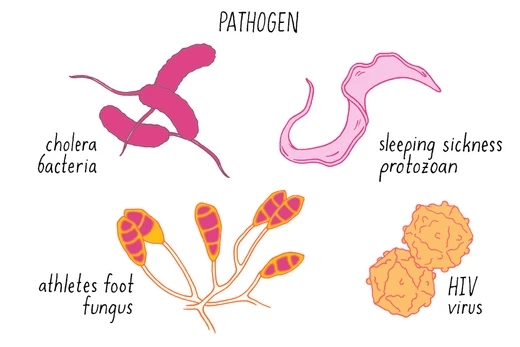
Trypanosoma
Parasitic protozoa causing sleeping sickness and Chagas disease.

Trypanosoma is a genus within the kinetoplastids, a group of single-celled, parasitic flagellates in the phylum Euglenozoa. Its name comes from the Ancient Greek words for "borer" and "body," a reference to its corkscrew-like movement. Most species in this genus are heteroxenous, meaning they require more than one obligatory host to complete their life cycle, and are typically transmitted by a vector. While most are spread by blood-feeding invertebrates, the mechanisms vary: *Trypanosoma equiperdum*, for instance, is transmitted between horses and other equines through sexual contact. In their invertebrate hosts, these parasites are usually found in the intestine, while in vertebrate hosts they typically occupy the bloodstream or an intracellular environment. Trypanosomes infect a wide range of hosts and cause several diseases, including the fatal human illnesses sleeping sickness (caused by *Trypanosoma brucei*) and Chagas disease (caused by *Trypanosoma cruzi*).
The mitochondrial genome of *Trypanosoma* and other kinetoplastids is called the kinetoplast. It consists of a highly complex network of catenated circles and minicircles and requires a set of proteins to organize during cell division.
The history of their study begins in 1841, when Gabriel Valentin observed flagellates now classified under *Trypanoplasma* in the blood of trout. The genus itself was named *Trypanosoma* (as *T. sanguinis*) by Gruby in 1843, after finding parasites in frog blood. In 1903, David Bruce identified both the protozoan parasite and the tsetse fly vector responsible for African trypanosomiasis.
Taxonomically, early phylogenetic analyses using 18S ribosomal RNA sequences suggested that *Trypanosoma* as traditionally defined was not monophyletic, with the biflagellate Bodonida nested within it. These studies indicated an ancient split between a branch containing all Salivarian trypanosomes and a branch containing all non-Salivarian lineages. The latter branch then split into a clade of bird, reptilian, and Stercorarian trypanosomes infecting mammals, and another clade with a branch of fish trypanosomes and a branch of reptilian or amphibian lineages.
- Field
- Parasitology, Protozoology
- Known for
- Causing sleeping sickness and Chagas disease; corkscrew-like motion; kinetoplast mitochondrial genome
- First described
- 1843 by Gruby (as T. sanguinis)
- Type species
- Trypanosoma sanguinis (in frogs)
Lore & Background
In 1841, Gabriel Valentin found flagellates that today are included in Trypanoplasma in the blood of trout. The genus was named by Gruby in 1843, after parasites in the blood of frogs. In 1903, David Bruce identified the protozoan parasite and the tsetse fly vector of African trypanosomiasis.
Trypanosomes are generally found in the intestine of their invertebrate host, but normally occupy the bloodstream or an intracellular environment in the vertebrate host. The majority of species are transmitted by blood-feeding invertebrates, but there are different mechanisms among the varying species. Trypanosoma equiperdum is spread between horses and other equine species by sexual contact.
The mitochondrial genome of the Trypanosoma, as well as of other kinetoplastids, known as the kinetoplast, is made up of a highly complex series of catenated circles and minicircles and requires a cohort of proteins for organisation during cell division.
Reader's Guide
Trypanosoma species are significant as agents of major human and animal diseases. The genus includes Trypanosoma brucei, which causes African sleeping sickness in humans and nagana in cattle, and Trypanosoma cruzi, which causes Chagas disease in humans. These diseases have substantial health and economic impacts in affected regions. The genus is divided into two groups: Salivaria (African trypanosomes transmitted via tsetse fly saliva) and Stercoraria (Central/South American trypanosomes transmitted via triatomine bug feces). Antigenic variation is a characteristic shared by the Salivaria, particularly well-studied in T. brucei. The evolution of parasitism in Trypanosoma dates back to the origin of the order Trypanosomatida. The Salivaria split from the rest of the trypanosomes about 150 million years ago, while the common ancestor of the T. cruzi clade appeared about 84 million years ago. Evidence has been obtained for meiosis in T. cruzi and T. brucei, which may provide recombinational repair of DNA damages acquired in the hostile environment of their hosts.
Did You Know?
- The name Trypanosoma comes from Ancient Greek trypano- (borer) and soma (body) due to their corkscrew-like motion.
- Evidence for meiosis has been obtained in both T. cruzi and T. brucei.
More in Infectious Agents And Pathogens 1-21
Spotted an error? Know more?
Reader corrections go straight into our review queue. Suggest an edit · How this site is sourced