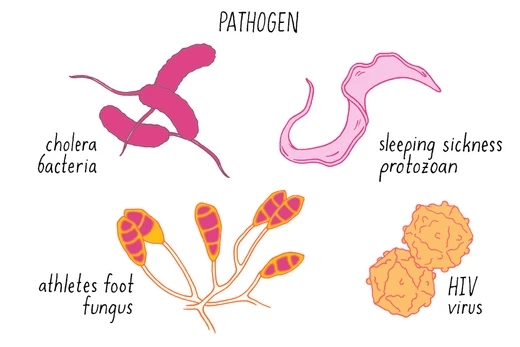
Trypanosoma brucei
Parasite causing sleeping sickness and nagana in sub-Saharan Africa.

Trypanosoma brucei is a parasitic kinetoplastid found only in sub-Saharan Africa. Unlike most protozoan parasites, which invade blood or tissue cells, this species lives exclusively outside cells, dwelling in blood plasma and other body fluids. It causes two deadly diseases spread by insect vectors: African trypanosomiasis, or sleeping sickness, in humans, and animal trypanosomiasis, called nagana, in cattle and horses. The species is actually a complex of five subspecies: *T. b. brucei*, *T. b. equiperdum*, *T. b. evansi*, *T. b. gambiense*, and *T. b. rhodesiense*. The first infects non-human mammals and causes nagana, while the last two are zoonotic, infecting both humans and animals and leading to African trypanosomiasis.
Transmission between mammal hosts occurs through the bite of various tsetse fly species (*Glossina*) during a blood meal. The parasite undergoes complex changes in shape and form as it moves between insect and mammal over its life cycle. In the mammalian bloodstream, it is notable for its surface proteins, called variant surface glycoproteins, which undergo remarkable antigenic variation. This allows the parasite to persistently evade the host's adaptive immunity, leading to chronic infection. *T. brucei* is one of the few pathogens that can cross the blood-brain barrier. Current treatments can have severe side effects and may even prove fatal, creating an urgent need for new drug therapies.
Although *T. b. equiperdum* and *T. b. evansi* have historically been regarded as subspecies of *T. brucei*, they differ in transmission routes, clinical presentations, and have lost part or all of their maxicircle DNA (though not all kinetoplast DNA). Genetic analyses show they evolved from parasites very similar to *T. b. brucei* and are now thought to belong to the brucei clade.
The parasite was discovered in 1894 by Sir David Bruce, and the scientific name was given in 1899.
Quick Facts
- Genus
- Trypanosoma
- Parent
- Trypanosoma (Trypanozoon)
- Species
- brucei
Facts from the source article.
Lore & Background
The parasite was discovered in 1894 by Sir David Bruce, who was appointed by the Royal Army Medical Corps to investigate nagana in South Africa. On 27 October 1894, Bruce and his wife Mary Elizabeth Bruce moved to Ubombo Hill, where the disease was most prevalent. On the sixth day of investigation, Bruce identified parasites from the blood of diseased cows, initially noting them as a kind of filaria, but by the end of the year established they were protozoan and the cause of nagana. The scientific name was created in 1899 by British zoologists Henry George Plimmer and John Rose Bradford as Trypanosoma brucii due to a printer's error.
Human sleeping sickness was first described medically by John Atkins in 1734, and Thomas Masterman Winterbottom gave a clearer description in 1803, noting swollen posterior cervical lymph nodes (Winterbottom's sign). The first human trypanosome was found by Robert Michael Forde in 1901 in Gambia, and identified as a protozoan by Joseph Everett Dutton, who proposed the name Trypanosoma gambiense. Another human trypanosome (now T. brucei rhodesiense) was discovered by John William Watson Stephens and Harold Benjamin Fantham in 1910.
The Royal Society constituted a Sleeping Sickness Commission in 1902 to investigate an epidemic in Uganda. David Bruce led the second commission, and by August 1903 established that the disease was transmitted by the tsetse fly Glossina palpalis. Friedrich Karl Kleine discovered in 1909 that the parasite had developmental stages in tsetse flies, and Muriel Robertson established between 1911 and 1912 how ingested trypanosomes reach the salivary glands.
Reader's Guide
Trypanosoma brucei is significant as the causative agent of African trypanosomiasis (sleeping sickness) in humans and nagana in animals, diseases that have caused major epidemics in sub-Saharan Africa. The parasite is transmitted by tsetse flies (Glossina) and undergoes complex morphological changes during its life cycle. Its mammalian bloodstream forms feature variant surface glycoproteins that undergo remarkable antigenic variation, enabling persistent evasion of host adaptive immunity and leading to chronic infection. T. brucei is one of only a few pathogens known to cross the blood-brain barrier. The parasite is a species complex grouped into five subspecies: T. b. brucei, T. b. equiperdum, T. b. evansi, T. b. gambiense, and T. b. rhodesiense. The first causes nagana in non-human mammals, while the latter two are zoonotic and cause African trypanosomiasis. Genetic analyses reveal that T. b. equiperdum and T. b. evansi evolved from parasites similar to T. b. brucei. There is an urgent need for new drug therapies, as current treatments can have severe side effects and can prove fatal.
Did You Know?
- The parasite was discovered in 1894 by Sir David Bruce, after whom it was named in 1899.
- It is exclusively extracellular, inhabiting blood plasma and body fluids, unlike other protozoan parasites.
- The subspecies T. b. equiperdum and T. b. evansi have lost kinetoplast DNA and are not historically regarded as T. brucei subspecies.
More in Infectious Agents And Pathogens 1-21
Spotted an error? Know more?
Reader corrections go straight into our review queue. Suggest an edit · How this site is sourced