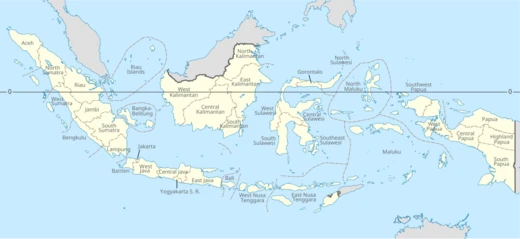
West Java
Most populous Indonesian province, homeland of the Sundanese people.

West Java, known in Indonesian as Jawa Barat and in Sundanese as Jawa Kulon, sits on the western end of Java island. Its provincial capital is Bandung, while its most populous city is Bekasi. The province was among the original eight formed right after Indonesia declared independence, and it was officially re-established on July 14, 1950. Together with Banten, West Java is the traditional homeland of the Sundanese people, who make up Indonesia’s second-largest ethnic group.
Quick Facts
- Native Name
- id · Jawa Barat
- Official Name
- Province of West Java / id · Provinsi Jawa Barat
- Nickname
- su · Tatar Sunda / ᮒᮒᮁ ᮞᮥᮔ᮪ᮓ / "Land of the Sundanese"
- Shield Size
- 100
- Motto
- su · Gemah, Ripah, Répéh, Rapih / ᮌᮨᮙᮂ ᮛᮤᮕᮂ ᮛᮦᮕᮦᮂ ᮛᮕᮤᮂ · "Prosperous, Peaceful, Convenient, and Harmonious"
- Established Title
- Established
- Established Date
- 14 July 1950
- Seat Type
- Capital
- Seat
- Bandung
Facts from the source article.
Lore & Background
West Java was one of the first eight provinces of Indonesia formed after independence and legally re-established on 14 July 1950. With effect from 18 February 1960, Jakarta was designated as a special capital region, and in October 2000 the western parts were split away to form Banten province. Even after these split-offs, West Java remains by far the most populous province of Indonesia, with a population of 48,274,162 as of the 2020 Census, growing to 50,759,003 at mid 2025. The province's largest cities—Bekasi, Bandung, and Depok—are the third, fourth, and sixth most populous cities in Indonesia respectively, with Bandung also being one of the most densely populated cities proper in the world.
Historically, the region was home to the Tarumanagara kingdom, with fourth-century stone inscriptions in Wengi letters and Sanskrit. The Sunda Kingdom later became the ruling power, reaching its peak under King Sri Baduga Maharaja (1482–1521). The Luso-Sundanese Treaty with the Portuguese was signed in 1522, but Sunda Kalapa harbor fell to the alliance of Demak and Cirebon sultanates in 1524. The Sunda kingdom declined under pressure from the Sultanate of Banten, losing its capital at Pakuan Pajajaran after 1576. In the 16th century, Dutch and British trading companies arrived, and for the next three hundred years western Java fell under Dutch East Indies administration.
Reader's Guide
West Java's significance lies in its role as the most populous province in Indonesia and the cultural heartland of the Sundanese people. Its history reflects the broader patterns of Indonesian state formation: it was among the first eight provinces established after independence, and its boundaries were reshaped by the separation of Jakarta as a special capital region in 1961 and the creation of Banten province in 2000. The province's demographic weight is substantial, with a population exceeding 50 million by mid 2025 and continuing to grow by about 400,000 per year. Its urban centers—Bekasi, Bandung, and Depok—are among Indonesia's largest cities, with Bandung noted for extreme population density. The region's archaeological heritage includes the prehistoric Buni culture and the Batujaya Archaeological Site dating from the 2nd century. Historically, the Sunda Kingdom's treaty with the Portuguese in 1512 represents an early international diplomatic engagement in the archipelago. The province's contemporary governance includes a governor, vice governor, and a 120-member Regional House of Representatives, with elections held on 14 February 2024. Proposals to rename the province Pasundan reflect ongoing cultural identity discussions.
Did You Know?
- West Java's population surpassed 50 million during late 2023.
- The Luso-Sundanese Treaty of 1522 was the first international treaty of the Sunda Kingdom with Europeans.
- The prehistoric Buni culture near present-day Bekasi produced clay pottery dated 400 BC – AD 100.
Frequently Asked Questions
Who is West Java?
West Java (Jawa Barat in Indonesian, Jawa Kulon in Sundanese) is a province occupying the western end of Java island. It was one of the original eight provinces created in the wake of Indonesia's independence and was formally re-established on 14 July 1950.
What are West Java's powers/role?
As Indonesia's most populous province—home to roughly 50.7 million people by mid-2025 estimates—West Java wields outsized demographic and economic influence. It also functions as the ancestral homeland of the Sundanese, the nation's second-largest ethnic group.
Where is West Java located?
West Java stretches across the western portion of Java island, sitting between the Java Sea to the north and the Indian Ocean to the south. Its western neighbor is the smaller province of Banten, while it extends eastward toward the central-Java border region.
What is West Java's capital and largest city?
Bandung serves as the provincial capital and a major cultural hub, while Bekasi is the most populous city within the province's borders.
Why is West Java important?
Beyond its sheer population size, West Java is the cultural heartland of the Sundanese people, whose language, literature, and traditions have long shaped broader Indonesian identity. Its status as one of the first provinces formed after independence also underscores its foundational place in the country's political architecture.
More in Indonesian Provinces 1-19
Spotted an error? Know more?
Reader corrections go straight into our review queue. Suggest an edit · How this site is sourced