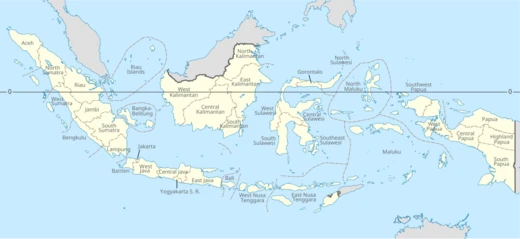
South Kalimantan
Smallest Kalimantan province, second most populous, Banjar cultural heartland.

Geospatial Information Agency of Indonesia · Public domain
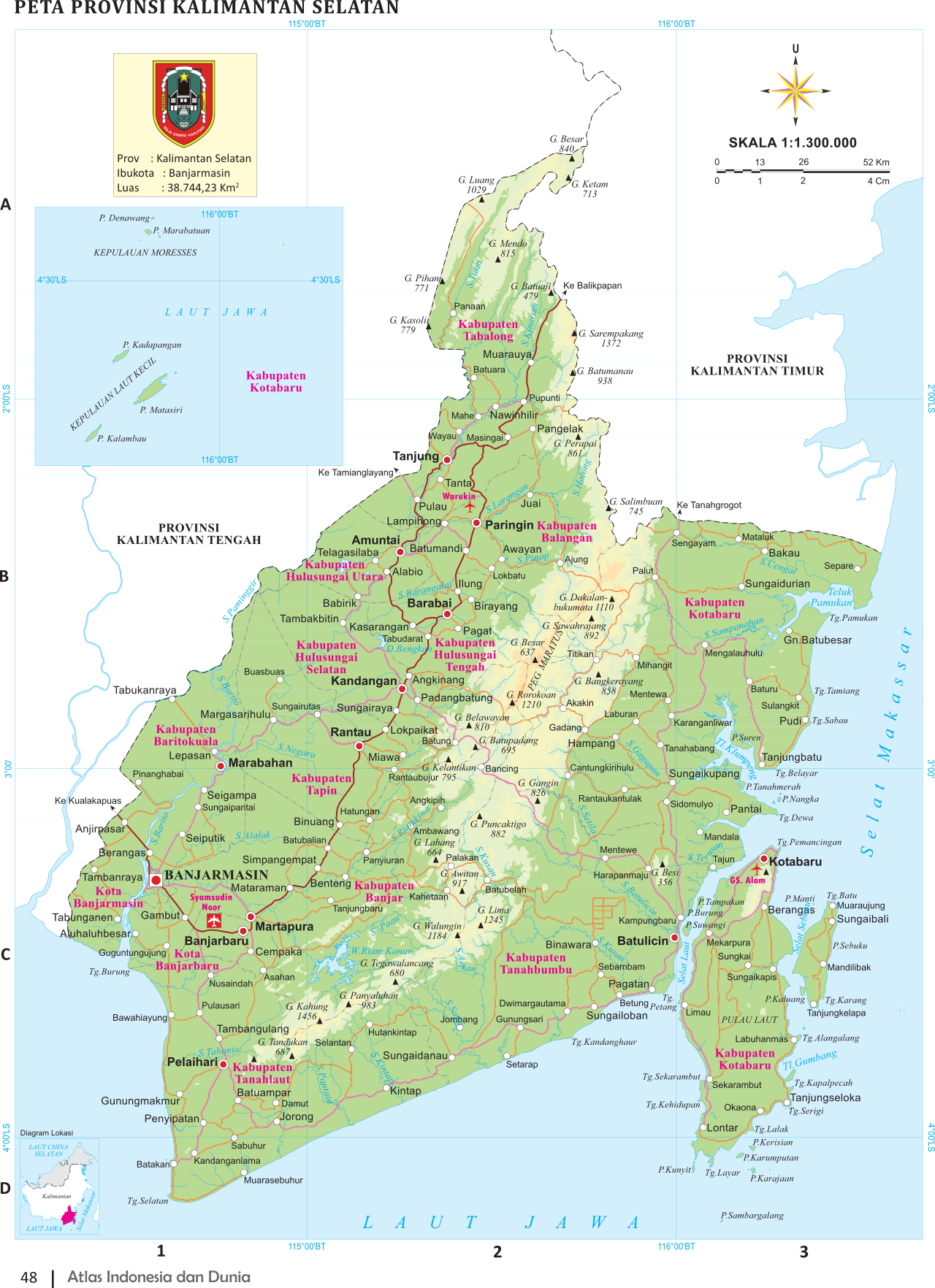
South Kalimantan is a province of Indonesia, the smallest on the island of Kalimantan by land area but the second most populous. It is the traditional homeland of the Banjar people and has long been the cultural capital of Banjarese culture, with its former capital Banjarmasin serving as the center. The province's history includes local kingdoms, Dutch colonization, and Japanese occupation before Indonesian independence.
Quick Facts
- Shield Link
- #Coat of arms
- Shield Size
- 80
- Established Title
- Established
- Established Date
- 14 August 1950
- Seat Type
- Capital
- Leader Title
- Governor
- Leader Name
- Muhidin (PAN)
- Governing Body
- South Kalimantan Provincial Government
Facts from the source article.
Lore & Background
The territory of what is now South Kalimantan alternated between local kingdoms due to its strategic trade location. According to Maanyan mythology, the first kingdom in southern Kalimantan was the Nan Sarunai Kingdom, estimated to have ranged from Tabalong to Paser. The Nan Sarunai kingdom was invaded multiple times by Majapahit, with the third and last invasion under Hayam Wuruk in 1355, leading to the founding of the Hindu kingdom Negara Dipa under Majapahit tributary, predecessor of Negara Daha and the Banjar Sultanate.
Raden Samudra, grandson of Maharaja Sukarama, became the first king of the Sultanate of Banjar around 1526 with the title Sultan Suriansyah, and was the first king to convert to Islam. The Banjar Sultanate experienced its golden age in the first decade of the 17th century with pepper as a trade commodity, with parts of Borneo paying tribute. The Banjar people are genetically a mix of ancient Malay Dayak and Maanyan ancestry, and other Barito-speaking peoples migrated out of Borneo between 500 and 800 AD to what is now Madagascar, with the Malagasy language similar to Banjar.
Reader's Guide
South Kalimantan holds significance as the smallest province on Kalimantan by land area yet the second most populous, with a population larger than Mongolia. Its history reflects a blend of indigenous Maanyan, Javanese, Malay, and later Islamic influences, culminating in the Banjar Sultanate. The province is the traditional homeland of the Banjar people, who have migrated to other parts of Indonesia and neighboring countries such as Singapore and Malaysia. The Banjar language's similarity to Malagasy and genetic evidence supports a migration from Borneo to Madagascar about 1,200 years ago, highlighting the province's role in broader Austronesian dispersal. The legacy of the Nan Sarunai kingdom, Negara Dipa, and the Banjar Sultanate is preserved in archaeological sites like the Candi Agung complex and in Dayak Maanyan poetry. Today, South Kalimantan remains a cultural capital for Banjarese culture, with its capital moved from Banjarmasin to Banjarbaru in 2022.
Did You Know?
- The Banjar language is similar to the Malagasy language spoken in Madagascar, and genetic evidence suggests other Barito-speaking peoples migrated there between 500 and 800 AD.
- The Nan Sarunai kingdom, according to Maanyan mythology, was invaded by Majapahit multiple times, with the last invasion in 1355 under Hayam Wuruk.
- The provincial capital was moved from Banjarmasin to Banjarbaru on 15 February 2022, 35 km southeast.
Provincial Origins & Administrative Evolution
South Kalimantan traces its provincial identity to a pivotal moment in Indonesian territorial reorganization. From 1945 to 1956, the entire Indonesian portion of Borneo was governed as a single administrative unit. In 1956, this monolithic province was divided into three: East Kalimantan, South Kalimantan, and West Kalimantan. However, South Kalimantan's borders were not yet final. Just a year later, in 1957, the newly formed province of Central Kalimantan was carved out of South Kalimantan's existing territory, reshaping the province's area and population. This two-step process—first gaining independence as a province, then losing a portion of its land to a new neighbor—established the boundaries that would persist for decades. The next major administrative change in the region came much later, on 25 October 2012, when North Kalimantan was split from East Kalimantan, bringing the total to five provinces. South Kalimantan, however, has retained its 1957 borders ever since, making it one of the more stable provincial entities in Indonesian Borneo.
The Name and Its Roots
The very name under which South Kalimantan operates—Kalimantan—carries a poetic weight rooted in ancient Sanskrit. The term derives from Kalamanthana, a compound of kal[a], meaning time, season, or period, and manthan[a], meaning boiling, churning, or burning. Together, the phrase evokes a burning weather island or a very hot island, a description that aptly captures the sweltering tropical climate of the region. When sixteenth-century Portuguese explorer Jorge de Menezes made contact with the island's native inhabitants, they identified their home as Pulu K'lemantan, a form that closely mirrors the modern name. Interestingly, the English-speaking world adopted a different label: Borneo, a name that stuck because European explorers first encountered the Bruneian Sultanate in the island's northern reaches. Within Indonesia itself, however, the name Borneo is not used; the island is simply Kalimantan. South Kalimantan, as one of five provinces, inherits this layered nomenclature—a blend of Sanskrit etymology, indigenous self-identification, and colonial-era cartography.
Scale, Environment, and Ecological Pressure
South Kalimantan sits within a region of staggering geographic magnitude. The Indonesian portion of Borneo spans 534,698.27 square kilometres, accounting for 73 percent of the entire island's land area. This vast territory is shared among five provinces, with South Kalimantan occupying a portion of this immense landscape. Yet the region's scale has come at a profound environmental cost. Academics have repeatedly characterized the widespread deforestation and ecological destruction across Kalimantan—and by extension the provinces within it, including South Kalimantan—as an ecocide. The term underscores the severity of habitat loss in one of the world's most biodiverse tropical regions. Meanwhile, the island's population has grown considerably: from 13,772,543 in the 2010 Census to 16,625,796 by 2020, a surge of nearly three million people in a decade. This demographic pressure, combined with industrial and agricultural expansion, intensifies the environmental challenges that scholars describe in the strongest possible terms. South Kalimantan, as a province within this system, is directly implicated in both the ecological and demographic dynamics shaping Indonesian Borneo.
South Kalimantan in the Broader Capital Narrative
While South Kalimantan itself is not the site of Indonesia's most ambitious modern project, it exists within the same provincial framework that frames the nation's capital relocation. In 2019, President Joko Widodo proposed moving the national capital from Java to Kalimantan. The People's Consultative Assembly approved the Law on State Capital in January 2022, and the planned city of Nusantara was designated within East Kalimantan. Construction was expected to be fully complete by 2045, and the unfinished capital officially marked Indonesian Independence Day for the first time before a scheduled inauguration on 17 August 2024—a ceremony that ultimately did not proceed due to construction delays. South Kalimantan, as a neighboring province within the five-province structure, is part of the broader administrative and geographic context in which this historic shift is unfolding. The capital move reshapes the political and economic gravity of the entire Kalimantan region, and South Kalimantan's position as one of the original three provinces created in 1956 gives it a foundational role in the island's modern administrative identity.
Gallery

Frequently Asked Questions
Who is South Kalimantan?
South Kalimantan is the smallest province on the island of Kalimantan by land area yet ranks second in population there. It is the traditional homeland of the Banjar people and has long been regarded as the cultural heartland of Banjarese identity.
What are South Kalimantan's powers/role?
Its defining role is serving as the cultural capital of Banjar heritage, a position historically anchored by Banjarmasin. It also administers 11 regencies and supports a population above four million, giving it outsized demographic influence despite its compact footprint.
Why is South Kalimantan important?
At roughly 37,125 km² it is the tiniest Kalimantan province, yet it holds the second-largest population on the island and is the epicenter of Banjar civilization. That rare blend of small area, dense population, and deep cultural heritage makes it a disproportionately significant slice of Indonesian identity.
Where does South Kalimantan sit on the map?
It occupies the southern portion of the island of Kalimantan, making it the southernmost province on that island. As of mid-2025 estimates, over 4.3 million people call this compact region home across its 11 regencies.
More in Indonesian Provinces 1-19
Spotted an error? Know more?
Reader corrections go straight into our review queue. Suggest an edit · How this site is sourced