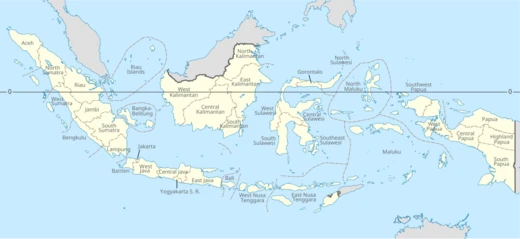
North Kalimantan
Province formed in 2012 from East Kalimantan.

Kaidor · CC BY-SA 4.0
North Kalimantan (Indonesian: Kalimantan Utara) is a province of Indonesia, located in the northernmost part of Kalimantan on the island of Borneo. Formed on 25 October 2012 after separating from East Kalimantan, it was created to reduce development disparity and Malaysia's influence over the territory. The province is bordered by the Malaysian states of Sabah and Sarawak, and by East Kalimantan to the south. Its capital is Tanjung Selor, while Tarakan is the largest urban area, sole city, and financial centre.
Quick Facts
- Official Name
- Province of North Kalimantan / id · Provinsi Kalimantan Utara
- Shield Size
- 90
- Shield Link
- #Coat of arms
- Established Title
- Established
- Established Date
- 17 November 2012
- Seat Type
- Capital
- Leader Title
- Governor
- Leader Name
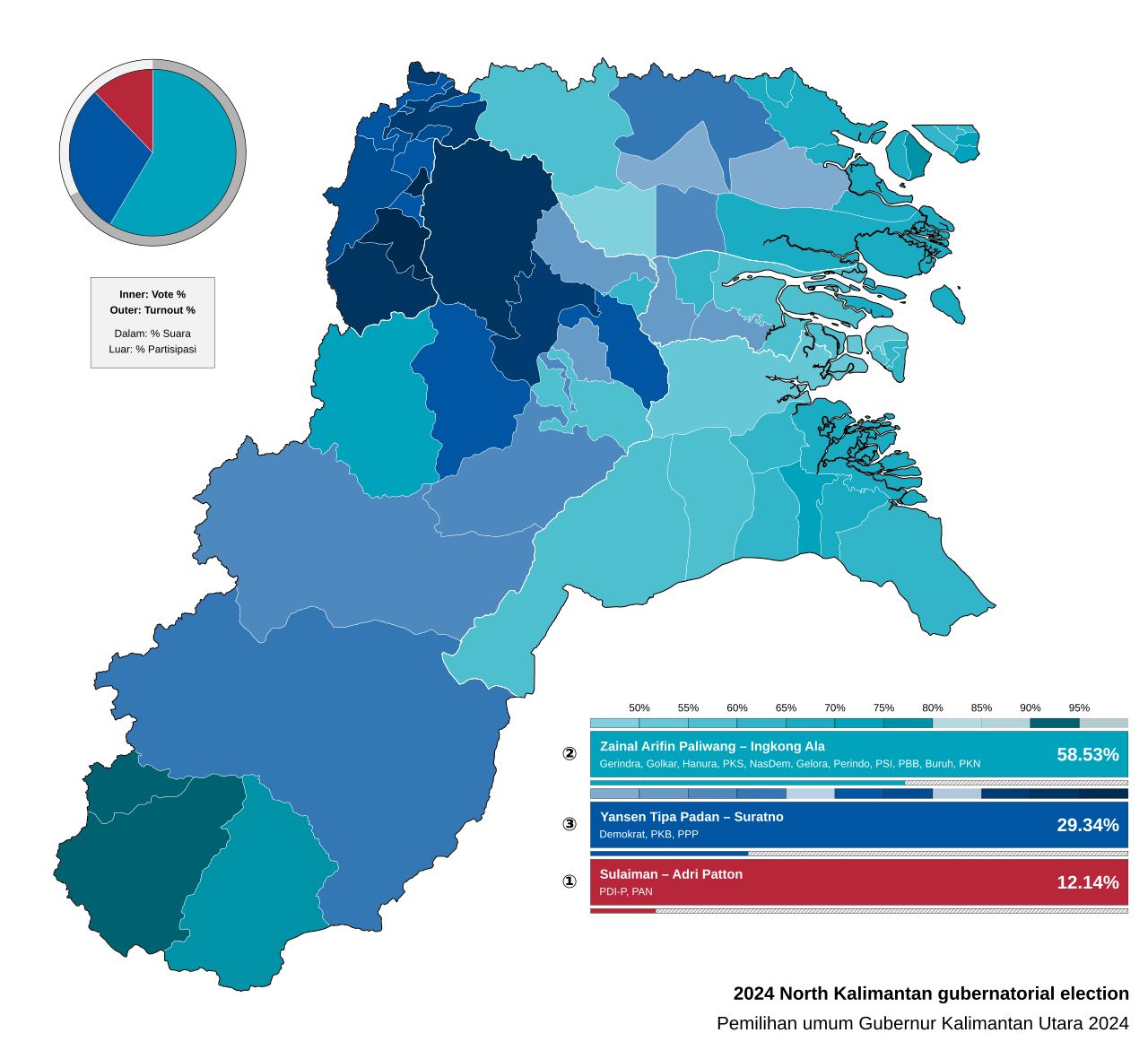
- Zainal Arifin Paliwang (Gerindra)
- Governing Body
- North Kalimantan Provincial Government
Facts from the source article.
Lore & Background
North Kalimantan is the territory of the Sultanate of Bulungan, founded by coastal Kayan. Around the 16th century, a Kayan princess named Asung Luwan married a Brunei nobleman, Datuk Mencang, establishing a princely state centered in Tanjung Selor. The sultanate was a vassal of Berau and later fell under Dutch influence. In the late 18th century, the royal family converted to Islam, and the first sultan to adopt the title Sultan Alimuddin marked the beginning of the Islamic sultanate. In 1853, the Dutch imposed sovereignty via a Politiek Contract, and in 1881 the British North Borneo Company claimed Tawau. After negotiations, the Dutch recognized British borders in 1915, forming the modern border with Sabah. During World War II, the Japanese occupation affected the region, though specific claims about resource-sharing or exemption from forced labor remain unsubstantiated.
During the Indonesia–Malaysia confrontation in 1963, the sultanate's position on Malaysia was ambiguous. In April 1964, a document allegedly proved ties between Bulungan aristocracy and Malaysia. This led to the Bultiken Tragedy, during which the palace was invaded by military units, burned and looted, and royal family members killed. While accounts vary, mainstream historical records do not consistently verify a direct order from Brigadier General Soeharjo or the exact date of 3 July 1964 for the burning. According to Burhan Djabier, the central TNI leadership did not act because Soeharjo was a leftist and politically connected. The sultanate holds that the PKI was responsible for the burning and ethnic cleansing. Surviving royals fled to Malaysia; in 2017, they announced they were in the process of becoming Indonesian citizens.
Reader's Guide
North Kalimantan is significant as Indonesia's youngest province at its formation, created to address development disparities and counter Malaysian influence in the border region. Its history is deeply tied to the Sultanate of Bulungan, which experienced a violent purge during the Indonesia–Malaysia confrontation, leading to the destruction of the royal palace and the flight of the aristocracy. The province remains sparsely populated and underdeveloped, with large stretches of unpaved roads and no international land crossings. Its transport relies on Tarakan's Juwata International Airport, shared with a military airbase, and ferry services to Malaysia. The Trans-Kalimantan Highway, completed in early 2019, connects the capital Tanjung Selor to Pontianak. The province's coat of arms, revised in 2021, incorporates Dayak, Bulungan, and Tidung motifs, and the motto 'Benuanta' means 'our land that must be developed together'. North Kalimantan's legacy includes its role in border security, its unique cultural heritage, and its ongoing efforts to integrate former royal exiles.
Did You Know?
- The province's capital is Tanjung Selor, but Tarakan is the largest urban area and sole city.
- During the 1964 Bultiken Tragedy, the Sultan of Bulungan's palace was burned and royal family members were killed.
- The Trans-Kalimantan Highway, finished in early 2019, connects Pontianak with Tanjung Selor.
Etymology & the Question of a Name
The name Kalimantan traces back to the Sanskrit compound Kalamanthana, a pairing of kal[a] (meaning time, season, or period) and manthan[a] (boiling, churning, or burning), together evoking an island of relentless, scorching tropical heat. When sixteenth-century Portuguese explorer Jorge de Menezes made first contact with the island's native inhabitants, they identified their home as Pulu K'lemantan. The English name Borneo arose because European explorers, during the Age of Exploration, first encountered the Bruneian Sultanate in the island's northern region, and that designation stuck in Western languages. In Indonesia itself, however, the entire island is simply called Kalimantan. A British colonist named Charles Hose, writing in the early twentieth century, described the island as home to a Klemantan people, a term that has since fallen out of use, reflecting the reality that Kalimantan has always been home to many distinct ethnic groups rather than a single unified people.
From One Province to Five: Administrative Evolution
From 1945 through 1956, the entire Indonesian portion of Borneo was governed as a single, unified province. The first major reorganization arrived in 1956, when that one territory was divided into three provinces: East Kalimantan, South Kalimantan, and West Kalimantan. The following year, 1957, brought another split as Central Kalimantan was carved out of South Kalimantan, bringing the total to four provinces. That four-province configuration endured for more than five decades until October 25, 2012, when North Kalimantan was formally separated from East Kalimantan, establishing the current five-province structure. This latest division adjusted both the population and area figures recorded for East Kalimantan in the 2015 census. The stepwise administrative fragmentation across nearly seven decades reflects a long and ongoing trajectory of decentralization, with each new province representing a political and geographic redefinition of the island's internal boundaries and governance.
Nusantara: The Ambition of a New Capital
In 2019, President Joko Widodo put forward the bold proposal to relocate Indonesia's national capital to Kalimantan. The initiative gained formal legislative backing when the People's Consultative Assembly approved the Law on State Capital in January 2022. The designated site, a planned city named Nusantara, will be developed within the province of East Kalimantan. A government official indicated that full construction completion is targeted for 2045, giving the project a long runway. The still-unfinished capital did manage to officially celebrate Indonesian Independence Day for the first time, and a formal inauguration as the seat of government was scheduled for August 17, 2024. However, that transfer never actually took place, as construction delays forced the postponement. The project stands as one of the most ambitious urban development undertakings in the nation's history, set to transform a portion of East Kalimantan into the future political heart of Indonesia.
Scale, Population, and the Weight of Ecocide
The Indonesian portion of Borneo spans 534,698.27 square kilometres, accounting for a commanding 73% of the island's total area. The 2020 census recorded a population of 16,625,796, a significant increase from 13,772,543 in 2010, and representing 72.1% of the island's combined 2020 population of 23,053,723. The remaining residents are distributed across Brunei (460,345) and East Malaysia (5,967,582, spread among the states of Sabah, Sarawak, and the federal territory of Labuan). Beyond its sheer physical scale and growing population, Kalimantan confronts severe environmental pressures. Academics have frequently characterized the widespread deforestation and other forms of ecological destruction across Kalimantan and other parts of Indonesia as an ecocide, underscoring the profound gravity of habitat loss on one of the world's largest tropical islands.
Gallery
Frequently Asked Questions
What is North Kalimantan?
North Kalimantan (Kalimantan Utara) is an Indonesian province sitting at the very top of Borneo, sharing a land border with Malaysia's Sabah and Sarawak to the north and East Kalimantan to the south.
When was North Kalimantan established?
The province was officially formed on 25 October 2012, carved out of the larger East Kalimantan province.
What is the capital of North Kalimantan?
Tanjung Selor holds the title of provincial capital, while Tarakan is the only city in the province and also its main financial centre.
Why was North Kalimantan split off from East Kalimantan?
The separation was pushed through to narrow the development gap in the far-north region and to strengthen Indonesia's sovereign hold on territory that had long been influenced by neighbouring Malaysia.
How big is North Kalimantan in area and population?
The province spans roughly 69,901 square kilometres and was home to about 701,784 people at the 2020 census, with a mid-2025 estimate pushing past 749,000.
More in Indonesian Provinces 1-19
Spotted an error? Know more?
Reader corrections go straight into our review queue. Suggest an edit · How this site is sourced