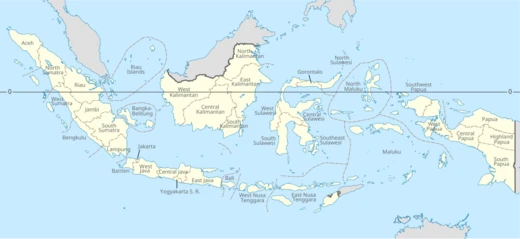
Special Region of Yogyakarta
A diarchic special region in southern Java, Indonesia.

The Special Region of Yogyakarta is a province-level special region of Indonesia, located in southern Java. It is a semi-enclave surrounded by Central Java Province on the landward side and the Indian Ocean to the south. Co-ruled by the Yogyakarta Sultanate and the Duchy of Pakualaman, it is the only officially recognized diarchy within the government of Indonesia. The region is a popular tourist destination and cultural center, known for its classical Javanese fine art and culture, and was the capital of Indonesia from January 1946 to December 1948 during the Indonesian National Revolution.
Quick Facts
- Native Name
- id · Daerah Istimewa Yogyakarta / jv · ꦥꦤꦒꦫꦩꦶꦫꦸꦁꦒꦤ꧀ꦔꦪꦺꦴꦒꦾꦏꦂꦠ / jv · Panagara Mirunggan Ngayogyakarta
- Seal Type
- Coat of arms
- Seat Type
- Capital / and largest city
- Seat
- Yogyakarta
- Established Title
- Established
- Established Date
- 4 March 1950
- Government Type
- Devolved non-sovereign diarchical special region within a unitary republic
- Governing Body
- Special Region of Yogyakarta Provincial Government
- Leader Title
- Governor
- Leader Name
- Hamengkubuwono X (Indp.)Concurrently as the Sultan of the Yogyakarta Sultanate.
Facts from the source article.
Lore & Background
The Yogyakarta Sultanate was established in 1755 and survived Dutch rule and the Japanese invasion of 1942. In August 1945, after Indonesia's independence was proclaimed, Sultan Hamengkubuwono IX and Duke Sri Paku Alam VIII expressed support for the new nation, acknowledging the sultanate as part of the Republic. The region's support was essential during the Indonesian National Revolution (1945–1949), and the city of Yogyakarta served as the national capital from January 1946 to December 1948, after Jakarta fell to the Dutch. In 1950, Yogyakarta was granted special administrative status, making it the only region in Indonesia headed by a monarchy.
Reader's Guide
The Special Region of Yogyakarta holds a unique place in Indonesian history and governance as the only officially recognized diarchy in the country, with the Sultan of Yogyakarta serving as governor and the Duke of Pakualaman as vice governor. Its unwavering support for Indonesian independence during the revolution led to its special status, which was formalized in 1950. The region is a cultural heartland, known for classical Javanese arts such as batik, ballet, and shadow puppetry, and is a major center of higher education. Despite being the second-smallest province-level entity in Indonesia, it has a high population density and is a key tourist destination. The region was struck by a devastating earthquake in 2006, which caused significant loss of life and damage, particularly in Bantul. Mount Merapi, the most active volcano in Indonesia, lies to the north and has erupted regularly since 1548, most recently in 2010.
Did You Know?
- The region was struck by a 6.3-magnitude earthquake on 27 May 2006, killing 5,782 people.
- Mount Merapi, located to the north of Yogyakarta city, is the most active volcano in Indonesia.
Frequently Asked Questions
What makes the Special Region of Yogyakarta unique among all Indonesian provinces?
It is the only officially recognized diarchy in Indonesia, jointly governed by the Yogyakarta Sultanate and the Duchy of Pakualaman. No other province in the country operates under this dual-rulership arrangement.
Where exactly is the Special Region of Yogyakarta located?
It sits in southern Java, hemmed in by Central Java Province on its landward sides with the Indian Ocean stretching out to the south. Geographically it functions as a semi-enclave nested within Central Java.
How many people live in the Special Region of Yogyakarta?
The mid-2025 official population estimate puts the resident count at approximately 3,781,550.
What role did Yogyakarta play during Indonesia's fight for independence?
From January 1946 through December 1948, the region served as the capital of Indonesia during the National Revolution. It hosted the young republic's government throughout that pivotal two-year stretch.
Why is the Special Region of Yogyakarta such a major cultural and tourist destination?
The region is widely regarded as the living heart of classical Javanese fine art, performing traditions, and royal court culture. Its deep heritage of craftsmanship and artistic expression draws visitors from around the world.
More in Indonesian Provinces 1-19
Spotted an error? Know more?
Reader corrections go straight into our review queue. Suggest an edit · How this site is sourced