Pads
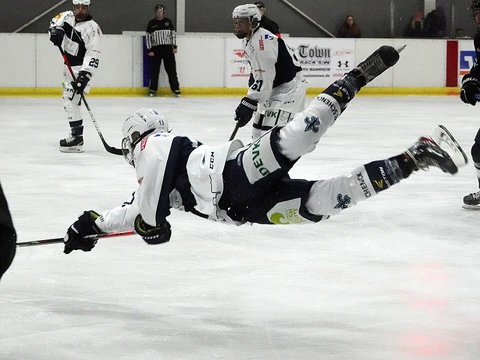
Leg pads protect goaltenders from low puck impacts in ice hockey.

Pads, also called leg guards, are a type of protective equipment used in several sports to shield the lower legs from high-speed impacts by a ball, puck, or other object of play. In ice hockey, goaltenders wear large leg pads to protect against low-down impact from a puck.
- Sports using pads
- cricket, baseball, fastpitch softball, ice hockey, ringette, bandy, rinkball, field hockey, rink hockey, box lacrosse
- Ice hockey goaltender pad materials
- traditional leather, modern lighter synthetic materials
- Ice hockey pad size restrictions
- tightened in recent years by the National Hockey League
- Box lacrosse pad restriction type
- depth of the pads
Lore & Background
In ice hockey, the goaltender wears large leg pads to protect him from low-down impact by a puck. To prevent these leg pads giving him advantage in defending the goal, there are restrictions on their size, which in recent years have been tightened by the National Hockey League. Traditional ice hockey leg pads were made of leather, but now lighter synthetic materials are used. Goaltenders' pads may be styled with geometric patterns for decoration.
Pads are also used by goaltenders in other sports such as ringette, bandy, rinkball, field hockey, rink hockey, and box lacrosse. In box lacrosse the goaltender wears leg pads to protect against the impact of shots low down (since the net is fairly low). There are restrictions on the dimensions of these pads, but unlike in ice hockey these relate to the depth of the pads.
In field hockey, pads are either small shin guards for outfield players or goalkeeping pads similar to those in cricket or ice hockey. In baseball and softball, leg guards are an integral piece of equipment for catchers, designed to protect the knees, shins, ankles, and top areas of the feet from injury due to balls in the dirt and foul tips.
Reader's Guide
The significance of pads in ice hockey lies in their essential role in goaltender safety, allowing the player to face high-speed pucks without serious leg injury. The development of lighter synthetic materials has improved mobility and comfort compared to traditional leather pads. The National Hockey League's tightening of size restrictions reflects a balance between protection and competitive fairness, preventing the pads from becoming an unfair advantage in goal coverage. The use of geometric patterns for decoration adds a visual element to the equipment. In the broader context of stick-and-ball sports, protective wear like pads has enabled tactical changes that would otherwise be impossible without safety equipment. The legacy of pads extends beyond ice hockey to other goalie positions in ringette, bandy, rinkball, field hockey, rink hockey, and box lacrosse, where similar protective needs exist. The restrictions on pad dimensions in box lacrosse, focusing on depth rather than overall size, illustrate sport-specific adaptations of the same protective concept.
Did You Know?
- Ice hockey goaltender pads were traditionally made of leather but now use lighter synthetic materials.
- The National Hockey League has tightened restrictions on the size of goaltender leg pads in recent years.
- In box lacrosse, restrictions on goaltender leg pads relate to the depth of the pads, unlike ice hockey.
Frequently Asked Questions
What are pads in ice hockey?
Pads, commonly referred to as leg guards, are protective gear worn on the lower legs to block high-speed impacts from a puck or other object of play. In ice hockey, goaltenders rely on oversized versions of these guards to shield themselves from low, direct puck shots.
What materials are modern hockey goalie pads made of?
Traditionally, goalie leg pads were constructed from heavy leather, but modern versions use lighter synthetic materials to reduce weight while maintaining protection. This shift allows goaltenders to move more quickly between saves without sacrificing impact resistance.
Why did the NHL tighten restrictions on goalie pad size?
The National Hockey League has progressively reduced the maximum dimensions allowed on goaltender leg pads in recent years. The goal is to open up more shooting lanes and make it harder for goalies to cover the entire lower portion of the net.
How do hockey pads compare to leg guards in other sports?
Leg guards appear across many sports including cricket, baseball, fastpitch softball, ringette, bandy, rinkball, field hockey, rink hockey, and box lacrosse. In ice hockey, however, the pads are notably larger and bulkier because the puck travels at extreme speeds and can strike the lower legs at close range.
What specific threat are hockey goalie pads designed to stop?
The primary purpose of a goaltender's leg pads is to absorb and deflect low-down puck impacts that come along the ice toward the crease. Without them, the repeated force of high-velocity shots would cause serious injury to the shins and lower legs.
More in Ice Hockey Equipment 1-24
Spotted an error? Know more?
Reader corrections go straight into our review queue. Suggest an edit · How this site is sourced