Blocker (ice hockey)
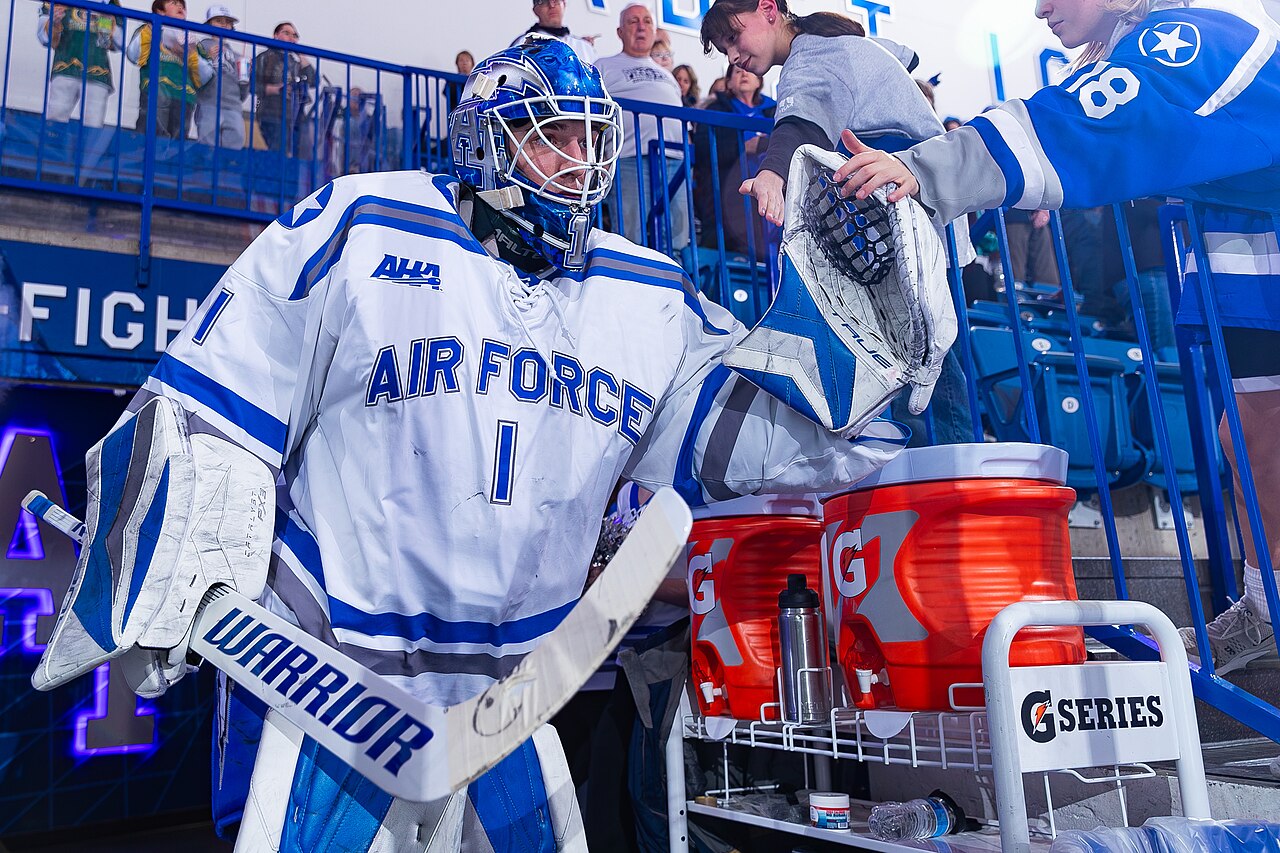
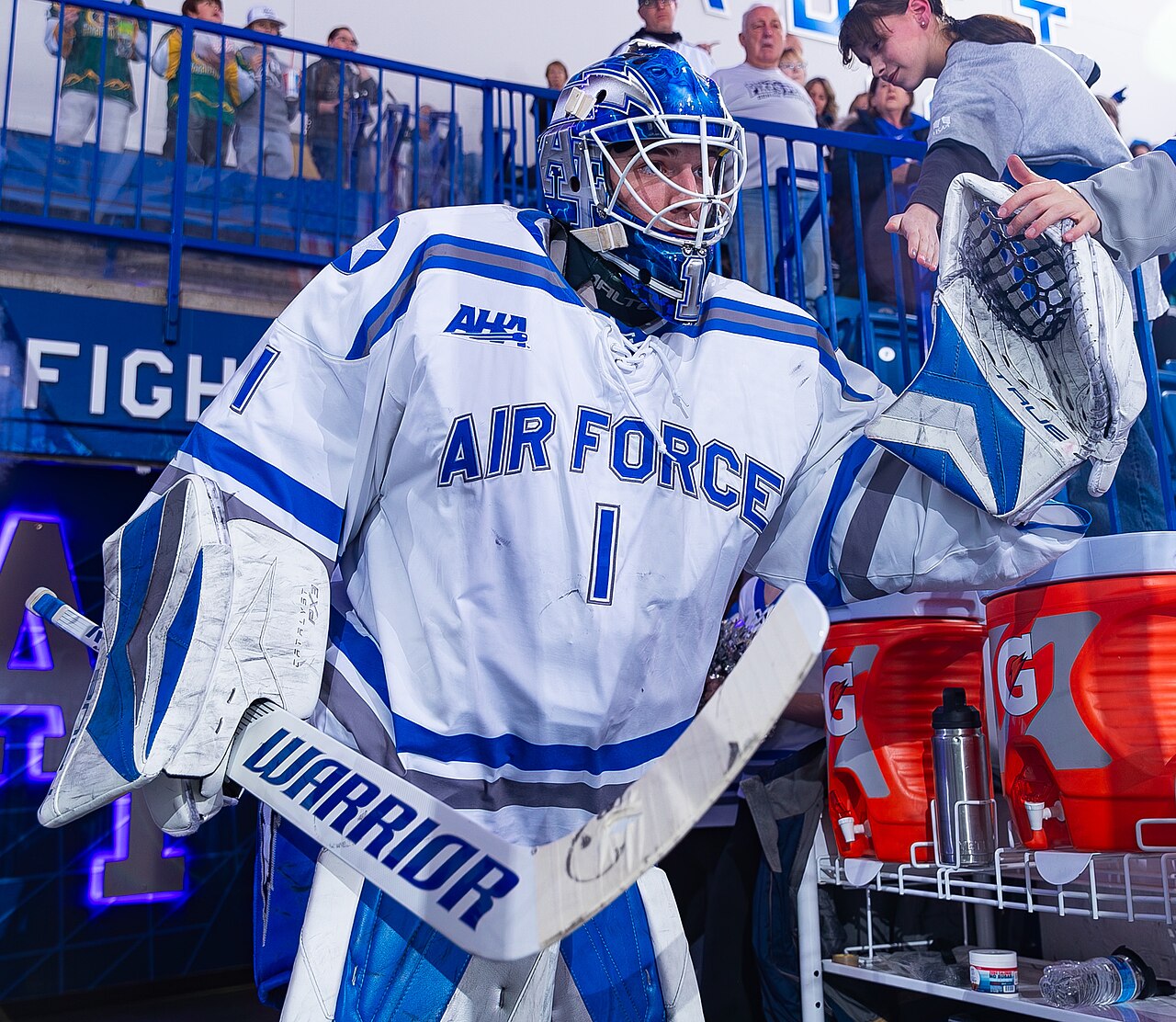
A padded glove used to block and deflect shots.

U.S. Air Force photo by Dylan Smith & Ray Bahner · Public domain
The goalie blocker is a rectangular piece of equipment worn by goaltenders in ice hockey, roller hockey, rink hockey, broomball, and ringette. It is generally worn on the dominant hand and is used to block shots, bouncing them away from the net rather than catching them.
- Also known as
- waffle or waffle-board
- Worn on
- dominant hand
- Sports used in
- ice hockey, roller hockey, rink hockey, broomball, ringette
- Typical setup
- manufactured for right-handed players (standard setup)
Lore & Background
The blocker is a close-fitting glove augmented on the back of the hand, wrist, and part of the forearm by a rectangular block of padding and fabric, either leather or synthetic. Goaltenders hold their stick in that hand and use the padded rectangle to block shots, steering the puck by angling the blocker as it strikes. The padding also protects the hand and lower forearm. The term 'waffle' or 'waffle-board' stems from the visual appearance of the blocker in the pre-modern ice hockey equipment era. Typically, a right-handed goaltender wears the blocker on their dominant right hand, while a left-handed goaltender mirrors this on the left side.
Reader's Guide
The blocker serves a distinct role in goaltending, complementing the catching glove by deflecting shots away from the net rather than holding them. Experienced goalies can steer the puck by angling the blocker upon impact, adding a tactical element to shot stopping. Its design has evolved from early visual forms resembling a waffle to modern close-fitting gloves with protective padding. The blocker's significance lies in its dual function: as a defensive tool to redirect pucks and as protective gear for the hand and forearm. It remains a standard piece of equipment across multiple winter sports, with manufacturing typically oriented toward right-handed players in a standard setup.
Did You Know?
- The blocker is also called a 'waffle' or 'waffle-board' due to its visual appearance in pre-modern equipment.
- It is worn on the dominant hand of the goaltender.
- Blockers are typically manufactured for right-handed players in a standard setup.
From Curling Courses to Hockey Rinks
The word "rink" is a Scots term meaning "course," originally attached to the playing surfaces of curling. When ice hockey was still in its infancy, the sport was predominantly contested on those same curling facilities, and the name simply carried over even after dedicated hockey venues were constructed. The geometric blueprint of the modern rink can be traced to the Victoria Skating Rink in Montreal, which opened in 1862 and hosted the very first indoor hockey game in 1875. That original surface measured 204 by 80 feet. The rounded corners that define every hockey rink today are credited to the design of the Montreal Arena, built in 1898. Beyond hockey itself, the same rectangular, board-surrounded surface—enclosed by walls roughly 1.22 metres high—also accommodates broomball, ringette, rinkball, and rink bandy, making it a genuinely multi-sport platform. The rounded-corner rectangle has endured as the universal template across all of these disciplines for well over a century.
Two Standards, Two Philosophies of Space
Hockey rinks exist in two standard sizes, each reflecting a distinct competitive philosophy. The North American format, codified by the NHL, measures 200 by 85 feet with a 28-foot corner radius. Goal lines sit 11 feet from the end boards, and the blue lines are placed 75 feet from those boards, yielding a 50-foot separation between them. The international standard, governed by the IIHF, stretches to 60 metres in length with a width ranging from 26 to 30 metres and corner radii between 7 and 8.5 metres. In this format the goal lines are set 4 metres from the end boards, and the blue lines are spaced exactly 15 metres apart. The 13.4-foot difference in width between the two formats produces a noticeably different width-to-length ratio, granting international rinks considerably more lateral room for players to skate and pass. Both share the same fundamental geometry—rectangle, rounded corners, surrounding boards—but those proportional shifts shape the tempo and tactical style of play in each region.
The Coloured Grammar of Ice
The playing surface is divided by a system of coloured lines that function as the rulebook's visual language. A thick centre line, which in the NHL must carry a distinctive interval pattern to differentiate it from the solid blue lines, splits the rink crosswise and is used to judge icing as well as, in some leagues, two-line pass violations. Two blue lines partition the ice into three zones and define offside calls: an attacking player who enters the opponent's zone before the puck is called offside. Thin red goal lines at each end determine whether a goal has been scored and assist in icing decisions. Nine faceoff spots are distributed across the surface—two in each defensive zone, two in the neutral zone, and one at centre ice. The centre spot and its 30-foot-diameter circle are blue, with a solid 12-inch blue dot at the middle. All remaining spots are red, 2 feet in diameter, featuring two vertical red lines 3 inches from each inner edge with a red-painted strip between them. Hash marks near the end-zone spots guide legal player positioning during faceoffs and in-game play.
Protecting the Net and Limiting the Keeper
The zone immediately in front of each goal is governed by precise geometric rules designed to shield the goaltender from interference. In North American professional play, the crease is formed by straight lines extending 4.5 feet perpendicularly from the goal line, 1 foot outside each post, joined by a 6-foot-radius arc. Red hash marks 5 inches thick are placed 4 feet from the goal line, extending 5 inches into the crease from either side, and the entire area is typically painted blue for visibility. The goal itself, under NHL rules, has an opening 72 inches wide by 48 inches tall with a 40-inch depth, and a goal is valid only when the entire puck crosses the entire goal line. Behind the net, the trapezoid rule—first trialled during the 2004–05 AHL season—restricts where a goaltender may handle the puck. The symmetrical trapezoid is bounded by the goal line and end boards, and handling the puck outside this zone draws a minor delay-of-game penalty served by a teammate. The rule was crafted to limit the influence of elite puck-handling keepers and promote sustained offensive pressure.
Gallery
Frequently Asked Questions
What is a blocker in ice hockey?
It is a rectangular padded glove that goaltenders use to stop and redirect shots away from the net. Instead of trapping the puck, the flat surface bounces it off, making it the primary defensive tool on one side of the goalie's body.
Which hand does a goalie wear the blocker on?
The blocker is worn on the dominant hand, and most off-the-shelf setups are manufactured for right-handed players as the standard configuration. This means the majority of goalies will have the blocker on their right hand.
Why do some people call the blocker a 'waffle'?
The nickname 'waffle' or 'waffle-board' comes from the grid of raised ridges and grooves molded into the flat blocking face. Those channels help steer deflected pucks outward rather than letting them bounce straight back toward the goal.
What's the difference between a blocker and a catcher glove?
The blocker is the flat, rigid glove built to stop and deflect shots, while the catcher (or trapper) is the deeper, more flexible glove designed to secure the puck in a pocket. Together they form the two-glove setup every goaltender relies on.
Is the blocker only used in ice hockey?
No — the same rectangular blocking glove shows up in roller hockey, rink hockey, broomball, and ringette as well. The core job of deflecting shots off a flat padded surface stays the same across all of those sports.
More in Ice Hockey Equipment 1-24
Spotted an error? Know more?
Reader corrections go straight into our review queue. Suggest an edit · How this site is sourced