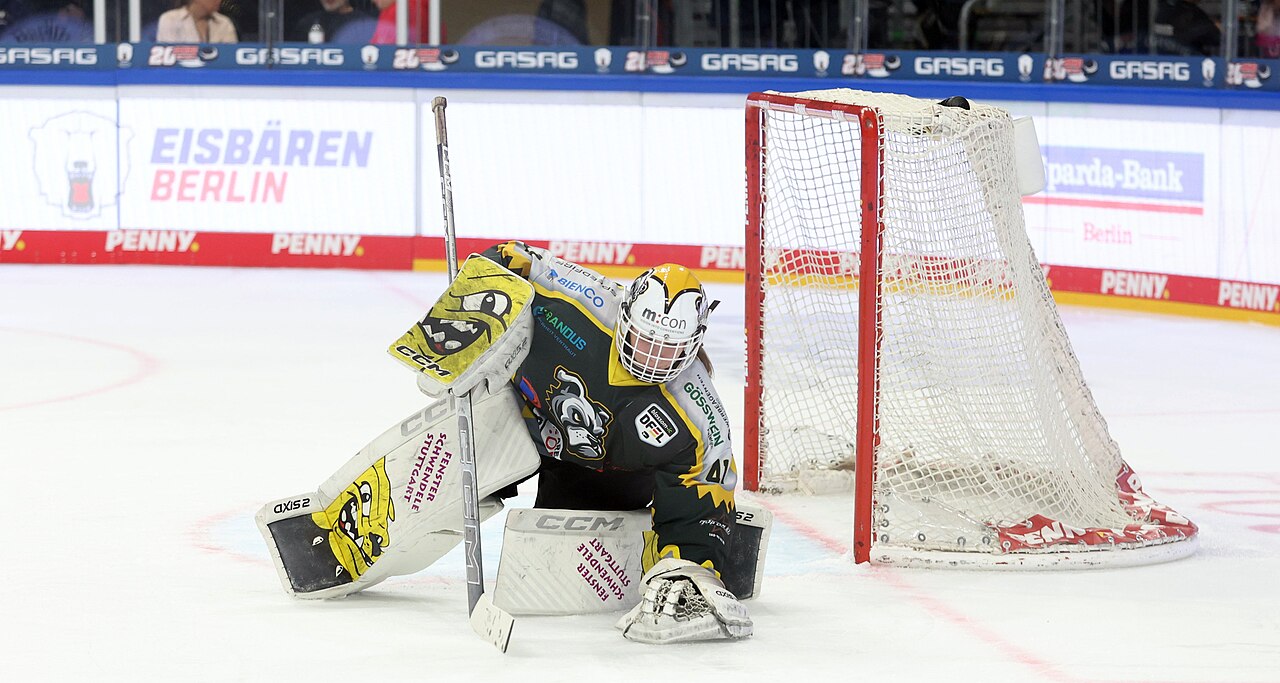
Ice hockey goaltending equipment
Goaltending equipment protects the player and aids in making saves.

Sandro Halank, Wikimedia Commons · CC BY-SA 4.0
In ice hockey, goaltenders wear specialized gear to shield themselves from pucks and help them stop shots. The same equipment, with a few differences, is used in ringette and rinkball. This entry focuses on ice hockey.
Most modern goaltending equipment has an outer layer of hydrophobic synthetic leather and nylon, with dense closed-cell foams and plastics inside. In the past, pads were often made of leather stuffed with horse hair, while professional pads used hollow deer hair for better protection.
Before the 1980s, heavy materials limited how large equipment could be. Lighter materials then allowed for bigger gear, especially leg pads. When scoring dropped dramatically as a result, the NHL, IIHF, and other leagues set maximum equipment sizes to keep the game fair and scoring reasonable. Most European pro leagues and many non-pro leagues follow IIHF size rules.
**Blocker** The blocker is a glove with a rectangular board on the backhand side. The board usually curves upward at one end to help control deflections and create a tougher angle on shots when using the shaft-down technique. It is worn on the hand that holds the stick—right-handed goaltenders wear it on the right, left-handed on the left. A goaltender who wears the catch glove on the right hand is called a "full right goalie." The blocker is sometimes called a waffle, or less commonly a domino, because older models had holes cut in the leather to save weight, giving them a waffle-like look. The palm placement on the back varies; traditionally centered, newer models place it further inward to cover more net. Typically only one blocker is worn, but retired goaltender Dan Blackburn used two late in his career after nerve damage prevented him from closing his glove hand.
**Catcher** The catcher, or glove, is worn on the free hand. It resembles a baseball mitt but has extra padding for the lower forearm, wrist, palm, fingers, and thumb, plus a deeper pocket. The first goaltender trapper, worn by Reid Miller in 1948 for the Wadena Wolverines and North Stars, was a baseball first baseman's mitt. Common variations include the pocket angle or "break," which is the angle at which the glove closes, usually between 60 and 90 degrees. Trappers are often carefully maintained; to avoid a "pancake pocket," goaltenders deepen the pocket by strapping objects inside when not in use.
- Max leg pad width
- 11 in
- Max leg pad length
- 38 in
- Max trapper circumference
- 45 inches
- Previous trapper circumference
- 48 inches
Lore & Background
Prior to the 1980s, the weight of the materials used subjected goaltending equipment to practical size limitations. The use of lighter materials made larger equipment feasible, with an emphasis on larger pads in particular. Once it became obvious that this was causing a dramatic decrease in scoring, the National Hockey League (NHL) and International Ice Hockey Federation (IIHF) along with other leagues and governing bodies began mandating maximum dimensions of goaltending equipment to encourage reasonable levels of scoring and prevent goaltenders from having an unfair advantage. Most European professional leagues and many non-professional leagues adhere to equipment size regulations based on IIHF rules.
In the past, pads were often made out of leather and stuffed with horse hair. Professional pads were stuffed with deer hair, which is hollow, giving more protection. The earliest leg pads were very similar to the cricket pads from which they were adopted. In the 1930s, leg pads became more specialized, becoming wider and thicker. In the 1940s, an extra roll of material, called a skip-over roll, was added to the outside edge of each pad face. In the 1950s, the skip-over roll was extended to the very top of the leg pad. In the 1980s, additional padding was added to protect the inside areas of the legs and knees. Toe foils, a plastic shield that was affixed to the bottom outside edge of the goaltender pad, began to be used but were later not allowed by equipment regulations. Leg pad design and construction remained static until the 1990s when synthetic leathers and high density foams began to be used in pad construction. Starting around 2000, the 'box' style leg pads became popular as goaltending playing technique evolved to a blocking style versus the reacting style of the past.
The first modern goaltender mask was pioneered by professional goaltender Jacques Plante. Early masks were constructed from fiberglass and were molded to the shape of the wearer's face. These became less popular in the year 1969 in North America when a series of severe and career ending injuries struck down many NHL goaltenders using molded masks and prompted the Canadian Standards Association to outlaw molded masks in 1978. Another significant advance in mask design came during the 1974–75 season, when goaltending great Tony Esposito, who had experienced puck and stick injuries to his eyes, fitted a steel cage over the eyeholes of his molded mask and crafted a fiberglass extension.
Reader's Guide
Goaltending equipment is notable for its specialized design to protect the goaltender from high-speed pucks while enabling effective saves. The blocker, worn on the stick hand, features a rectangular board to control deflections; it is sometimes called a waffle due to older models with holes cut in the leather to save weight. The catcher or glove, worn on the free hand, resembles a baseball mitt but has additional padding and a deeper pocket; its total circumference is 45 inches. The chest and arm protector, worn under the jersey, has become more protective over time, with attention given to protecting the goaltender's heart from physical shock. The jockstrap for male goaltenders includes a cup pocket and extra padding; female goaltenders wear a pelvic protector called a jill. Leg pads have evolved from cricket-pad-like designs to modern synthetic pads with maximum dimensions of 11 inches wide and 38 inches long, with NHL rules also calculating allowable pad height in proportion to the goaltender's height. The mask has transitioned from fiberglass molded masks to helmet/cage-type designs, with the Canadian Standards Association outlawing molded masks in 1978. The NHL and IIHF mandate maximum equipment dimensions to maintain reasonable scoring levels.
Did You Know?
- Professional pads were once stuffed with deer hair, which is hollow and gives more protection.
- The total circumference of a trapper is 45 inches, modified down from 48 inches.
From Bicycles to Blades: The 1905 Pivot
CCM's story begins not on the ice but in the workshop. In 1899, four major Canadian bicycle manufacturers — H. A. Lozier, Massey-Harris, Goold, and Welland Vale Manufacturing — merged to form Canada Cycle and Motor Limited, a response to the collapse of the bicycle market. The company spent years producing bicycles in the Weston area of Toronto, Ontario, and even briefly ventured into automobile production with the Russell brand. By 1905, however, the bicycle market had become saturated, and CCM needed a new direction. The solution came from an unlikely source: scrap steel left over at the plant from manufacturing bicycles and automobiles. That surplus material was put to work crafting hockey skates, and from there the company expanded into other hockey gear. What began as a secondary sideline for a struggling bicycle firm would eventually become one of the most recognized names in ice hockey equipment, a transformation that set the stage for more than a century of innovation on the ice.
Bankruptcy, Rescue, and the Sport Maska Era
When Canada Cycle and Motor filed for bankruptcy in 1982, the company was split in two: the bicycle division went to Pro-Cycle Inc. in St. Georges-de-Beauce, Quebec, while the hockey division was acquired by Sport Maska Inc., also based in Quebec. Sport Maska carried its own textile heritage, having been founded in 1936 by Gérard Côté as G. C. Knitting Inc. In 1976, David Zunenshine purchased the company and renamed it after the Seigneurie de Maska. Under his leadership the business expanded aggressively. In 1991 he created SLM International, a Delaware holding company that consolidated his growing portfolio. By 1998, SLM's brand family had swelled to include Canadien, CCM, Heaton, Jofa, Koho, and Titan — the latter two being well-known wooden stick brands of the 1980s and 1990s, with Wayne Gretzky famously using the Titan 2020 with the Edmonton Oilers. Heaton, meanwhile, was synonymous with goaltending equipment, worn for years by Martin Brodeur and many other NHL netminders. In 1999, SLM rebranded as The Hockey Company, cementing its identity as the world's top producer of hockey merchandise.
The Reebok-Adidas Chapter and Brand Consolidation
In June 2004, Reebok made a bold move by purchasing The Hockey Company outright. The strategy was clear: retire every brand in the portfolio except CCM and build a unified Reebok Hockey line, later rebranded as Reebok Hockey. That consolidation, however, proved short-lived. In 2005, Adidas acquired Reebok, and the hockey division found itself under a new corporate umbrella. For several years the CCM and Reebok names coexisted in the hockey market. Then, in the fall of 2013, Adidas made a strategic decision to launch a new goaltending equipment line under the CCM brand name, signaling a shift in emphasis. Beginning in 2015, the company systematically phased out the Reebok name from its hockey product lines, replacing them with equivalent or similar offerings under the CCM banner. By 2017, Adidas decided to exit hockey entirely, selling all of its hockey operations and brand rights — which had remained consolidated under Sport Maska Inc. — to the Canadian private equity firm Birch Hill Equity Partners for approximately one hundred million dollars. The following year, CCM appointed new CEO Rick Blackshaw, who spoke publicly about investing in product innovation and strengthening the brand.
Safety Innovation and the NHL Legacy
CCM's influence on player safety stretches back to a tragic moment in 1939, when NHL player George Parsons was forced to retire after a career-ending eye injury. Parsons channeled his experience into working with CCM on developing helmets and facial protection that would better shield players on the ice. That early collaboration planted seeds that would bear fruit decades later. By early 1976, CCM had produced a complete hockey helmet featuring an eye and face shield along with a lower face protector — a design that earned approval from the Canadian Standards Association and endorsement from the Canadian Amateur Hockey Association. Beyond safety gear, CCM built a product catalog spanning sticks, skates, helmets, shoulder pads, elbow pads, goaltender masks, pads, gloves, knee pads, throat collars, and even team uniforms for the American Hockey League, available at every price point from recreational to professional. The brand served as an official NHL equipment supplier until 2014, and its roster of star endorsers has included Sidney Crosby, Alexander Ovechkin, Patrice Bergeron, Nathan MacKinnon, and Connor McDavid.
Gallery
Frequently Asked Questions
What does a hockey goaltender actually wear on the ice?
A goalie's kit is a full-body set of specialized protective gear—leg pads, blocker, trapper, chest protector, helmet, and neck guard—designed specifically to absorb puck impacts and give the player a larger surface area to stop shots. It is a distinct category from skater equipment because its primary job is shielding the body rather than facilitating movement.
What are the maximum size limits for goalie leg pads?
Under current rules, leg pads may be no wider than 11 inches and no longer than 38 inches from the knee to the blade. These caps exist to keep the blocker from covering the entire goal mouth while still allowing enough coverage for effective saves.
How big is a goalie's trapper allowed to be?
The trapper (catching glove) is limited to a circumference of 45 inches, a reduction from the previous 48-inch maximum. The tighter measurement was introduced to curb the trend of ever-growing gloves that could swallow pucks and reduce offensive chances.
What materials make up modern goalie gear?
Today's pads and gloves typically feature an outer shell of hydrophobic synthetic leather and nylon, layered over dense closed-cell foams and rigid plastics for impact absorption. This is a far cry from earlier eras when pads were stuffed with horse hair or, in pro models, hollow deer hair for cushioning.
Why did goalie equipment get bigger over the decades?
Before the 1980s, the sheer weight of leather-and-hair construction kept pad dimensions modest, since a goalie simply could not move in overly bulky gear. Once lighter synthetic foams and plastics replaced those fillings, manufacturers could enlarge pads and gloves without sacrificing mobility, which is why modern kits look dramatically larger than vintage ones.
More in Ice Hockey Equipment 1-24
Spotted an error? Know more?
Reader corrections go straight into our review queue. Suggest an edit · How this site is sourced