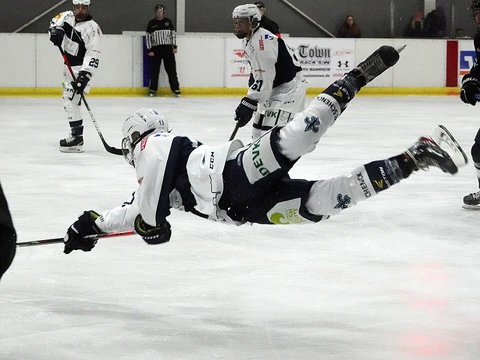
Hockey sock
Form-fitting leg garment worn over protective gear in ice hockey.

Sandro Halank, Wikimedia Commons · CC BY-SA 4.0
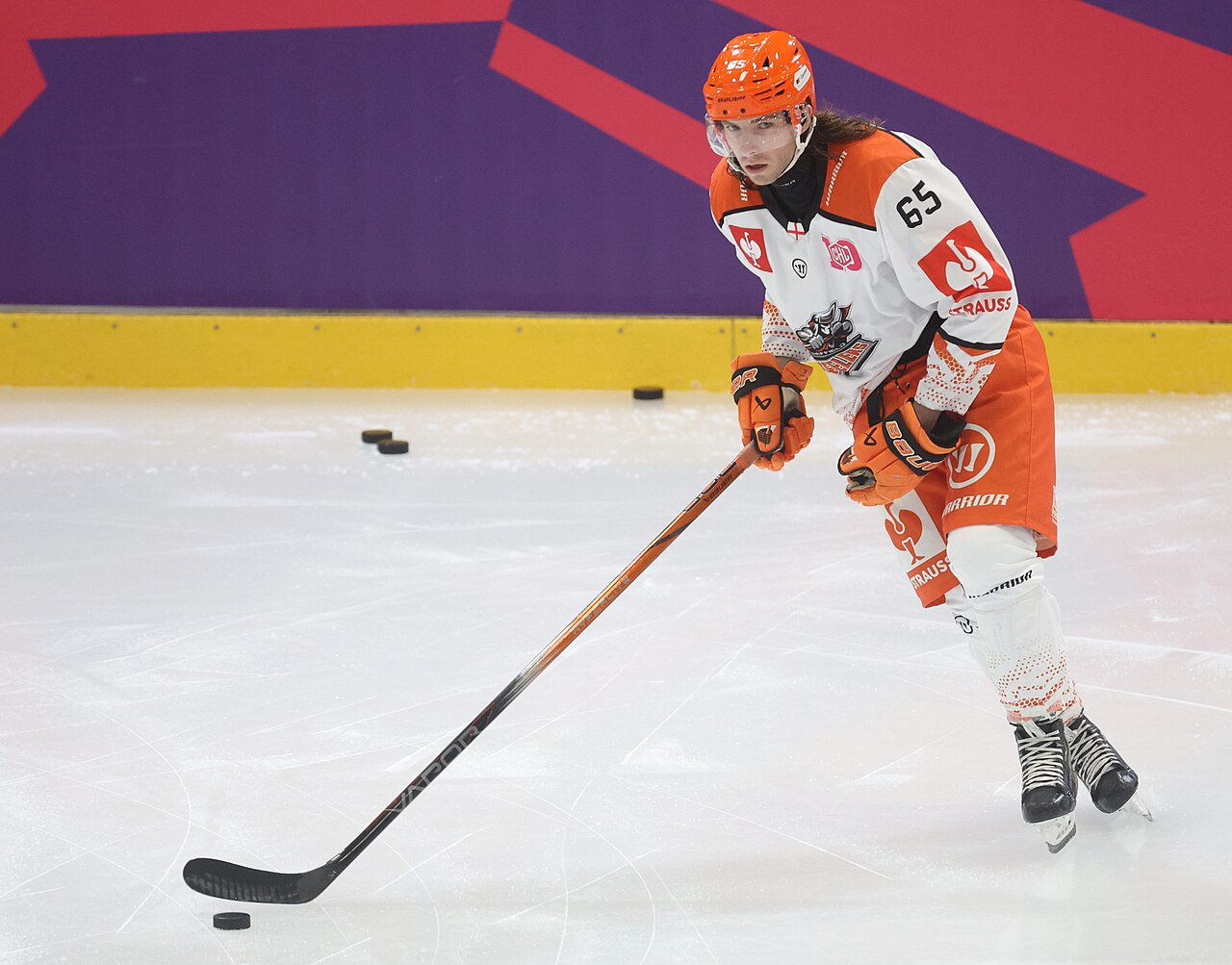
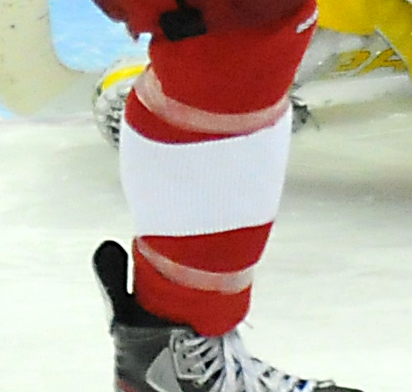
Hockey socks are form-fitting garments that cover a player's leg from ankle to thigh, worn on top of protective gear. They are usually made from a rib-knit fabric, either cotton or synthetic. These socks are not the same as hockey skate socks, which are thin, traditional socks worn inside the skate, directly over the foot.
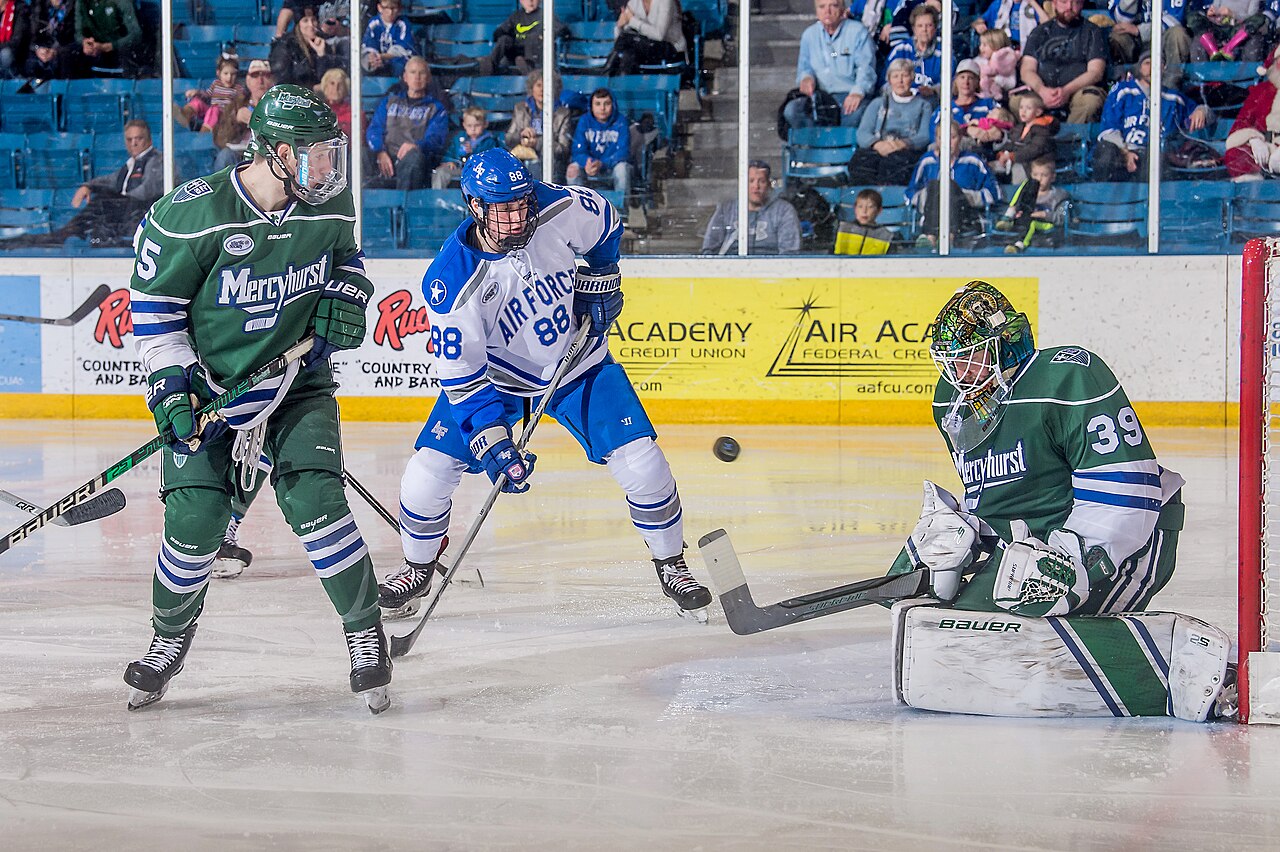
To keep them in place, hockey socks are secured either by an old-style garter or by Velcro tabs attached to undershorts. Players typically tuck the sock into the upper ankle area of their skate. Athletic tape is often applied below the knee—and sometimes at the ankle—to hold the sock steady. Under USA Hockey's rules, hockey socks are part of the team uniform, along with the jersey, and are required to cover protective equipment like shinguards. Organized teams wear socks in designated colors that match the team jersey.
- Material
- cotton or synthetic rib-knit fabric
- Length
- ankle-to-thigh
- Fastening methods
- garter (old style) or Velcro tabs attached to undershorts
- Team uniform rule
- USA Hockey rule 304(a) (2005–06 season)
Lore & Background
Hockey socks are held up either by a garter (old style) or attached to undershorts with Velcro tabs. Players usually keep their socks inside the upper ankle area of their skates. Athletic tape is generally used below the knee to hold the sock in place, and sometimes at the ankle as well. Experiments have been made with a lightweight fabric sock of material similar to that used in hockey jerseys, and most recently (mid-2000s) with a streamlined lightweight sock used by the U.S. Olympic and other international teams. Organized teams wear hockey socks in designated team colors, complementary to the team jersey.
Reader's Guide
Hockey socks serve as a required component of a team uniform under USA Hockey's rule 304(a) for the 2005–06 season, mandated as coverage for protective equipment such as shinguards. Along with the jersey, they establish team identity through designated colors that complement the jersey. The socks are worn over protective gear and are held in place by traditional garters or modern Velcro attachments to undershorts, with athletic tape commonly applied below the knee and sometimes at the ankle for additional security. Innovations include lightweight fabric socks similar to jersey material and, by the mid-2000s, streamlined lightweight socks adopted by U.S. Olympic and other international teams. The distinction between hockey socks and hockey skate socks—thin traditional socks worn inside the skate—is important for proper equipment use.
Did You Know?
- Hockey socks are ankle-to-thigh garments worn over protective gear.
- They are traditionally made of cotton or synthetic rib-knit fabric.
- A streamlined lightweight sock was used by the U.S. Olympic and other international teams in the mid-2000s.
Hockey Socks Within the Protective Gear Ecosystem
In ice hockey, the playing environment presents a constellation of physical dangers that demand comprehensive bodily protection. The hard surfaces of the ice and surrounding boards, pucks traveling at high velocity, and the constant threat of intentional collisions—commonly referred to as checking—create a sport where bruises and severe fractures are ever-present risks. To mitigate these hazards, players rely on a layered array of safety equipment that extends far beyond the basic skate and stick. This ensemble typically encompasses a helmet, shoulder and chest protectors, elbow pads, a mouth guard, protective gloves, heavily padded shorts, an athletic cup, shin pads, and a neck guard. Hockey socks occupy a specific niche within this broader protective framework, serving as a foundational layer for the lower leg. They work in tandem with shin pads and the thick leather or nylon construction of the skate boot to create a continuous barrier between the player's vulnerable lower limbs and the punishing elements of the game. Far from being a mere fashion accessory, the hockey sock is a functional component of a system designed to keep players on the ice rather than in the infirmary.
The Garter Belt and the Mechanics of Sock Retention
One of the most practical engineering challenges in hockey equipment is keeping the sock securely in place during intense physical activity. The standard solution is the garter belt, an elastic band that wraps around the waist and features several attachment points designed to grip the top of the hockey sock and prevent it from sliding down during skating, checking, or falls. This simple yet essential accessory is so integrated into the sport's gear culture that manufacturers have found ways to combine it with other protective items. For instance, certain jock straps are produced with inbuilt garter belts, allowing a player to wear long socks while simultaneously securing the protective cup that guards the genitals. This dual-purpose design eliminates the need for a separate waistband and streamlines the layering process. The existence of these integrated solutions underscores how the hockey sock is not an afterthought but a considered element of the equipment system. Whether a player opts for a standalone garter or a combined jock-and-garter unit, the underlying principle remains the same: the sock must stay anchored to the leg so that the protective layers above it—shin pads, the skate boot, and the padded knee-length shorts—function as intended throughout the duration of a game.
Lower-Leg Defense: Socks, Pads, and the Skate Boot
The hockey sock functions as one link in a chain of lower-leg protection that also includes shin pads and the skate boot itself. The skate, typically constructed from a thick layer of leather or nylon, is engineered to shield the feet and lower legs from the constant barrage of impacts on the ice. Its blade is rounded at both ends to facilitate quick maneuvering for skaters, while goaltenders use a different profile—blades that sit lower to the ice and are more square in shape—prioritizing lateral stability and the ability to brace against direct puck hits over speed and agility. The sock sits within this protective architecture, filling the gap between the padded knee-length shorts (which incorporate thigh, pelvic, hip, and tailbone protection) and the upper edge of the skate. Together, these layers address the specific threats of the sport: pucks struck at high speed, the unforgiving ice surface, and the boards that line the rink. For goaltenders, who face a greater volume of direct puck contact, the entire lower-leg assembly must withstand repeated high-impact strikes, making the sock's role as a cushioning and positioning layer all the more critical to the goalie's safety.
Socks in the Long Arc of Hockey Equipment Evolution
The story of the hockey sock is inseparable from the broader narrative of how hockey gear transformed from rudimentary items into sophisticated protective systems. In the sport's earliest days, players laced simple metal blades onto regular shoes, and sticks were thin wooden branches. Protective gear was virtually nonexistent. It was not until 1897 that G.H. Merritt borrowed wicket-keeper's pads for the first goalie leg protection, and 1948 saw a Detroit goaltender combine a rectangular leather piece with a baseball catcher's glove to create the trapper and blocker. The mask followed a parallel arc: Clint Benedict wore a crude leather covering in 1928 to shield a broken nose, Jacques Plante became the first regular mask user, and Vladislav Tretiak's design introduced the first helmet-and-cage combination. Some players, like Chris Osgood, still favor that older Tretiak-style mask, while the alternative helmet-cage design last worn by Dominik Hasek and Dan Cloutier has drawn safety questions. The modern goalie mask, resembling a fortified motorcycle helmet with an attached cage, marks the culmination of this evolution. In that same arc, the hockey sock has evolved from a simple band of fabric into an integrated element of a multi-layered protective system, working alongside shin pads, padded shorts, and the skate boot.
Gallery



Frequently Asked Questions
What is a hockey sock?
A hockey sock is a form-fitting garment that stretches from the ankle up to the thigh, worn over a player's protective leg gear. It sits on top of shin guards and other padding rather than replacing them.
What material are hockey socks made from?
They are typically constructed from a rib-knit fabric, either cotton or a synthetic blend. The ribbed texture helps the sock cling to the leg and hold its shape during play.
How do players keep their hockey socks from sliding down?
Older setups use a garter strapped around the thigh, while modern kits rely on Velcro tabs that hook into the undershorts. Players also tuck the sock into the upper ankle area of their skate for extra security.
Are hockey socks the same thing as skate socks?
No—skate socks are thin, traditional socks worn directly on the foot inside the skate, while hockey socks are the much longer garments that cover the leg above the skate. They serve entirely different functions on the player.
Is there a rule governing the color of hockey socks?
USA Hockey's rule 304(a), in effect during the 2005–06 season, addresses team uniform standards that include sock color as part of the required kit. This ensures each team's socks match their official color scheme on the ice.
More in Ice Hockey Equipment 1-24
Spotted an error? Know more?
Reader corrections go straight into our review queue. Suggest an edit · How this site is sourced