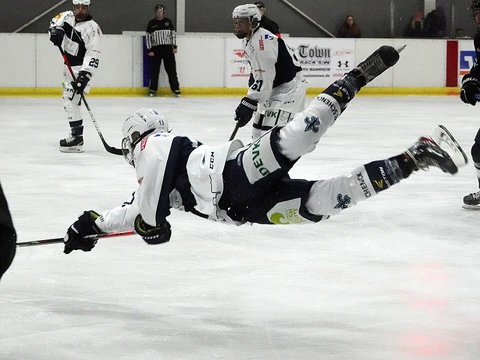
Neck guard
Protective gear designed to prevent neck injuries in ice hockey.

A neck guard is a piece of protective equipment worn by ice hockey players and officials. It is designed to prevent injury to the neck from pucks, skate blades, and sticks. The guard is especially critical for goaltenders, who face a higher risk of injury in that area. It may also be worn in other ice sports such as bandy, ringette, and rinkball.
- Developed in
- Ontario, Canada
- Year of development
- 1975
- First prototype creator
- Ed Crouch
- First user
- Kim Crouch
- Notable injury year 1
- 1989
- Notable injury year 2
- 2008
- Notable injury year 3
- 2023
Lore & Background
The neck guard was developed in Ontario, Canada, after Kim Crouch, a goaltender for the Royal York Royals, suffered a serious neck injury when his jugular vein was sliced by a skate during a 1975 match against the Markham Waxers. His father, Ed Crouch, created a prototype neck guard to help him return to the game, and the guard was subsequently widely adopted. In Canada, neck protectors for ringette and ice hockey must contain fabric that is BNQ certified and approved. BNQ, based in Quebec, created a standard for cut-resistant neck guards that involves a blade on a swinging apparatus testing for cut penetration. Most neck guards include a moisture system to keep the player's neck cool during play.
Notable injuries have driven adoption. In 1989, Buffalo Sabres goalie Clint Malarchuk suffered a severe neck cut from a skate during a game against the St. Louis Blues; he recovered but would have died without immediate medical aid. In 2008, Florida Panthers forward Richard Zedník had his external carotid artery cut by teammate Olli Jokinen's skate. In 2023, Nottingham Panthers forward Adam Johnson died after his neck was cut by a skate; he was not wearing a neck guard. Johnson's death led to increased use of neck guards among professional players and new mandates across various leagues.
Reader's Guide
The neck guard's significance lies in its role as a potentially life-saving piece of equipment, particularly for goaltenders and players in high-risk situations. Its development followed a specific injury in 1975, and its adoption has been shaped by subsequent severe injuries and fatalities. The death of Adam Johnson in 2023 served as a major catalyst, prompting mandates in several leagues. The Western Hockey League began requiring neck guards in November 2023, while the Ontario Hockey League and Quebec Maritimes Junior Hockey League already had mandates. The American Hockey League and International Ice Hockey Federation also began requiring them after Johnson's death. USA Hockey mandated neck laceration protection for all players and officials under 18 as of August 1, 2024, and strongly recommends them for adults. The 2026 Winter Olympics required all ice hockey players to wear neck guards for the first time. The Professional Women's Hockey League recommends but does not require them as of the 2025–2026 season. Beginning in the 2026–2027 season, new NHL players will be required to wear neck guards, while players who played at least one game before that season are grandfathered in. As of 2025, only about 8% of NHL players wore a neck guard.
Did You Know?
- The neck guard was first developed after Kim Crouch's jugular vein was sliced by a skate in 1975.
- Clint Malarchuk's 1989 neck injury would have been fatal without immediate medical assistance.
- Adam Johnson's death in 2023 led to new neck guard mandates in multiple leagues.
Frequently Asked Questions
What is a neck guard in ice hockey?
A neck guard is a protective piece of gear worn by players and officials to shield the neck region from impacts caused by pucks, skate blades, or sticks. It serves as a dedicated safety layer for one of the most vulnerable areas on the ice.
Who created the first neck guard prototype?
Ed Crouch developed the initial prototype in Ontario, Canada, back in 1975. His son Kim Crouch is credited as the first person to actually wear and use the device during play.
Why is the neck guard especially important for goaltenders?
Goaltenders sit directly in the line of fire for shots and have far less ability to dodge incoming pucks, leaving their necks much more exposed than a skater's. The guard dramatically cuts the risk of lacerations or blunt-force trauma to that area.
Which notable incidents highlighted the need for neck protection in hockey?
High-profile neck injuries in 1989 and again in 2008 drew serious attention to the dangers of an unprotected neck during gameplay. Those events pushed leagues and individual players to treat neck guards as essential rather than optional gear.
Is the neck guard used in any sports besides ice hockey?
Yes, similar neck guards are also worn in bandy, ringette, and rinkball, where athletes face comparable risks from pucks or sticks striking the neck area.
More in Ice Hockey Equipment 1-24
Spotted an error? Know more?
Reader corrections go straight into our review queue. Suggest an edit · How this site is sourced