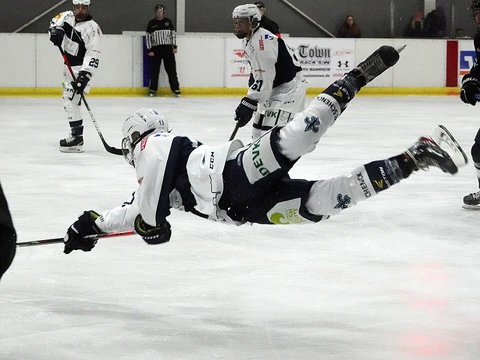
Ice hockey stick
A long-shafted blade used to shoot, pass, and carry the puck.

An ice hockey stick is a piece of equipment players use to shoot, pass, and move the puck. The stick has a long, thin shaft and a flat blade at one end. The blade sits at roughly a 135° angle to the shaft, giving the stick a sort of "L" shape. Sticks are usually between 150 and 200 cm long, though NHL sticks can be up to 63 inches (160 cm). The blade, which contacts the puck, is typically 25 to 40 cm long. Dimensions vary widely because sticks are often made to fit a player’s size and preference. The shaft is fairly rigid but slightly elastic to improve shot performance. The blade is slightly curved to help control the puck, especially when shooting; the direction of the curve depends on which side of the body the player uses the stick.
Goaltenders use a modified stick. Its lower part is wider, the angle is smaller, and the blade curves slightly toward the direction of play. Newer goaltender sticks are made with the same composite technology used in regular sticks.
The oldest known hockey stick dates to the mid-1830s. It was made for William "Dilly" Moffatt from sugar maple wood and is now owned by the Canadian Museum of History. In 2006, a stick from the 1850s—at the time the oldest known—sold at auction for $2.2 million, after being appraised at US$4.25 million. The Moffatt stick may have been made by the Mi'kmaq people. References to the Mi'kmaq of Nova Scotia playing ice hockey go back to the 18th century, and by the 19th century there were claims they invented the ice hockey stick. In the mid-19th century, the Starr Manufacturing Company began selling Mic-Mac hockey sticks nationally and internationally. Through the first decade of the 1900s, it was the best-selling hockey stick in Canada. By 1903, making these sticks was the primary occupation of the Mi'kmaq on reserves throughout Nova Scotia, especially Shubenacadie, Indian Brook, and Millbrook. In 1927, the department of Indian Affairs for Nova Scotia identified the Mi'kmaq as the "experts" at making hockey sticks. Mi'kmaq continued making them until the 1930s.
Early hockey sticks were mostly made from maple or willow, which were also common for golf club shafts and wooden tools. As hornbeam supplies ran low, other hardwoods like yellow birch and ash became more cost-effective. Ash became the preferred material, and by the 1920s, a single-piece ash hockey stick was the most common type.
- Length range cm
- 150–200
- Nhl max length inches
- 63
- Blade length range cm
- 25–40
- Blade angle degrees
- 135
- Oldest known stick date
- mid-1830s
- Oldest stick auction price usd
- 2.2 million
- Tallest nhl player height m
- 2.06
Lore & Background
The oldest known hockey stick dates to the mid-1830s, made for William 'Dilly' Moffatt from sugar maple wood. In 2006, a stick made in the 1850s sold at auction for $2.2 million. The Moffatt stick may have been made by the Mi'kmaq people of Nova Scotia, who have been referenced playing ice hockey since the 18th century and are claimed to have invented the ice hockey stick. The Starr Manufacturing Company sold Mic-Mac hockey sticks nationally and internationally in the mid-19th century, and by 1903 producing them was the primary occupation of the Mi'kmaq on reserves throughout Nova Scotia. Mi'kmaq continued to make hockey sticks until the 1930s.
Hockey sticks were mostly made from maple or willow, then hornbeam, and later yellow birch and ash. By the 1920s, an ash hockey stick crafted from a single piece of wood was most common. The laminated stick was created in the 1940s, and in the 1960s companies added fiberglass coating. Also in the 1960s, players began curving the blade. In the early 1980s, a single-piece all-aluminum stick was introduced, followed by an aluminum shaft with a removable wooden blade, which became popular in the late 1980s and early 1990s. In recent years, composite designs using fiberglass and carbon fiber have largely replaced aluminum and wooden sticks.
Reader's Guide
The ice hockey stick has evolved from heavy, single-piece wooden designs to lightweight composite constructions, reflecting broader material advances in sports equipment. The shift from wood to aluminum in the 1980s and 1990s, and then to carbon fiber composites, has changed how the stick performs: composite sticks store and release elastic potential energy predictably and efficiently, though debate continues over whether they enable more powerful shots. The stick's lie—the angle between shaft and blade—is tailored to a player's skating stance; for example, Wayne Gretzky used a low lie for his deep crouch. Goaltender sticks are modified with a wider lower part, smaller angle, and blade curved toward play. The Mi'kmaq people's historical role in stick-making, from the 18th century through the 1930s, underscores the stick's cultural significance in Canada. Today, no NHL players use wooden sticks, and carbon fiber dominates due to its light weight and favorable mechanical characteristics, despite higher cost and lower durability compared to aluminum.
Did You Know?
- A stick from the 1850s sold at auction for $2.2 million in 2006.
- Zdeno Chára, the NHL's tallest player at 2.06 m, had a special exemption to use a 67-inch shafted stick.
More in Ice Hockey Equipment 1-24
Spotted an error? Know more?
Reader corrections go straight into our review queue. Suggest an edit · How this site is sourced