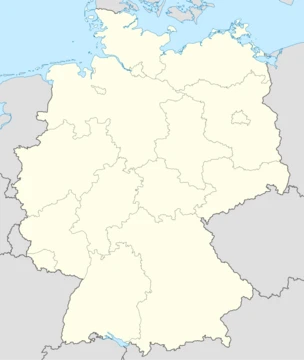
Mecklenburg-Vorpommern
Coastal German state formed from Mecklenburg and Western Pomerania.

Mecklenburg-Vorpommern (MV), also known as Mecklenburg–Western Pomerania, is a coastal state in north-east Germany. It was established in 1945 after World War II by the Soviet military administration through the merger of Mecklenburg and Prussian Western Pomerania, became part of the German Democratic Republic in 1949, was dissolved in 1952, and re-established in 1990 after German reunification. The state is named after its two constituent regions and is a leading tourist destination due to its Baltic Sea coastline, islands, and the Mecklenburg Lake District.
- Capital
- Schwerin
- Largest city
- Rostock
- Area
- 23,300 km² (9,000 sq mi)
- Population rank
- 14th among German states
- Population density rank
- 16th among German states
- Established
- 1945 (re-established 1990)
- Notable universities
- University of Rostock (1419), University of Greifswald (1456)
Quick Facts
- Official Name
- Mecklenburg-Vorpommern
- Native Name
- nds · Mäkelborg-Vörpommern
- Settlement Type
- State
- Subdivision Type
- Country
- Subdivision Name
- Germany
- Seat Type
- Capital
- Seat
- Schwerin
- Seat1 Type
- Largest city
- Seat1
- Rostock
- Governing Body
- Landtag of Mecklenburg-Vorpommern
- Leader Party
- SPD
- Leader Title
- Minister-President
Facts from the source article.
Lore & Background
Mecklenburg-Vorpommern was created on 9 July 1945 by order No. 5 of Red Army Marshal Georgy Zhukov, head of the Soviet Military Administration in Germany, as the Province of Mecklenburg and West Pomerania. After the war, the population increased by 40% due to refugees and expellees from former eastern German territories. The state was dissolved in 1952 during administrative reforms of the German Democratic Republic, with its territory divided into the districts of Rostock, Schwerin, and Neubrandenburg. It was re-established in 1990 following German reunification.
Reader's Guide
Mecklenburg-Vorpommern holds significance as a German state that embodies the post-World War II reorganization of territories and the subsequent reunification. Its history reflects the merger of two distinct regions—Mecklenburg, a historically stable duchy, and Western Pomerania, once under Swedish and Prussian rule. The state is a major tourist destination, featuring three of Germany's fourteen national parks, numerous nature conservation areas, and Baltic Sea islands like Rügen and Usedom. It hosts two of Europe's oldest universities: the University of Rostock (1419) and the University of Greifswald (1456). In 2007, the 33rd G8 summit was held at the Grand Hotel Heiligendamm on its coast during Angela Merkel's chancellorship. The state's name is often abbreviated as MV or MeckPomm, and its inhabitants are called Mecklenburger or Pomeranians.
Did You Know?
- The name 'Mecklenburg' comes from the castle 'Mikilenburg' (meaning 'large castle' in Old Saxon), while 'Vorpommern' derives from the Slavic 'po more' meaning 'land by the sea'.
- Mecklenburg-Vorpommern ranks 14th in population but 6th in area among German states.
- The University of Rostock was founded in 1419, and the University of Greifswald in 1456.
- After World War II, the population increased by 40% due to refugees from former eastern German territories.
Structure and Core Functions
The Landtag serves as the elected representative assembly of Mecklenburg-Vorpommern, meeting in the state capital of Schwerin to carry out the legislative and oversight duties of the federal state. Its current composition includes 79 elected members drawn from six different political parties. At present, the governing majority is a red-red coalition pairing the Social Democratic Party with The Left, which together back the cabinet led by Minister-President Manuela Schwesig. The chamber's two principal constitutional responsibilities are straightforward yet powerful: it elects the Minister-President who heads the executive branch, and it votes on the laws that bind and regulate the state government's actions. In this way, the Landtag functions as both the source of executive legitimacy and the legislative check on governmental power within Mecklenburg-Vorpommern's political architecture.
Electoral Mechanics and Voting Rules
Elections to the Landtag are constitutionally defined as general, direct, free, equal, and secret, mirroring the framework applied in federal Bundestag contests. Voters cast two distinct ballots: the first selects a candidate within a single-member constituency, while the second expresses a preference for a political party. Of the total seats, 36 are allocated through a first-past-the-post mechanism tied to individual district candidates, and the remaining 35 are apportioned via the Hare-Niemeyer method based on the aggregate party vote from the second ballot. A key structural rule links the two votes: every seat a party wins in the constituency round reduces its proportional allocation by the same number. The party-list component operates under proportional representation with a five-percent electoral threshold. The most recent state election was held in 2021, following earlier contests in 2016, 2011, and 2006.
Political Evolution from Reunification
The Landtag's history begins in the immediate aftermath of German reunification. The first state election was held on 14 October 1990, and the chamber constituted itself on 26 October—just 23 days after the two Germanys formally merged. That inaugural government was a CDU-FDP coalition under Alfred Gomolka, initially sustained as a minority arrangement before a non-attached SPD member joined. In 1992, Gomolka's dismissal of justice minister Ulrich Born on disloyalty charges triggered a confidence withdrawal by his own party, compounded by the shipyard crisis, and he resigned in March of that year. Berndt Seite of the CDU then took over. By 1994, the FDP fell short of the threshold, forcing a grand coalition. A pivotal shift came in 1998 when the SPD, led by Harald Ringstorff, formed the first SPD-PDS coalition anywhere in Germany. In 2006, the parliament voted to extend the electoral term from four years to five.
Milestones and Defining Moments
Several episodes stand out as defining moments in the Landtag's relatively brief history. The 1992 shipyard crisis proved decisive: Gomolka had been the sole minister to oppose the sale of East German shipyards to their West German competitors, and the controversy contributed directly to his resignation. In 1998, the chamber became the birthplace of Germany's first SPD-PDS coalition government, a landmark for the newly re-established state. In 2011, the death of CDU candidate Udo Timm necessitated a by-election in the Rügen I constituency, a rare disruption to the legislative calendar. Perhaps the most celebrated milestone came on 4 July 2017, when the Landtag elected Manuela Schwesig as Minister-President, making her the first woman to head the government of Mecklenburg-Vorpommern. The same period saw the parliament select Heinz Müller as State Commissioner for Data Protection and Freedom of Information in December 2016, a five-year appointment that underscored the chamber's role in safeguarding civil liberties.
Frequently Asked Questions
Who is Mecklenburg-Vorpommern?
Mecklenburg-Vorpommern is a northern German state stretching along the Baltic Sea coast, born from the combination of the historic Mecklenburg and Western Pomerania regions. Schwerin serves as its capital, while Rostock is the largest city in the state.
What are Mecklenburg-Vorpommern's powers and role?
As one of Germany's sixteen federal states, it manages regional affairs such as schooling, local policing, and infrastructure planning. It also capitalises on its extensive Baltic shoreline and the Mecklenburg Lake District to anchor a major tourism economy.
How does Mecklenburg-Vorpommern's story end?
The state first created in 1945 was wiped out in 1952 when the GDR abolished all Länder and folded the territory into plain administrative districts. After the fall of the Wall, it was reconstituted in 1990 and has since functioned as a full federal state within the reunified German republic.
Why is Mecklenburg-Vorpommern important?
It stands as one of the most striking examples of post-war border and administrative reshaping in Germany, having been forged, erased, and revived within a single century. Its long Baltic coastline and island groups also give it outsized influence on northern European tourism and maritime heritage.
Where is Mecklenburg-Vorpommern located and how big is it?
The state sits in the north-eastern corner of Germany, sharing a border with Poland and fronting the Baltic Sea. It spans roughly 23,300 square kilometres and ranks 14th in population and 16th in density among the sixteen German states.
More in German States 1-17
Spotted an error? Know more?
This is a living reference — every entry is fact-audited, and reader corrections feed straight into our audit queue. Suggest an edit · See this site's audit record