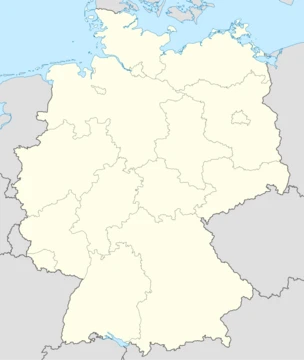
Hesse
Landlocked German state, financial centre Frankfurt, named after the Chatti tribe.

Hesse (German: Hessen) is a landlocked state in Germany, with its capital at Wiesbaden and its largest urban area at Frankfurt am Main, the country's principal financial centre. As a cultural region, it also includes Rhenish Hesse in the neighboring state of Rhineland-Palatinate. The name derives from the Hessian tribe, whose ancient name Chatti evolved into Hessi by the 8th century.
- Area
- 21,114.73 square kilometers
- Population
- over six million
- Rank by area
- seventh among sixteen German states
- Rank by population
- fifth among sixteen German states
- Largest urban area
- Frankfurt am Main
- Capital
- Wiesbaden
- Major historic cities
- Darmstadt and Kassel
Quick Facts
- Official Name
- State of Hesse
- Native Name
- de · Land Hessen
- Settlement Type
- State
- Anthem
- de · Hessenlied / "Song of Hesse"
- Mapframe-Zoom
- 5
- Mapframe-Point
- none
- Subdivision Type
- Country
- Subdivision Name
- Germany
- Seat Type
- Capital
- Seat
- Wiesbaden
Facts from the source article.
Lore & Background
The territory of Hesse was delineated only in 1945 as Greater Hesse under American occupation, corresponding loosely to the medieval Landgraviate of Hesse. In the 19th century, before German unification, the area comprised the Grand Duchy of Hesse (Hesse-Darmstadt), the Duchy of Nassau, the free city of Frankfurt, the Electorate of Hesse (Hesse-Kassel), the Principality of Waldeck, and the Landgraviate of Hesse-Homburg. The synthetic element hassium, number 108 on the periodic table, was named after the Latin name for Hesse (Hassia); discovered in 1984, the name was officially approved by IUPAC in 1997.
Reader's Guide
Hesse's significance lies in its role as a major German state both historically and economically. Frankfurt am Main, its largest city, serves as Germany's principal financial centre, and the Frankfurt Rhine-Main region is the country's second-largest metropolitan area. Historically, the Landgraviate of Hesse rose to prominence under Philip the Magnanimous, a leader of German Protestantism, and after his death in 1567 the territory split into lines including Hesse-Kassel and Hesse-Darmstadt. The American English term 'Hessian' for 18th-century British auxiliary troops originates with Landgrave Frederick II of Hesse-Kassel hiring out regular army units to fight in the American Revolutionary War. The state's legacy also includes the naming of the element hassium after it, and its name continues the tribal name of the ancient Chatti, who were involved in the Revolt of the Batavi in AD 69. The European Commission uses the German form Hessen even in English-language contexts.
Did You Know?
- The name Hesse derives from the dative plural form of the tribal name Hessians, which ultimately continues the ancient tribal name Chatti.
- The synthetic element hassium, number 108 on the periodic table, was named after the Latin name for Hesse (Hassia); discovered in 1984, the name was officially approved by IUPAC in 1997.
- The American English term 'Hessian' for 18th-century British auxiliary troops originates with Landgrave Frederick II of Hesse-Kassel hiring out regular army units to fight in the American Revolutionary War.
- The European Commission uses the German form Hessen, even in English-language contexts.
Geography & Modern Identity
Hesse is a landlocked state in Germany, ranking seventh in area at roughly 21,115 square kilometers and fifth in population with over six million residents. Its capital, Wiesbaden, serves as the administrative seat, while Frankfurt am Main dominates as the largest urban area and the country's principal financial hub. Darmstadt and Kassel round out the trio of major historic cities. The Frankfurt Rhine-Main region, Germany's second-largest metropolitan area behind Rhine-Ruhr, sits predominantly within Hesse's borders. Beyond its official boundaries, Hesse also claims a cultural footprint in Rhenish Hesse, a wine-growing area in the neighboring state of Rhineland-Palatinate that shares linguistic and traditional ties with the core region. This blend of dense urban finance, historic smaller cities, and rural cultural extension gives the state a notably layered identity among Germany's sixteen Länder.
Etymology & Naming Legacy
The name Hesse traces back through centuries of linguistic evolution. The Old High German form Hessun was the dative plural of Hessi, referring to the inhabitants, and the geographical label essentially shortened the older compound Hessenland, meaning the land of the Hessians. In Middle Latin, the state appeared as Hassonia, Hassia, or Hessia. The root ultimately descends from the tribal name Chatti, recorded as Chassi by the seventh century and as Hassi or Hessi from the eighth onward. The English word Hessian carries a very different connotation: it refers to the eighteenth-century British auxiliary troops that Landgrave Frederick II of Hesse-Kassel hired out to fight in the American Revolutionary War. The element hassium, number 108 on the periodic table, was named in the state's honor in 1997 following a 1992 proposal. The European Commission consistently uses the German form Hessen even in English-language documents, while the latinate Hessia persisted in common English usage well into the nineteenth century.
Ancient & Prehistoric Roots
Human presence in the Hessian landscape stretches back thousands of years. Tool finds in Rüsselsheim point to Pleistocene hunters operating in southern Hesse roughly thirteen thousand years ago, while a fossil hominid skull discovered just outside the village of Rhünda in the north dates to about twelve thousand years ago. The Züschen tomb, a gallery grave near Fritzlar, stands as one of Central Europe's most significant megalithic monuments, dating to approximately 3000 BC and belonging to the Late Neolithic Wartberg culture. A mid-fifth-century BCE La Tène-style burial at Glauberg signals an early Celtic foothold in the region. Around the first century BCE, the Germanic Chatti tribe settled the area, giving the land its enduring name. The Romans established a military camp at Dorlar and were constructing a civil settlement at Waldgirmes near Wetzlar, possibly intended as a provincial administrative center, before abandoning the region following the catastrophic defeat at the Teutoburg Forest in AD 9. The Chatti also participated in the Revolt of the Batavi in AD 69.
Political Fragmentation & Modern Unification
The modern borders of Hesse were not drawn until 1945, when American occupation authorities delineated Greater Hesse, loosely corresponding to the medieval Landgraviate of Hesse. Before that, the territory was a patchwork of distinct political entities. In the nineteenth century, prior to German unification, the area now constituting Hesse was divided among the Grand Duchy of Hesse, commonly called Hesse-Darmstadt, the Duchy of Nassau, the free city of Frankfurt, the Electorate of Hesse, also known as Hesse-Kassel, the Principality of Waldeck, and the Landgraviate of Hesse-Homburg. Each of these entities maintained its own governance, traditions, and identity for centuries. The hyphenated names Hesse-Cassel and Hesse-Darmstadt were in common English use by the eighteenth century, reflecting this fragmented reality. It was only the post-war reorganization that stitched these disparate territories into the single, unified state recognized today, ending centuries of political division within what had been, in the early seventh century, a buffer zone between Saxon and Frankish spheres of influence.
Frequently Asked Questions
What is Hesse and where is it located?
Hesse is a landlocked state in central Germany with no access to the sea. Its official capital is Wiesbaden, though the state is most widely recognized for Frankfurt am Main, which serves as Germany's primary financial hub.
Why is Frankfurt so famous if it isn't the capital?
Frankfurt am Main is the largest urban area in Hesse and anchors Germany's banking and finance sector, making it economically far more prominent than the seat of government. Wiesbaden retains the capital title, but in everyday conversation most people equate Hesse with Frankfurt.
Where does the name 'Hesse' actually come from?
The state's name traces back to the ancient Chatti tribe, whose designation gradually shifted to 'Hessi' by roughly the 8th century. That evolved form is what we now know as Hesse (Hessen in German).
How big is Hesse compared to other German states?
At about 21,100 square kilometers it ranks seventh in area among the sixteen federal states. Its population of just over six million places it fifth, making it a mid-sized state that punches above its weight economically thanks to Frankfurt.
Does the cultural region of Hesse match the modern political state?
Not exactly. The broader Hessian cultural area also includes Rhenish Hesse, a stretch of territory that now belongs to the neighboring state of Rhineland-Palatinate. The modern political entity, however, is strictly the landlocked region governed from Wiesbaden.
More in German States 1-17
Spotted an error? Know more?
This is a living reference — every entry is fact-audited, and reader corrections feed straight into our audit queue. Suggest an edit · See this site's audit record